Zhang Hao, Liu Yan, Xu Zhihong, Chen Quan
Department of Reproductive and Genetic Diseases, Deyang People's Hospital, Deyang, Sichuan, People's Republic of China.
Department of Pharmacy, Deyang People's Hospital, Deyang, Sichuan, People's Republic of China.
Int J Gen Med. 2022 Mar 29;15:3433-3445. doi: 10.2147/IJGM.S352120. eCollection 2022.
Lung adenocarcinoma (LUAD) accounts for approximately 40% of all lung cancer cases. The tumour microenvironment (TME) and microRNAs affect the occurrence, metastasis, recurrence and treatment of tumours. However, the role of microRNAs in the TME and LUAD still needs to be further investigated.
RNA-seq and microRNA-seq data of LUAD and NSCLC samples were downloaded from the TCGA and GEO database. The immune and stromal components in the TME and the abundance of tumour-infiltrating immune cells (TICs) were calculated by the ESTIMATE and CIBERSORT algorithms, respectively. The differentially expressed microRNAs (DEMs) between different StromalScore and ImmuneScore groups were screened out by the edgeR package. Bioinformatics analysis was performed to screen out important DEMs and explore their functional effect.
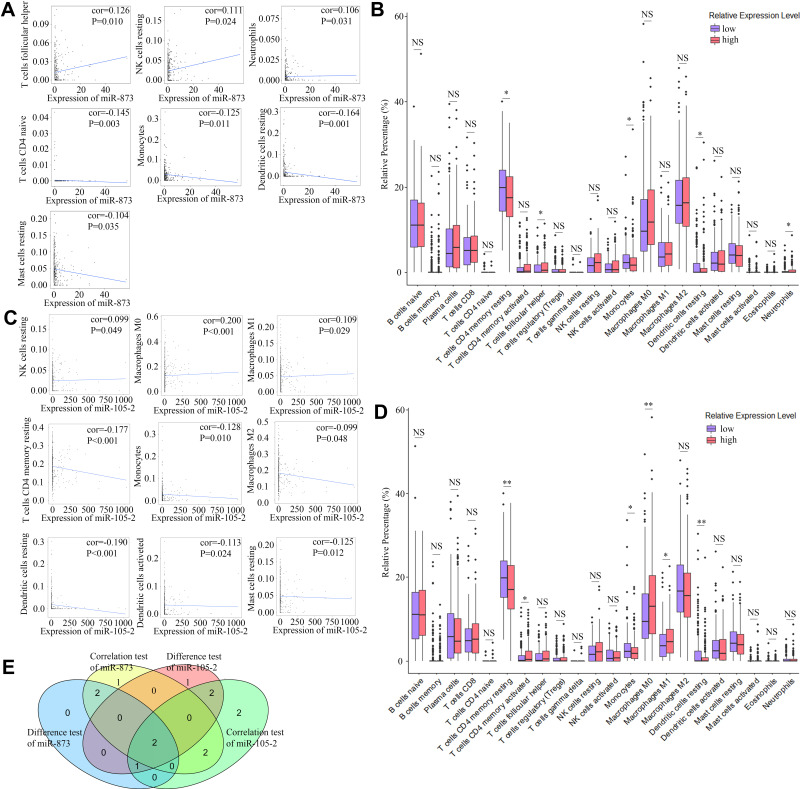
Our results revealed that a low StromalScore, ImmuneScore and ESTIMATEScore led to poor prognosis of LUAD. Then, 62 DEMs were screened out as downregulated in both the high StromalScore and ImmuneScore groups. Among these DEMs, elevated expression levels of miR-873, miR-105-2 and miR-516a-2 significantly shortened the survival time of LUAD patients. Subsequent analysis revealed that the expression levels of miR-873 and miR-105-2 were increased significantly in tumour tissues. The expression patterns of these 2 microRNAs were confirmed by GSE102286, implying the important roles of these 2 microRNAs in LUAD. Further analysis showed that miR-873 and miR-105-2 were mainly involved in immune-related pathways and that high expression levels of miR-873 and miR-105-2 decreased the abundance of monocytes and resting dendritic cells in the TME.
Although further exploration is still needed, our results revealed that miR-873 and miR-105-2 were closely related to the TME and affected the prognosis of LUAD by altering the abundance of TICs.
肺腺癌(LUAD)约占所有肺癌病例的40%。肿瘤微环境(TME)和微小RNA影响肿瘤的发生、转移、复发及治疗。然而,微小RNA在TME和LUAD中的作用仍需进一步研究。
从TCGA和GEO数据库下载LUAD和非小细胞肺癌(NSCLC)样本的RNA测序和微小RNA测序数据。分别通过ESTIMATE和CIBERSORT算法计算TME中的免疫和基质成分以及肿瘤浸润免疫细胞(TIC)的丰度。使用edgeR软件包筛选不同基质评分和免疫评分组之间差异表达的微小RNA(DEM)。进行生物信息学分析以筛选出重要的DEM并探索其功能作用。
我们的结果显示,低基质评分、免疫评分和ESTIMATE评分导致LUAD预后不良。然后,筛选出62个在高基质评分和免疫评分组中均下调的DEM。在这些DEM中,miR-873、miR-105-2和miR-516a-2表达水平升高显著缩短了LUAD患者的生存时间。后续分析显示,miR-873和miR-105-2在肿瘤组织中的表达水平显著升高。GSE102286证实了这两种微小RNA的表达模式,表明这两种微小RNA在LUAD中具有重要作用。进一步分析表明,miR-873和miR-105-2主要参与免疫相关途径,且miR-873和miR-105-2的高表达降低了TME中单核细胞和静息树突状细胞的丰度。
尽管仍需进一步探索,但我们的结果显示,miR-873和miR-105-2与TME密切相关,并通过改变TIC的丰度影响LUAD的预后。