Young Robert S, Talmane Lana, Marion de Procé Sophie, Taylor Martin S
Usher Institute, University of Edinburgh, Teviot Place, Edinburgh, EH8 9AG, UK.
Zhejiang University - University of Edinburgh Institute, Zhejiang University, 718 East Haizhou Road, 314400, Haining, China.
Genome Biol. 2022 Apr 4;23(1):89. doi: 10.1186/s13059-022-02634-w.
Promoters are sites of transcription initiation that harbour a high concentration of phenotype-associated genetic variation. The evolutionary gain and loss of promoters between species (collectively, termed turnover) is pervasive across mammalian genomes and may play a prominent role in driving human phenotypic diversity.
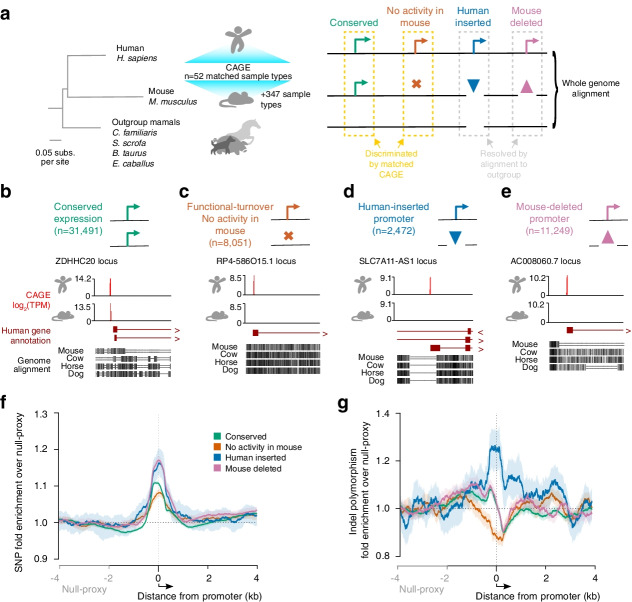
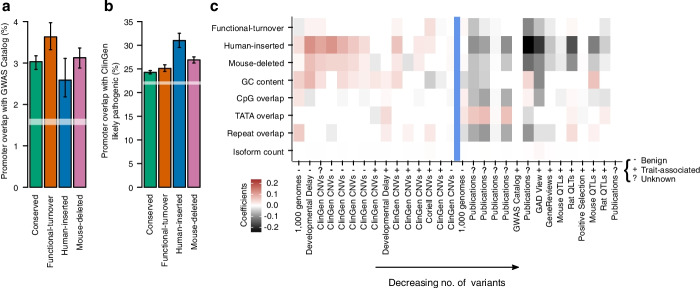
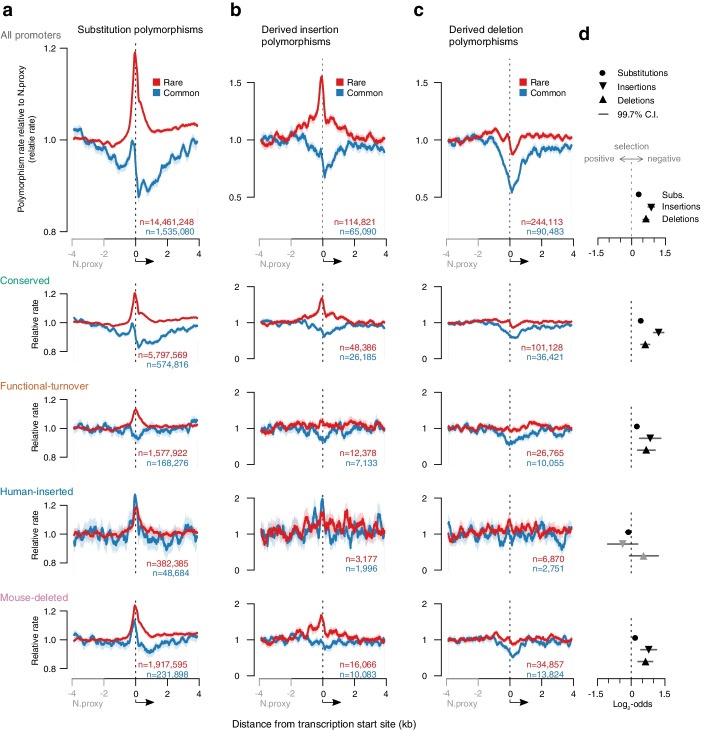
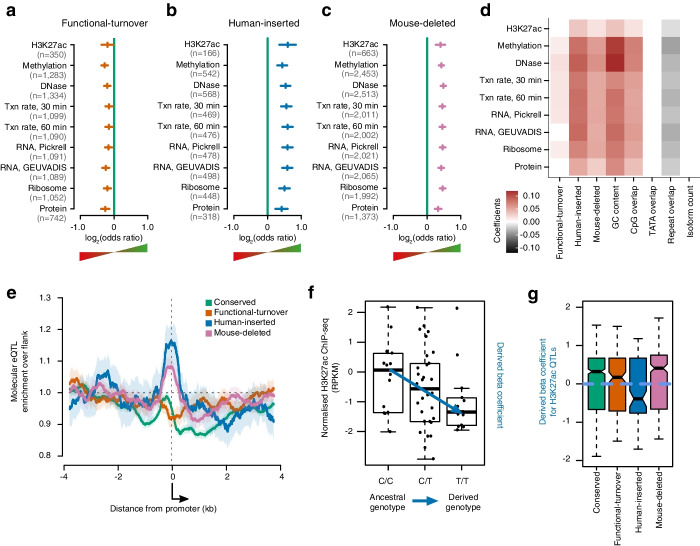
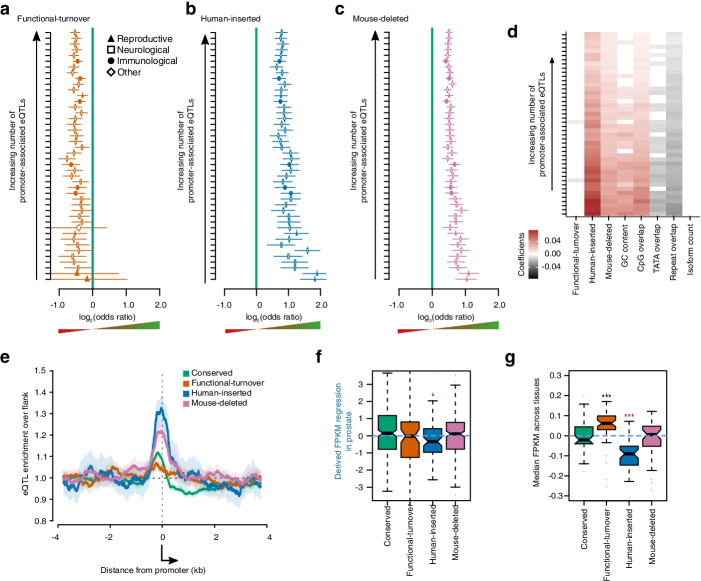
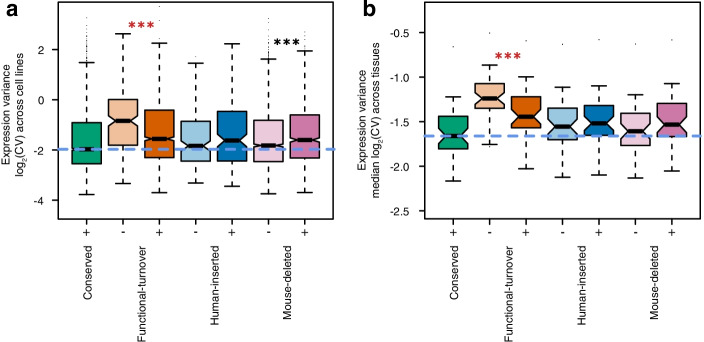
We classified human promoters by their evolutionary history during the divergence of mouse and human lineages from a common ancestor. This defined conserved, human-inserted and mouse-deleted promoters, and a class of functional-turnover promoters that align between species but are only active in humans. We show that promoters of all evolutionary categories are hotspots for substitution and often, insertion mutations. Loci with a history of insertion and deletion continue that mode of evolution within contemporary humans. The presence of an evolutionary volatile promoter within a gene is associated with increased expression variance between individuals, but only in the case of human-inserted and mouse-deleted promoters does that correspond to an enrichment of promoter-proximal genetic effects. Despite the enrichment of these molecular quantitative trait loci (QTL) at evolutionarily volatile promoters, this does not translate into a corresponding enrichment of phenotypic traits mapping to these loci.
Promoter turnover is pervasive in the human genome, and these promoters are rich in molecularly quantifiable but phenotypically inconsequential variation in gene expression. However, since evolutionarily volatile promoters show evidence of selection, coupled with high mutation rates and enrichment of QTLs, this implicates them as a source of evolutionary innovation and phenotypic variation, albeit with a high background of selectively neutral expression variation.
启动子是转录起始位点,含有高浓度的与表型相关的遗传变异。物种间启动子的进化得失(统称为更替)在哺乳动物基因组中普遍存在,可能在推动人类表型多样性方面发挥重要作用。
我们根据人类和小鼠谱系从共同祖先分化过程中的进化历史对人类启动子进行了分类。这定义了保守启动子、人类插入型启动子和小鼠缺失型启动子,以及一类功能更替型启动子,它们在物种间对齐但仅在人类中活跃。我们表明,所有进化类别的启动子都是替换和插入突变的热点。具有插入和缺失历史的基因座在当代人类中继续这种进化模式。基因内存在进化不稳定的启动子与个体间表达差异增加有关,但只有在人类插入型和小鼠缺失型启动子的情况下,这才对应于启动子近端遗传效应的富集。尽管这些分子数量性状基因座(QTL)在进化不稳定的启动子处富集,但这并未转化为映射到这些基因座的表型性状的相应富集。
启动子更替在人类基因组中普遍存在,这些启动子在基因表达方面富含分子可量化但表型无关紧要的变异。然而,由于进化不稳定的启动子显示出选择的证据,再加上高突变率和QTL的富集,这表明它们尽管存在高背景的选择性中性表达变异,但仍是进化创新和表型变异的来源。