Ulverscroft Eye Unit, Neuroscience, Psychology and Behaviour, University of Leicester, Leicester, UK.
Ulverscroft Eye Unit, Neuroscience, Psychology and Behaviour, University of Leicester, Leicester, UK
Br J Ophthalmol. 2023 Aug;107(8):1202-1208. doi: 10.1136/bjophthalmol-2020-318192. Epub 2022 Apr 4.
BACKGROUND/AIMS: To investigate the foveal morphology in carriers of oculocutaneous albinism (OCA) using spectral domain optical coherence tomography (SD-OCT). A cross-sectional, observational study.
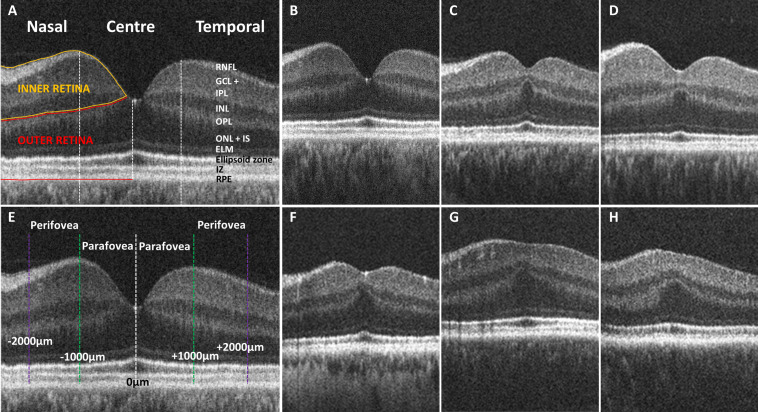
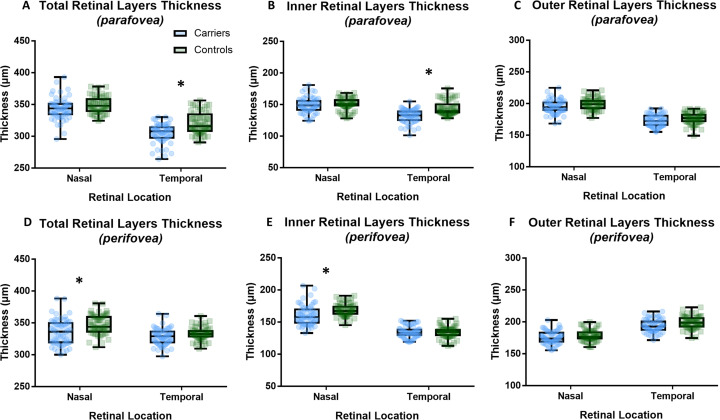
Handheld SD-OCT (Envisu C2300) was used to acquire horizontal scans through the centre of the fovea in biological parents of patients with OCA (n=28; mean age±SD=40.43±8.07 years) and age-matched and ethnicity-matched controls (n=28; mean age±SD=38.04±10.27 years). Sequence analysis was performed for variants in known genes associated with OCA. Best-corrected visual acuity (BCVA), presence of foveal hypoplasia and grade, foveal, parafoveal and perifoveal thickness measurements of total retinal layers (TRL), inner retinal layers (IRL) and outer retinal layers (ORL) thickness were measured.
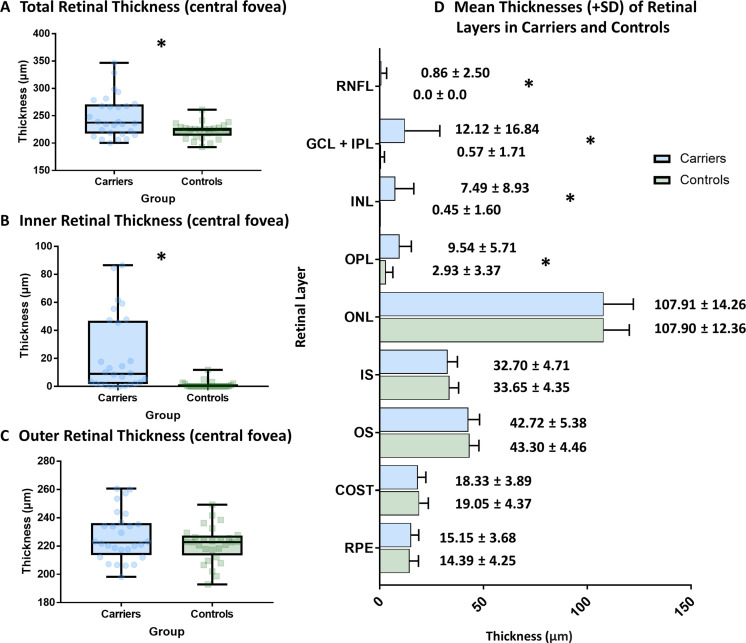
Foveal hypoplasia was identified in 32.14% of OCA carriers; grade 1 in all cases. OCA carriers demonstrated significant thicker TRL thickness (median difference: 13.46 µm, p=0.009) and IRL thickness (mean difference: 8.98 µm, p<0.001) at the central fovea compared with controls. BCVA of carriers was between -0.16 and 0.18 logMAR (mean: 0.0 logMAR). No significant differences in BCVA was noted between OCA carriers or controls (p=0.83). In the OCA carriers, we identified previously reported pathogenic variants in , and , novel variants (n=3) and heterozygosity of the pathogenic haplotype.
We have, for the first time, identified foveal abnormalities in OCA carriers. This provides clinical value, particularly in cases where limited phenotype data are available. Our findings raise the possibility that previously reported mild cases of foveal hypoplasia or isolated foveal hypoplasia could correspond to OCA carrier status.
背景/目的:使用频域光相干断层扫描(SD-OCT)研究眼皮肤白化病(OCA)携带者的黄斑形态。一项横断面观察性研究。
使用手持式 SD-OCT(Envisu C2300)通过 OCA 患者的生物父母(n=28;平均年龄±标准差=40.43±8.07 岁)和年龄匹配、种族匹配的对照组(n=28;平均年龄±标准差=38.04±10.27 岁)的黄斑中心进行水平扫描。对与 OCA 相关的已知基因的变异进行序列分析。测量最佳矫正视力(BCVA)、黄斑发育不全的存在及其分级、黄斑、旁黄斑和近黄斑总视网膜层(TRL)、内视网膜层(IRL)和外视网膜层(ORL)厚度。
在 32.14%的 OCA 携带者中发现了黄斑发育不全;所有病例均为 1 级。与对照组相比,OCA 携带者的 TRL 厚度(中位数差异:13.46 µm,p=0.009)和 IRL 厚度(平均差异:8.98 µm,p<0.001)在中央黄斑处明显增厚。携带者的 BCVA 介于-0.16 和 0.18 logMAR(平均值:0.0 logMAR)之间。OCA 携带者和对照组之间的 BCVA 无显著差异(p=0.83)。在 OCA 携带者中,我们发现了先前报道的致病性变异体、和,新的 变异体(n=3)和致病性 单倍型的杂合性。
我们首次在 OCA 携带者中发现了黄斑异常。这具有临床价值,特别是在有限的表型数据可用的情况下。我们的研究结果表明,先前报道的轻度黄斑发育不全或孤立性黄斑发育不全的病例可能与 OCA 携带者状态相对应。