School of Pharmacy, Faculty of Medical Sciences, Newcastle University, Newcastle upon Tyne, UK.
Population Health Sciences Institute, Newcastle University, Newcastle upon Tyne, UK.
Health Expect. 2022 Aug;25(4):1432-1443. doi: 10.1111/hex.13482. Epub 2022 Apr 5.
Regular reviews of medications, including prescription reviews and adherence reviews, are vital to support pharmacological effectiveness and optimize health outcomes for patients. Despite being more likely to report a long-term illness that requires medication when compared to their white counterparts, individuals from ethnic minority communities are less likely to engage with regular medication reviews, with inequalities negatively affecting their access. It is important to understand what barriers may exist that impact the access of those from ethnic minority communities and to identify measures that may act to facilitate improved service accessibility for these groups.
Semi-structured interviews were conducted between June and August 2021 using the following formats as permitted by governmental COVID-19 restrictions: in person, over the telephone or via video call. Perspectives on service accessibility and any associated barriers and facilitators were discussed. Interviews were audio-recorded and transcribed verbatim. Reflexive thematic analysis enabled the development of themes. QSR NVivo (Version 12) facilitated data management. Ethical approval was obtained from the Health Research Authority (ref: 21/HRA/1426).
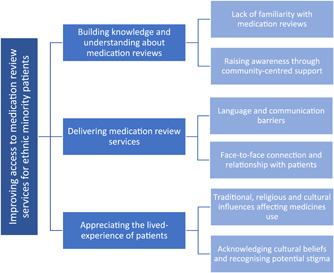
In total 20 participants from ethnic minority communities were interviewed; these participants included 16 UK citizens, 2 refugees and 2 asylum seekers, and represented a total of 5 different ethnic groups. Three themes were developed from the data regarding the perceived barriers and facilitators affecting access to medication reviews and identified approaches to improve the accessibility of such services for ethnic minority patients. These centred on (1) building knowledge and understanding about medication reviews; (2) delivering medication review services; and (3) appreciating the lived experience of patients.
The results of this study have important implications for addressing inequalities that affect ethnic minority communities. Involving patients and practitioners to work collaboratively in coproduction approaches could enable better design, implementation and delivery of accessible medication review services that are culturally competent.
The National Institute for Health Research Applied Research Collaboration and Patient and Public Involvement and Engagement group at Newcastle University supported the study design and conceptualization. Seven patient champions inputted to ensure that the research was conducted, and the findings were reported, with cultural sensitivity.
定期审查药物,包括处方审查和用药依从性审查,对于支持药物疗效和优化患者健康结果至关重要。与他们的白人同龄人相比,少数民族社区的人更有可能长期患有需要药物治疗的疾病,但他们参与定期药物审查的可能性较低,这种不平等情况对他们的药物治疗产生了负面影响。了解可能影响少数民族社区患者获得药物治疗的障碍,并确定可能有助于改善这些群体获得服务的措施非常重要。
2021 年 6 月至 8 月期间,根据政府对 COVID-19 的限制,以以下格式进行了半结构式访谈:面对面、电话或视频通话。讨论了对服务可及性的看法,以及任何相关的障碍和促进因素。采访内容被录音并逐字记录。反思性主题分析使主题得以发展。QSR NVivo(版本 12)促进了数据管理。已获得健康研究管理局的伦理批准(编号:21/HRA/1426)。
共有 20 名来自少数民族社区的参与者接受了采访;这些参与者包括 16 名英国公民、2 名难民和 2 名寻求庇护者,代表了 5 个不同的种族群体。从关于影响药物审查可及性的感知障碍和促进因素的数据中,确定了三种方法来改善少数民族患者获得此类服务的可及性。这些方法集中在(1)建立对药物审查的认识和理解;(2)提供药物审查服务;(3)理解患者的生活体验。
这项研究的结果对解决影响少数民族社区的不平等问题具有重要意义。让患者和医务人员合作参与 coproduction 方法,可以更好地设计、实施和提供具有文化能力的药物审查服务。
纽卡斯尔大学国家卫生研究院应用研究合作和患者和公众参与及参与小组支持了研究设计和概念化。七名患者冠军参与其中,以确保研究的进行和报告具有文化敏感性。