Biophysics Program and Institute for Physical Science and Technology, University of Maryland, College Park, Maryland 20742, United States.
Center for Biophysics and Quantitative Biology, Beckman Institute for Advanced Science and Technology, University of Illinois at Urbana-Champaign, Urbana, Illinois 61801, United States.
J Chem Theory Comput. 2022 May 10;18(5):3231-3238. doi: 10.1021/acs.jctc.2c00058. Epub 2022 Apr 6.
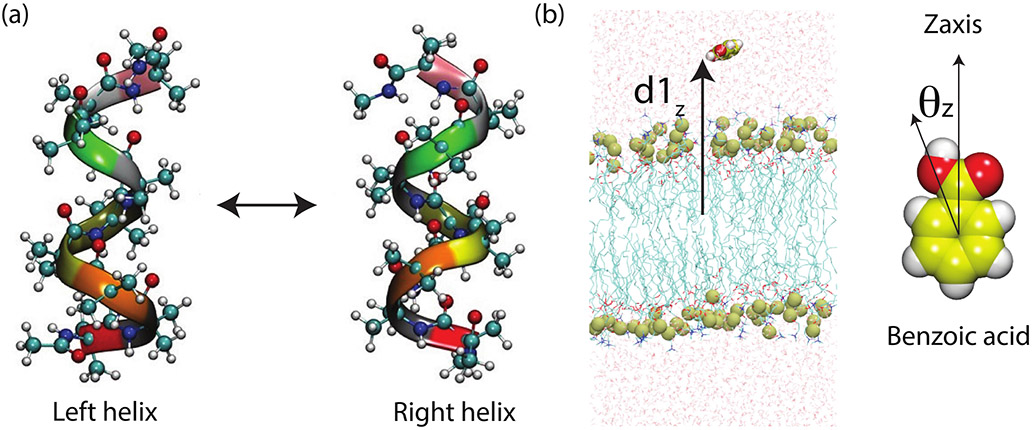
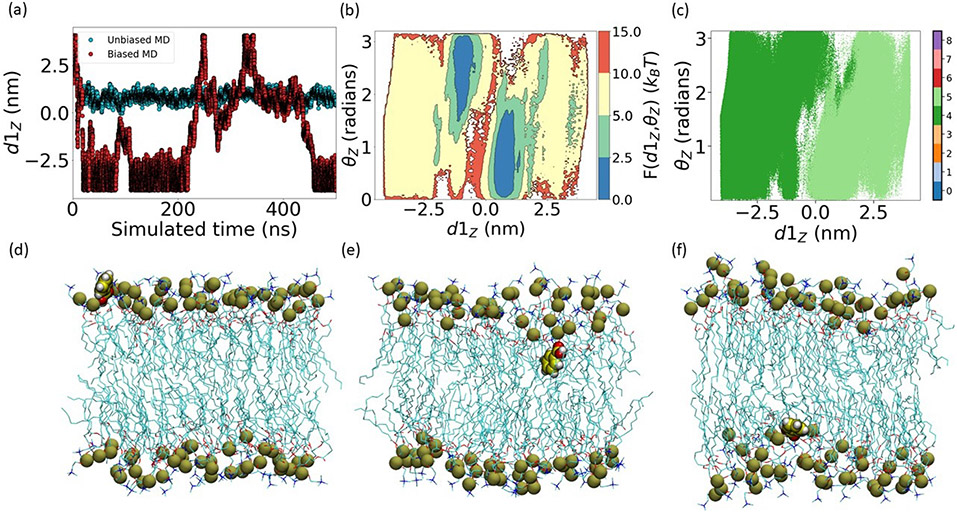
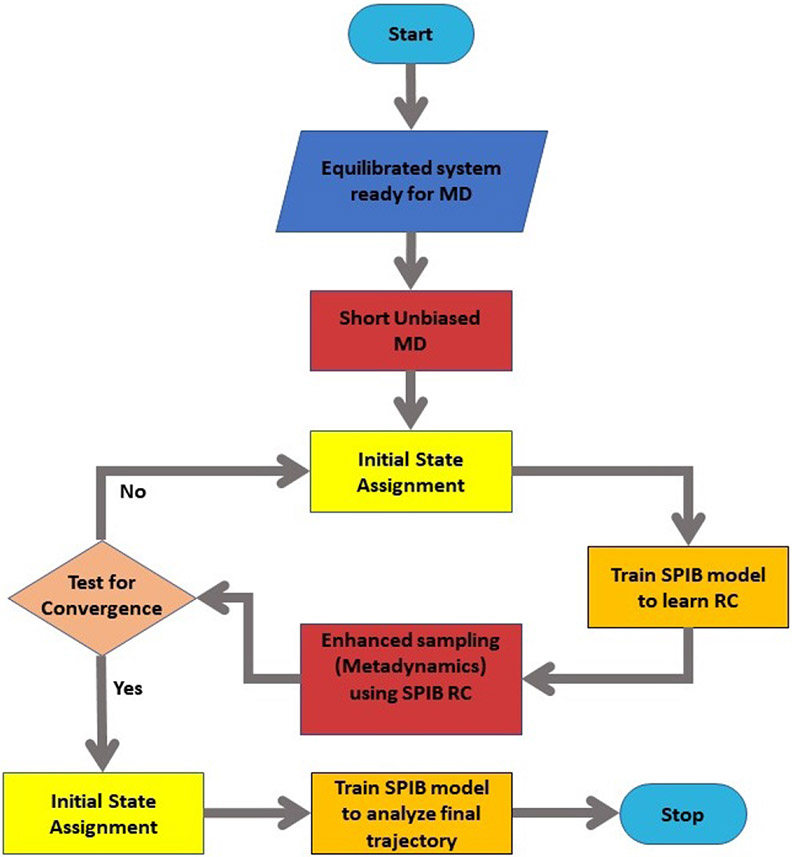
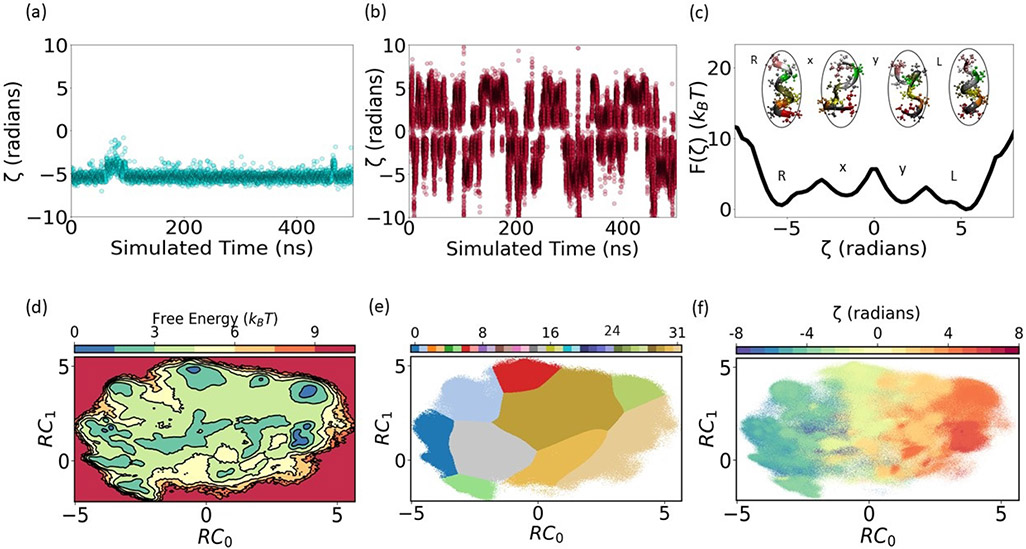
An effective implementation of enhanced sampling algorithms for molecular dynamics simulations requires knowledge of the approximate reaction coordinate describing the relevant mechanisms in the system. In this work, we focus on the recently developed artificial intelligence-based State Predictive Information Bottleneck (SPIB) approach and demonstrate how SPIB can learn such a reaction coordinate as a deep neural network even from undersampled trajectories. We exemplify its usefulness by achieving more than 40 times acceleration in simulating two model biophysical systems through well-tempered metadynamics performed by biasing along the SPIB-learned reaction coordinate. These include left- to right-handed chirality transitions in a synthetic helical peptide (Aib) and permeation of a small benzoic acid molecule through a synthetic, symmetric phospholipid bilayer. In addition to significantly accelerating the dynamics and achieving back and forth movement between different metastable states, the SPIB-based reaction coordinate gives mechanistic insights into the processes driving these two important problems.
为了在分子动力学模拟中有效地实施增强采样算法,需要了解描述系统中相关机制的近似反应坐标。在这项工作中,我们专注于最近开发的基于人工智能的状态预测信息瓶颈(SPIB)方法,并展示了 SPIB 如何即使从欠采样轨迹中也可以作为深度神经网络学习这样的反应坐标。我们通过沿 SPIB 学习的反应坐标进行偏置来实现对两个模型生物物理系统的模拟,从而证明了其在超过 40 倍加速方面的有用性,其中包括在合成螺旋肽(Aib)中从左手性到右手性的手性转变和小分子苯甲酸分子通过合成的对称磷脂双层的渗透。除了显著加速动力学并实现不同亚稳状态之间的来回运动之外,基于 SPIB 的反应坐标还深入了解了驱动这两个重要问题的过程。