Fujiyabu Takeshi, Sakumichi Naoyuki, Katashima Takuya, Liu Chang, Mayumi Koichi, Chung Ung-Il, Sakai Takamasa
Department of Bioengineering, Graduate School of Engineering, The University of Tokyo, 7-3-1 Hongo, Bunkyo-ku, Tokyo, Japan.
Material Innovation Research Center (MIRC) and Department of Advanced Materials Science, Graduate School of Frontier Sciences, The University of Tokyo, 5-1-5 Kashiwanoha, Kashiwa, Chiba 277-8561, Japan.
Sci Adv. 2022 Apr 8;8(14):eabk0010. doi: 10.1126/sciadv.abk0010. Epub 2022 Apr 6.
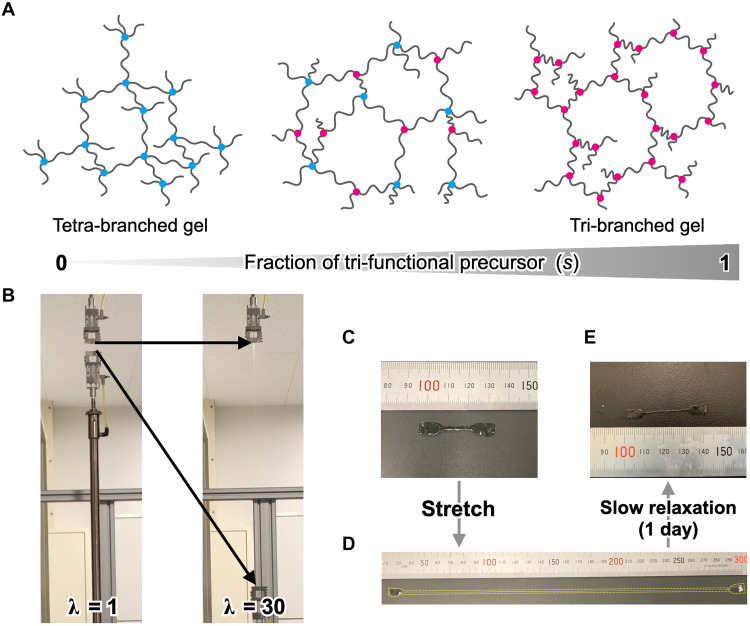
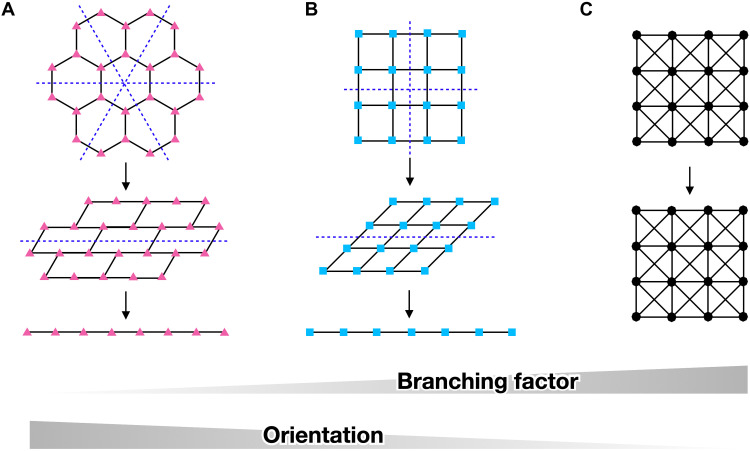
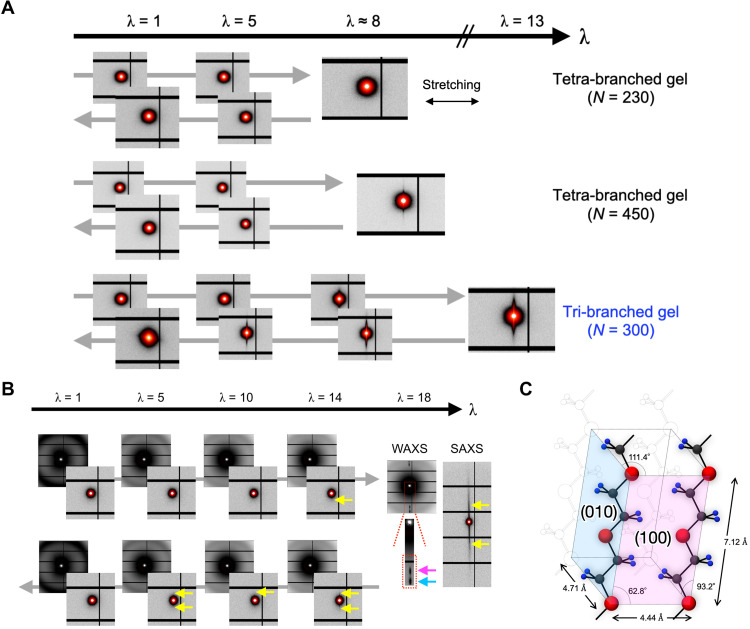
Unlike hard materials such as metals and ceramics, rubbery materials can endure large deformations due to the large conformational degree of freedom of the cross-linked polymer network. However, the effect of the network's branching factor on the ultimate mechanical properties has not yet been clarified. This study shows that tri-branching, which entails the lowest branching factor, results in a large elastic deformation near the theoretical upper bound. This ideal elastic limit is realized by reversible strain-induced crystallization, providing on-demand reinforcement. The enhanced reversible strain-induced crystallization is observed in the tri-branched and not in the tetra-branched network. A mathematical theory of structural rigidity is used to explain the difference in the chain orientation. Although tetra-branched polymers have been preferred since the development of vulcanization, these findings highlighting the merits of tri-branching will prompt a paradigm shift in the development of rubbery materials.
与金属和陶瓷等硬质材料不同,橡胶材料由于交联聚合物网络具有较大的构象自由度,能够承受较大的变形。然而,网络分支因子对极限力学性能的影响尚未明确。本研究表明,具有最低分支因子的三叉分支导致接近理论上限的大弹性变形。这种理想的弹性极限是通过可逆应变诱导结晶实现的,可按需增强。在三叉分支网络中观察到增强的可逆应变诱导结晶,而在四叉分支网络中未观察到。使用结构刚度的数学理论来解释链取向的差异。尽管自硫化技术发展以来,四叉分支聚合物一直更受青睐,但这些突出三叉分支优点的发现将促使橡胶材料开发领域发生范式转变。