Department of Psychiatry, Psychotherapy and Psychosomatics, Psychiatric University Hospital Zurich, University of Zurich, Zurich, Switzerland.
Department of Biostatistics at Epidemiology, Biostatistics and Prevention Institute, University of Zurich, Zurich, Switzerland.
Eur J Psychotraumatol. 2022 Mar 31;13(1):2040818. doi: 10.1080/20008198.2022.2040818. eCollection 2022.
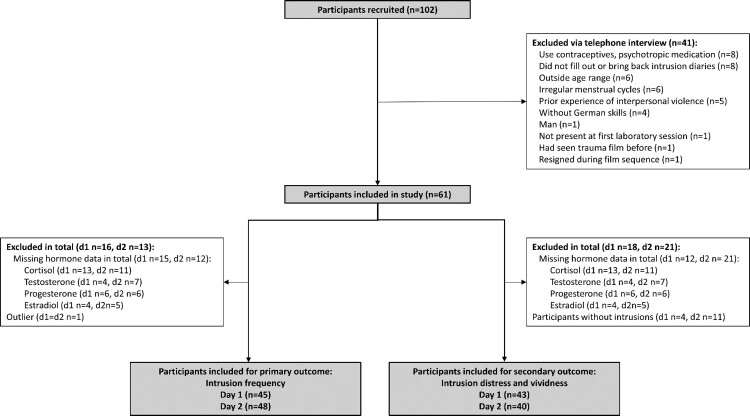
Background Trauma- and stress-related disorders, such as post-traumatic stress disorder (PTSD), are more common in females than in males. Sex hormones affect learning and emotional memory formation and may be associated with the development of PTSD. Most previous studies have indexed these hormones in isolation. To investigate associations of sex hormones and cortisol during memory consolidation on the development of intrusive memories. We employed an experimental trauma film paradigm in 61 healthy women and indexed salivary testosterone, progesterone, estradiol, and cortisol on day one and day two post experimental trauma exposure and their effects on intrusion frequency, distress, and vividness. Intrusive trauma memories were indexed by means of a diary in which participants documented intrusion frequency, distress, and vividness. Participants reported an average of 5.3 intrusions over the course of seven days (SD = 4.6, range 0-26). Progesterone, and estradiol indexed on day one predicted intrusion frequency, with higher progesterone and lower estradiol predicting more intrusive memories (-values AUC progesterone 0.01 and estradiol 0.02). There was no evidence for associations between hormone concentration indices on day two and intrusion outcomes. Further research on the roles of gonadal and adrenal hormones in trauma memory formation is needed to advance our efforts to understand their influence on PTSD development.
创伤和应激相关障碍,如创伤后应激障碍(PTSD),在女性中比在男性中更为常见。性激素影响学习和情绪记忆的形成,可能与 PTSD 的发展有关。大多数先前的研究都是单独对这些激素进行索引。为了研究记忆巩固期间性激素和皮质醇与侵入性记忆发展之间的关联。我们在 61 名健康女性中采用了实验性创伤电影范式,在实验性创伤暴露后的第一天和第二天分别索引唾液睾酮、孕酮、雌二醇和皮质醇,并评估它们对侵入频率、痛苦和生动性的影响。侵入性创伤记忆通过日记来索引,参与者在日记中记录侵入频率、痛苦和生动性。参与者在七天的时间里平均报告了 5.3 次侵入(SD=4.6,范围 0-26)。第一天的孕酮和雌二醇指标预测了侵入频率,孕酮水平较高、雌二醇水平较低预示着侵入性记忆更多(-值 AUC 孕酮 0.01,雌二醇 0.02)。第二天激素浓度指标与侵入性结果之间没有关联的证据。需要进一步研究性腺和肾上腺激素在创伤性记忆形成中的作用,以推进我们理解它们对 PTSD 发展影响的努力。