Department of Psychological and Brain Sciences, Johns Hopkins University School of Arts and Sciences, Baltimore, Maryland 21218, USA.
Department of Psychology, University of Maryland, College Park, Maryland, 20742, USA.
Learn Mem. 2019 Mar 21;26(4):121-127. doi: 10.1101/lm.048546.118. Print 2019 Apr.
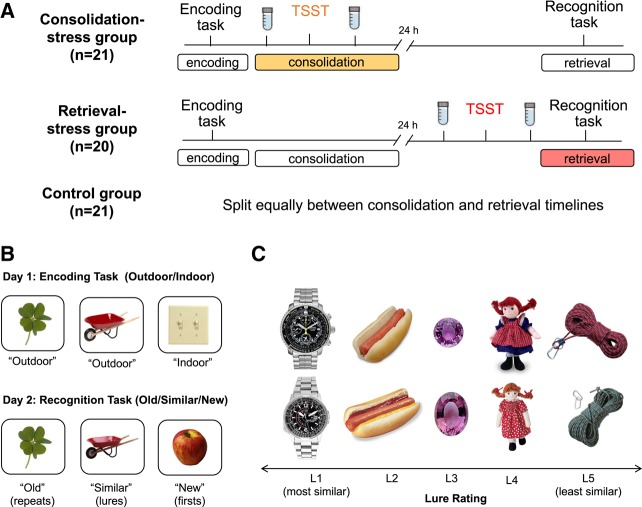
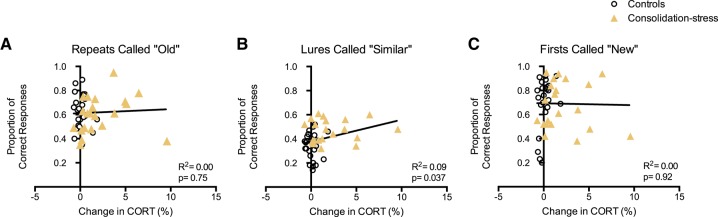
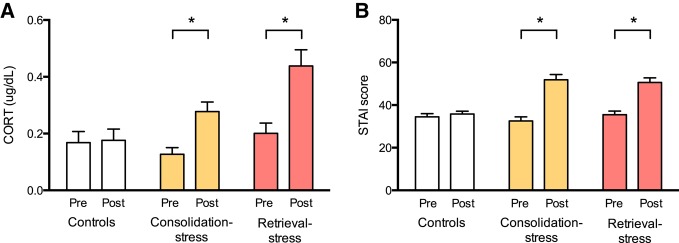
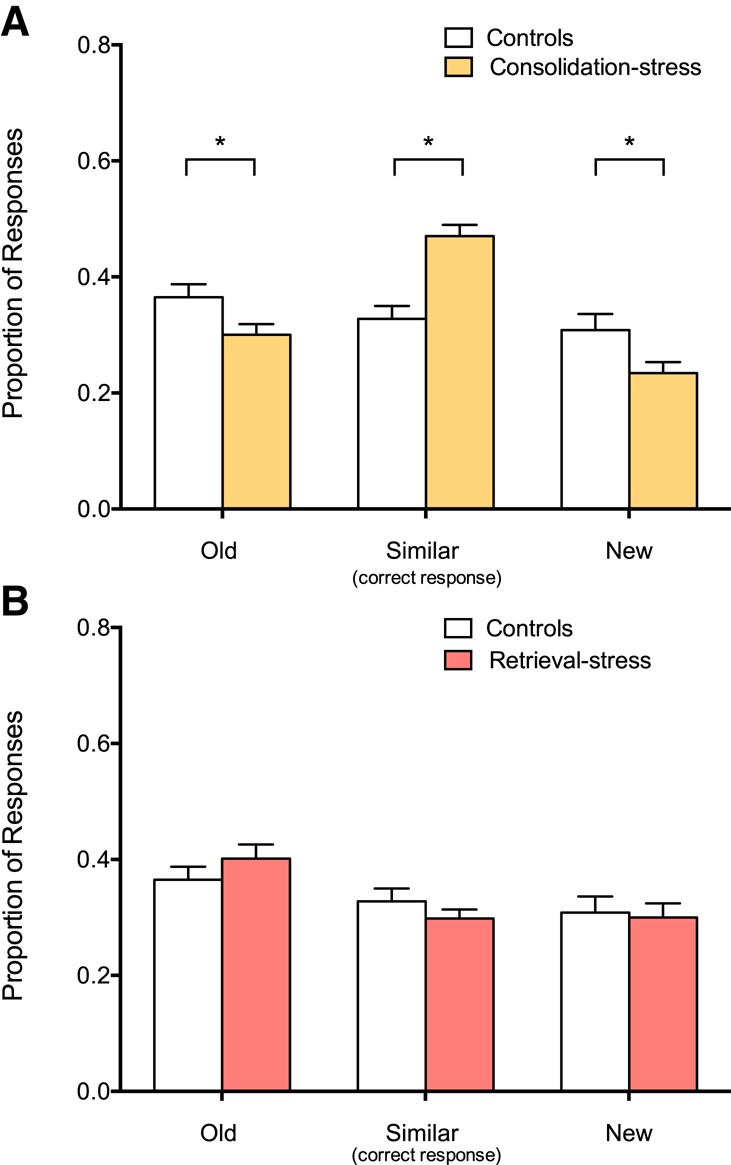
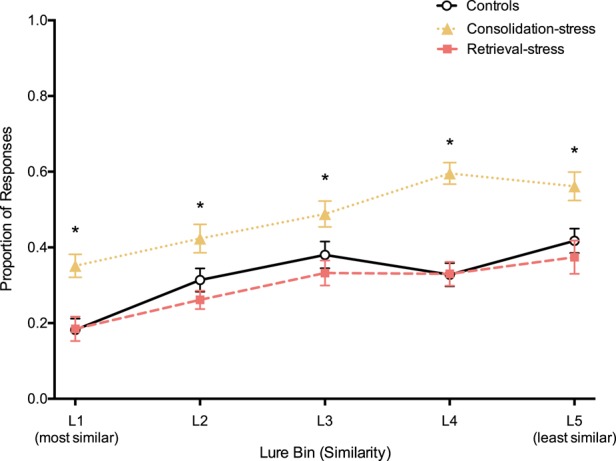
Stress is a potent modulator of brain function and particularly mnemonic processes. While chronic stress is associated with long-term deficits in memory, the effects of acute stress on mnemonic functions are less clear as previous reports have been inconsistent. Some studies suggest that cortisol, a stress hormone that modulates biological changes in response to stress, may enhance memory consolidation and impair memory retrieval. However, other studies report no effect of cortisol on either memory consolidation or retrieval. These discrepancies could be due to differences in the timing and sequencing of the experimental procedures or individual differences in participants' stress response. In the present study, we examined the effect of increased cortisol levels due to acute stress, induced by the Trier Social Stress Test (TSST), on a pattern separation memory task while differentiating the distinct stages of memory processing and controlling for the effects of diurnal variation. Sixty-nine young adults completed a 2-d study in which subjects either underwent the TSST immediately following the encoding part of the memory task, targeting memory consolidation, or immediately prior to the recognition part of the memory task on the second day, targeting memory retrieval. Control subjects completed the same study procedures but underwent a control version of the TSST that did not induce a stress response. Mnemonic discrimination of highly similar stimuli was enhanced by stress induced during consolidation with better discrimination showing a significant correlation with increased cortisol responses. Stress induced during memory retrieval showed no significant effect on memory performance. These findings suggest that stress induced changes in cortisol differentially affect the consolidation and retrieval stages of memory function.
压力是大脑功能的一个强有力的调节因子,尤其是记忆过程。虽然慢性压力与长期记忆缺陷有关,但急性压力对记忆功能的影响不太明确,因为之前的报告并不一致。一些研究表明,皮质醇是一种应激激素,可调节生物对压力的变化,可能增强记忆巩固并损害记忆检索。然而,其他研究报告皮质醇对记忆巩固或检索均没有影响。这些差异可能是由于实验程序的时间和顺序或参与者应激反应的个体差异不同所致。在本研究中,我们通过特里尔社会应激测试(TSST)检查了由于急性压力导致的皮质醇水平升高对模式分离记忆任务的影响,同时区分了记忆处理的不同阶段,并控制了昼夜变化的影响。69 名年轻人完成了为期 2 天的研究,其中受试者要么在记忆任务的编码部分后立即接受 TSST,以针对记忆巩固,要么在第二天的记忆任务识别部分之前立即接受 TSST,以针对记忆检索。对照受试者完成了相同的研究程序,但接受了不引起应激反应的 TSST 的对照版本。在巩固过程中,应激诱导增强了对高度相似刺激的记忆辨别力,更好的辨别力与皮质醇反应的增加呈显著相关性。在记忆检索过程中,应激诱导对记忆表现没有显著影响。这些发现表明,皮质醇诱导的压力变化对记忆功能的巩固和检索阶段有不同的影响。