Department of Clinical Nutrition, Union Shenzhen Hospital of Huazhong University of Science and Technology, No. 89 Taoyuan Road, Shenzhen, Guangdong, 518052, P.R. China.
Department of Obstetrics, Union Shenzhen Hospital of Huazhong University of Science and Technology, Shenzhen, China.
BMC Pregnancy Childbirth. 2022 Apr 6;22(1):290. doi: 10.1186/s12884-022-04636-9.
To examine the association of hemoglobin (Hb) levels during gestation with the risk of selected adverse pregnancy outcomes such as preterm birth (PTB), low-birth-weight infants (LBW) and small-for-gestational-age infants (SGA) in Chinese women.
This retrospective cohort study was conducted in the Department of Gynecology and Obstetrics at the Union Shenzhen Hospital of the Huazhong University of Science and Technology, using routinely collected maternity and hospital data on pregnancies (2015-2018). Hb levels were measured during the second (16-18th weeks) and third (28-30th weeks) trimesters of pregnancy, and pregnancy outcomes were recorded in the hospital information system. Hb levels were categorized into four groups as follows: < 110 g/L, 110-119 g/L, 120-130 g/L, and > 130 g/L. The second group (Hb 110-119 g/L) was defined as the reference group. Statistical analysis was performed using multivariate logistic regression.
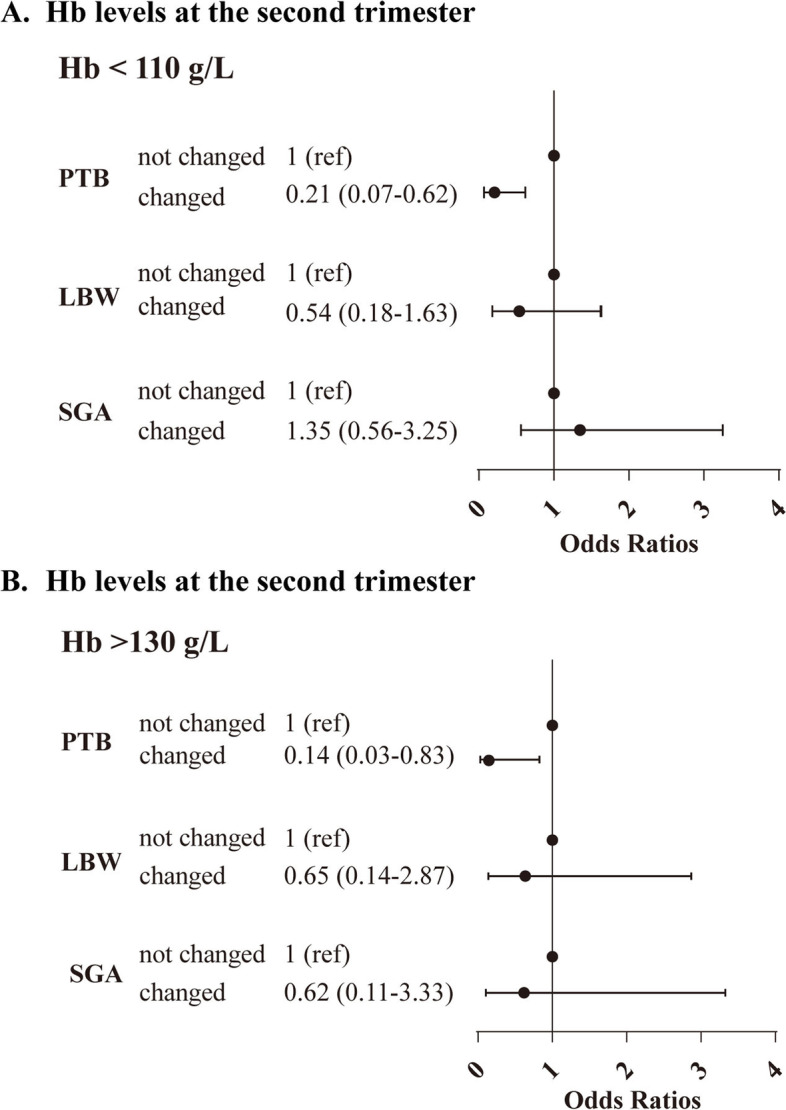
A total of 1911 singleton mothers were included. After multivariable adjustment, Hb levels > 130 g/L in the second trimester increased the risk of LBW (odds ratio [OR], 2.54; 95% confidence interval [CI], 1.12-5.76). In the third trimester of gestation, compared with women whose Hb levels between 110 and 119 g/L, women with Hb levels > 130 g/L had an increased risk of LBW (OR, 2.20; 95% CI, 1.07-4.51) and SGA (OR, 2.00; 95% CI, 1.05-3.80). When we compared the highest and lowest quartiles of changes in the Hb across the second and third trimesters, the adjusted ORs were 0.35 (95% CI: 0.18-0.68) for PTB and 0.47 (95% CI: 0.23-0.98) for LBW.
Maternal Hb > 130 g/L was associated with increased risk of adverse pregnancy outcomes. Reduction of the risks of PTB and SGA were observed with the appropriate increase of Hb level during the third trimester.
本研究旨在探讨中国孕妇妊娠期间血红蛋白(Hb)水平与早产(PTB)、低出生体重儿(LBW)和小于胎龄儿(SGA)等不良妊娠结局风险之间的关系。
本回顾性队列研究在华中科技大学附属深圳医院妇产科进行,使用医院信息系统收集 2015 年至 2018 年期间的妊娠常规产妇和医院数据。在妊娠第 2 个(16-18 周)和第 3 个(28-30 周) trimester 时测量 Hb 水平,并记录妊娠结局。Hb 水平分为以下四组:<110 g/L、110-119 g/L、120-130 g/L 和>130 g/L。第 2 组(Hb 110-119 g/L)为参考组。采用多变量 logistic 回归进行统计分析。
共纳入 1911 名单胎母亲。多变量调整后,第 2 个 trimester 的 Hb>130 g/L 增加了 LBW 的风险(比值比[OR],2.54;95%置信区间[CI],1.12-5.76)。在妊娠第 3 个 trimester 时,与 Hb 水平在 110-119 g/L 之间的女性相比,Hb 水平>130 g/L 的女性 LBW(OR,2.20;95% CI,1.07-4.51)和 SGA(OR,2.00;95% CI,1.05-3.80)的风险增加。当我们比较第 2 和第 3 trimester 的 Hb 变化的最高和最低四分位数时,PTB 的调整后 OR 为 0.35(95% CI:0.18-0.68),LBW 的调整后 OR 为 0.47(95% CI:0.23-0.98)。
母体 Hb>130 g/L 与不良妊娠结局风险增加有关。在第 3 trimester 适当增加 Hb 水平可降低 PTB 和 SGA 的风险。