Catalan Health Service, Barcelona, Spain.
Digitalization for the Sustainability of the Healthcare System DS3 - IDIBELL, Barcelona, Spain.
BMC Health Serv Res. 2022 Apr 6;22(1):451. doi: 10.1186/s12913-022-07865-y.
Non-attendance to scheduled hospital outpatient appointments may compromise healthcare resource planning, which ultimately reduces the quality of healthcare provision by delaying assessments and increasing waiting lists. We developed a model for predicting non-attendance and assessed the effectiveness of an intervention for reducing non-attendance based on the model.
The study was conducted in three stages: (1) model development, (2) prospective validation of the model with new data, and (3) a clinical assessment with a pilot study that included the model as a stratification tool to select the patients in the intervention. Candidate models were built using retrospective data from appointments scheduled between January 1, 2015, and November 30, 2018, in the dermatology and pneumology outpatient services of the Hospital Municipal de Badalona (Spain). The predictive capacity of the selected model was then validated prospectively with appointments scheduled between January 7 and February 8, 2019. The effectiveness of selective phone call reminders to patients at high risk of non-attendance according to the model was assessed on all consecutive patients with at least one appointment scheduled between February 25 and April 19, 2019. We finally conducted a pilot study in which all patients identified by the model as high risk of non-attendance were randomly assigned to either a control (no intervention) or intervention group, the last receiving phone call reminders one week before the appointment.
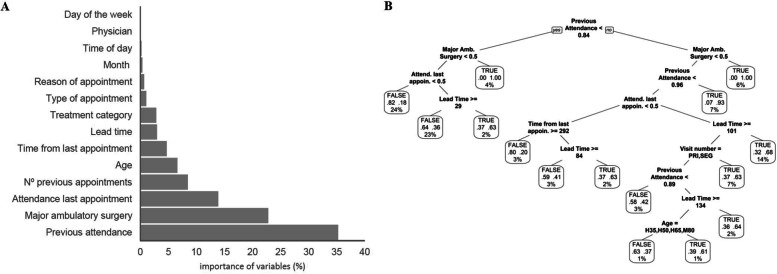
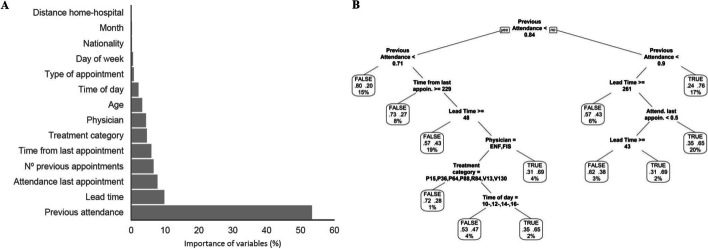
Decision trees were selected for model development. Models were trained and selected using 33,329 appointments in the dermatology service and 21,050 in the pneumology service. Specificity, sensitivity, and accuracy for the prediction of non-attendance were 79.90%, 67.09%, and 73.49% for dermatology, and 71.38%, 57.84%, and 64.61% for pneumology outpatient services. The prospective validation showed a specificity of 78.34% (95%CI 71.07, 84.51) and balanced accuracy of 70.45% for dermatology; and 69.83% (95%CI 60.61, 78.00) for pneumology, respectively. The effectiveness of the intervention was assessed on 1,311 individuals identified as high risk of non-attendance according to the selected model. Overall, the intervention resulted in a significant reduction in the non-attendance rate to both the dermatology and pneumology services, with a decrease of 50.61% (p<0.001) and 39.33% (p=0.048), respectively.
The risk of non-attendance can be adequately estimated using patient information stored in medical records. The patient stratification according to the non-attendance risk allows prioritizing interventions, such as phone call reminders, to effectively reduce non-attendance rates.
未按时出席预约的医院门诊可能会影响医疗资源规划,从而通过延迟评估和增加候诊名单来降低医疗服务质量。我们开发了一种预测失约的模型,并根据该模型评估了减少失约的干预措施的有效性。
该研究分三个阶段进行:(1)模型开发;(2)使用新数据对模型进行前瞻性验证;(3)包括模型作为分层工具选择干预组患者的试点研究的临床评估。候选模型是使用 2015 年 1 月 1 日至 2018 年 11 月 30 日期间在西班牙巴达洛纳市立医院皮肤科和肺病科门诊预约的回顾性数据构建的。然后,使用 2019 年 1 月 7 日至 2 月 8 日期间预约的前瞻性数据验证选定模型的预测能力。根据模型对高失约风险患者进行选择性电话提醒的效果,评估了 2019 年 2 月 25 日至 4 月 19 日期间至少有一次预约的所有连续患者。最后,我们在一项试点研究中,将所有通过模型确定为高失约风险的患者随机分配到对照组(无干预)或干预组,干预组在预约前一周接受电话提醒。
决策树被选为模型开发的方法。在皮肤科服务中,使用 33329 次预约和在肺病科服务中使用 21050 次预约进行了模型训练和选择。对失约的预测的特异性、敏感性和准确性分别为皮肤科 79.90%、67.09%和 73.49%,以及肺病科门诊服务 71.38%、57.84%和 64.61%。前瞻性验证显示皮肤科的特异性为 78.34%(95%CI 71.07,84.51),平衡准确率为 70.45%;而对于肺病科分别为 69.83%(95%CI 60.61,78.00)。根据选定的模型,对 1311 名被确定为高失约风险的个体进行了干预效果评估。总体而言,干预措施显著降低了皮肤科和肺病科的失约率,分别下降了 50.61%(p<0.001)和 39.33%(p=0.048)。
可以使用医疗记录中存储的患者信息充分估计失约风险。根据失约风险对患者进行分层,可以优先考虑电话提醒等干预措施,从而有效降低失约率。