Qutub Nida, Singh Preeti, Sabir Suhail, Sagadevan Suresh, Oh Won-Chun
Department of Chemistry, Jamia Millia Islamia, New Delhi, 110025, India.
Department of Fibers and Textile Processing Technology, Institute of Chemical Technology, Mumbai, 400019, India.
Sci Rep. 2022 Apr 6;12(1):5759. doi: 10.1038/s41598-022-09479-0.
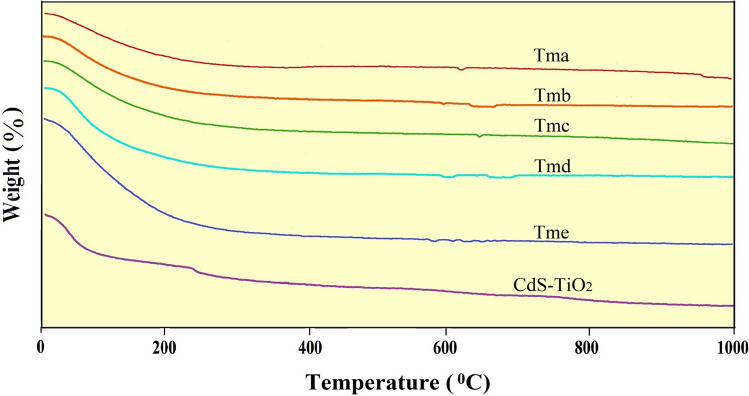
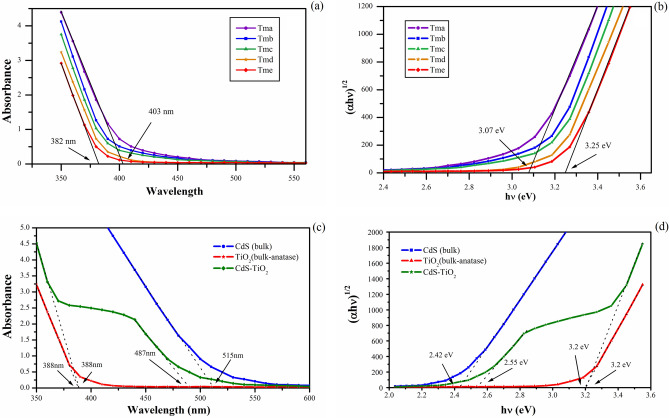
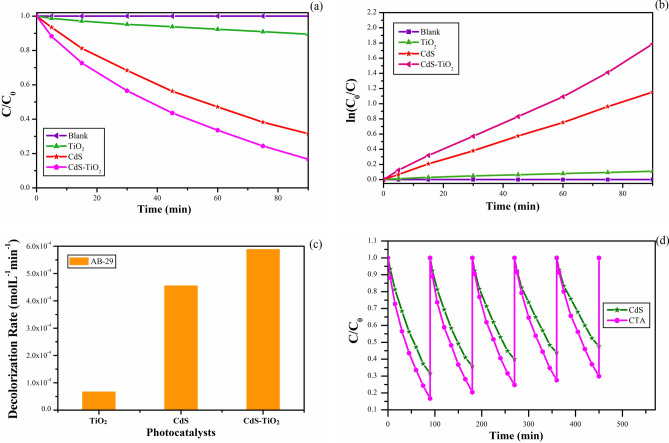
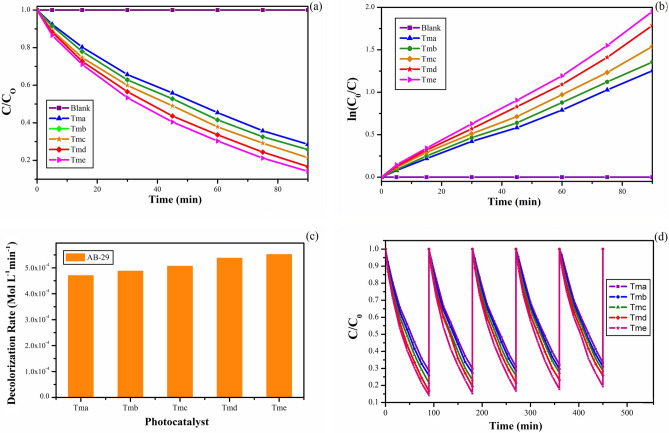
Photocatalytic degradation is essential for the successful removal of organic contaminants from wastewater, which is important for ecological and environmental safety. The advanced oxidation process of photocatalysis has become a hot topic in recent years for the remediation of water. Cadmium sulphide (CdS) nanostructures doped with Titanium oxide (CdS/TiO) nanocomposites has manufactured under ambient conditions using a simple and modified Chemical Precipitation technique. The nanocomposites crystal structure, thermal stability, recombination of photo-generated charge carriers, bandgap, surface morphology, particle size, molar ratio, and charge transfer properties are determined. The production of nanocomposites (CdS-TiO) and their efficient photocatalytic capabilities are observed. The goal of the experiment is to improve the photocatalytic efficiency of TiO in the visible region by doping CdS nanocomposites. The results showed that as-prepared CdS-TiO nanocomposites has exhibited the highest photocatalytic activity in the process of photocatalytic degradation of AB-29 dye, and its degradation efficiency is 84%. After 1 h 30 min of visible light irradiation, while CdS and TiO showed only 68% and 09%, respectively. The observed decolorization rate of AB-29 is also higher in the case of CdS-TiO photocatalyst ~ 5.8 × 10mol L min) as compared to the reported decolorization rate of CdS ~ 4.5 × 10mol L min and TiO ~ 0.67 × 10mol L min. This increased photocatalytic effectiveness of CdS-TiO has been accomplished by reduced charge carrier recombination as a result of improved charge separation and extension of TiO in response to visible light.
光催化降解对于成功去除废水中的有机污染物至关重要,这对生态和环境安全具有重要意义。光催化的高级氧化过程近年来已成为水修复领域的热门话题。采用简单的改进化学沉淀技术,在环境条件下制备了掺杂二氧化钛的硫化镉(CdS/TiO)纳米复合材料。测定了纳米复合材料的晶体结构、热稳定性、光生电荷载流子的复合、带隙、表面形貌、粒径、摩尔比和电荷转移性能。观察到了纳米复合材料(CdS-TiO)的制备及其高效的光催化能力。该实验的目的是通过掺杂CdS纳米复合材料来提高TiO在可见光区域的光催化效率。结果表明,所制备的CdS-TiO纳米复合材料在AB-29染料的光催化降解过程中表现出最高的光催化活性,其降解效率为84%。在可见光照射1小时30分钟后,CdS和TiO的降解效率分别仅为68%和9%。与报道的CdS的脱色率4.5×10mol L min和TiO的脱色率0.67×10mol L min相比,CdS-TiO光催化剂对AB-29的脱色率也更高~5.8×10mol L min)。CdS-TiO光催化效率的提高是由于电荷分离得到改善以及TiO对可见光的响应范围扩大,从而减少了电荷载流子的复合。