Wu Cheng, Wang Ming, Zhou Qing, Shi Hui
Department of Gastroenterology, The Second Medical Center and National Clinical Research Center for Geriatric Diseases, Chinese PLA General Hospital, Beijing 100853, China.
J Healthc Eng. 2022 Mar 27;2022:2426301. doi: 10.1155/2022/2426301. eCollection 2022.
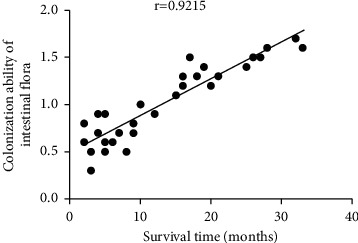
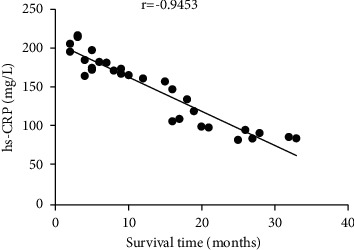
This study aims to explore the associations of changes in intestinal flora and inflammatory factors with the prognosis of patients with esophageal cancer (EC). A total of 40 EC patients treated and 40 normal people who underwent gastroscopy and CT examination for gastrointestinal discomfort during the same period were selected as the participants of the study. The endotoxin level, colonization ability of intestinal flora, and distribution of intestinal flora (, , , and ) were compared between the two groups. The levels of inflammatory factors interleukin-6 (IL-6), high-sensitivity C-reactive protein (hs-CRP), and tumor necrosis factor- (TNF-) were also compared between the two groups. All participants were followed up for 3 years, and the associations of survival time with colonization ability of intestinal flora and changes in hs-CRP were analyzed. Finally, the univariate and multivariate logistic regression analyses were performed for related factors affecting the survival time of EC patients. In the observation group, the endotoxin level was significantly higher ( < 0.05), the colonization ability of intestinal flora was significantly weaker ( < 0.05), the levels of and were obviously lower ( < 0.05), and the levels of and were obviously higher than those in the normal group ( < 0.05). Besides, the observation group had abnormal and evidently higher levels of IL-6, hs-CRP, and TNF- than the normal group ( < 0.05). The survival time was positively correlated with the colonization ability of intestinal flora ( < 0.05), but negatively correlated with the changes in hs-CRP ( < 0.05). Moreover, the increased level of endotoxin, weakened colonization ability of intestinal flora, abnormal distribution of intestinal flora, and elevated levels of inflammatory factors were all related and independent risk factors affecting the survival time of EC patients. In EC patients, the endotoxin level markedly rises, the colonization ability of intestinal flora declines, and there are intestinal flora disorders and enhanced inflammatory response. With the decline in colonization ability of intestinal flora and the increase of inflammatory response, the survival time of EC patients will be shortened.
本研究旨在探讨肠道菌群变化及炎症因子与食管癌(EC)患者预后的相关性。选取40例接受治疗的EC患者以及同期因胃肠道不适接受胃镜和CT检查的40例正常人作为研究对象。比较两组患者的内毒素水平、肠道菌群定植能力及肠道菌群分布(、、和)。同时比较两组炎症因子白细胞介素-6(IL-6)、高敏C反应蛋白(hs-CRP)及肿瘤坏死因子-(TNF-)水平。对所有研究对象进行3年随访,分析生存时间与肠道菌群定植能力及hs-CRP变化的相关性。最后,对影响EC患者生存时间的相关因素进行单因素和多因素logistic回归分析。观察组内毒素水平显著升高(<0.05),肠道菌群定植能力显著减弱(<0.05),和水平明显降低(<0.05),和水平明显高于正常组(<0.05)。此外,观察组IL-6、hs-CRP及TNF-水平异常且明显高于正常组(<0.05)。生存时间与肠道菌群定植能力呈正相关(<0.05),与hs-CRP变化呈负相关(<0.05)。而且,内毒素水平升高、肠道菌群定植能力减弱、肠道菌群分布异常及炎症因子水平升高均为影响EC患者生存时间的相关且独立危险因素。在EC患者中,内毒素水平明显升高,肠道菌群定植能力下降,存在肠道菌群紊乱且炎症反应增强。随着肠道菌群定植能力下降及炎症反应增强,EC患者的生存时间将缩短。