Belay Daniel Gashaneh, Taddese Asefa Adimasu, Gelaye Kasahun Alemu
Department of Human Anatomy, School of Medicine, College of Medicine and Health Sciences, University of Gondar, Gondar, Ethiopia.
Department of Epidemiology and Biostatistics, Institute of Public Health, College of Medicine and Health Sciences, University of Gondar, Gondar, Ethiopia.
BMC Public Health. 2022 Apr 7;22(1):684. doi: 10.1186/s12889-022-12966-8.
Only one in five children aged below 24 months in the low-income countries feed the minimum recommended diet, and significantly varied across socio-economic classes. Though sub-saharan Africa (SSA) shares the huge burden of children under nutrition, as to our search of literature there is limited evidence on the pooled magnitude and factors associated with minimum acceptable diet (MAD) intake among children aged 6 to 23 months in the region. This study aimed to assess the pooled magnitude and associated factors of MAD intake among children aged 6-23 months in SSA using recent 2010-2020 DHS data.
Demographic and Health Survey datasets of SSA countries were used for this study with a total of 78,542 weighted samples. The data were cleaned using MS excel and extracted and analyzed using STATA V.16 software. A multilevel binary logistic regression model was fitted. The adjusted odds ratio (AOR) with P-value < 0.05 was taken to declare statistical significance.
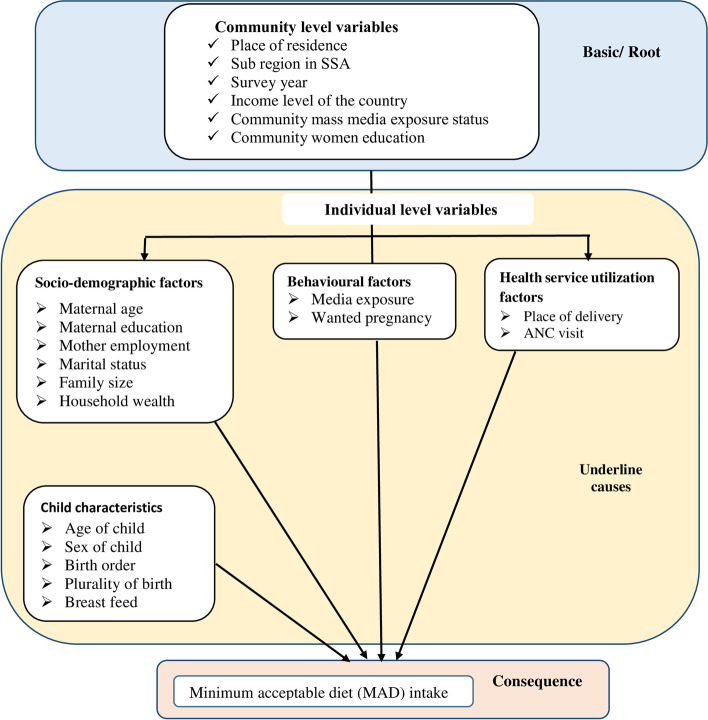
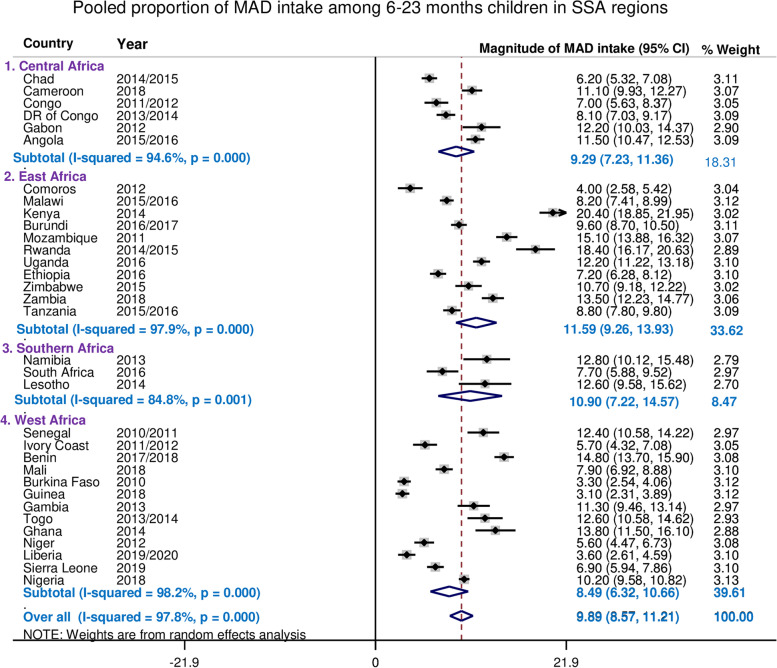
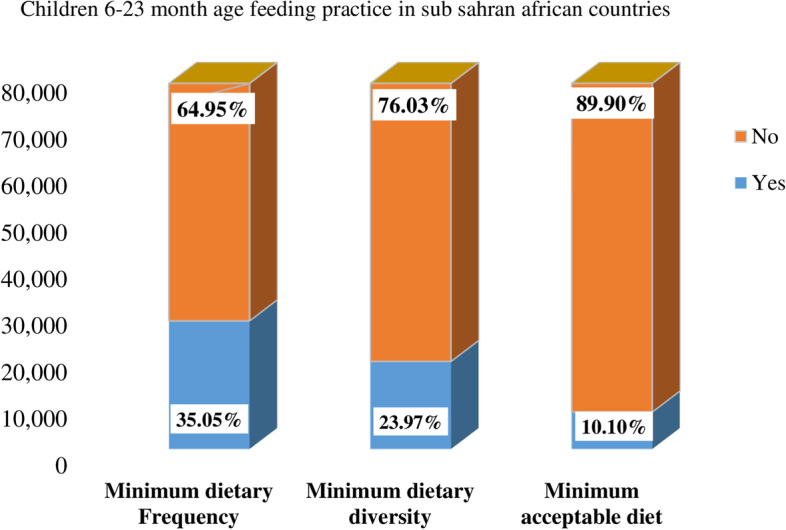
The pooled magnitude of MAD intake among children aged 6-23 months in SSA was 9.89% [95%CI: 8.57, 11.21%] ranging from 3.10% in Guinea to 20.40% in Kenya. Individual level factors such as; secondary &above women educational status [AOR = 1.41; 95%CI; 1.29, 1.53], having employed women [AOR = 1.25;95%CI;1.17,1.33], having media exposure [AOR = 1.55;95%CI;1.45,1.66], richest household wealth [AOR = 1.93; 95%CI; 1.73, 2.15], plural birth [AOR = 0.68;95%CI; 0.56, 0.82] and breastfed child [AOR = 2.04; 95%CI; 1.89, 2.21], whereas, community level factor such as rural residence [AOR = 0.74; 95%CI; 0.69, 0.79] and living in upper middle income country [AOR = 1.62; [95%CI; 1.41,1.87] were significantly associated with MAD intake.
Minimum acceptable diet intake in SSA is relatively low. Variables such as; secondary &above maternal education, having employed mother, exposure to media, richest wealth, breast feeding child, and upper middle income country have a significant positive association, whereas having plural birth and living in rural residence have a significant negative association with MAD intake. These findings highlight that policymakers and other stakeholders had better give prior attention to empowering women, enhance household wealth status and media exposure to increase the MAD intake in the region.
在低收入国家,24个月以下儿童中只有五分之一摄入了最低推荐饮食,且社会经济阶层间差异显著。尽管撒哈拉以南非洲地区(SSA)承担着儿童营养不良的巨大负担,但就我们对文献的检索而言,关于该地区6至23个月儿童最低可接受饮食(MAD)摄入量的汇总规模及相关因素的证据有限。本研究旨在利用2010 - 2020年最新的 DHS 数据评估SSA地区6 - 23个月儿童MAD摄入量的汇总规模及相关因素。
本研究使用了SSA国家的人口与健康调查数据集,共有78542个加权样本。数据使用MS excel进行清理,并使用STATA V.16软件进行提取和分析。拟合了一个多水平二元逻辑回归模型。调整后的优势比(AOR)且P值<0.05被视为具有统计学意义。
SSA地区6 - 23个月儿童MAD摄入量的汇总规模为9.89%[95%置信区间:8.57,11.21%],范围从几内亚的3.10%到肯尼亚的20.40%。个体层面的因素包括:女性接受中等及以上教育程度[AOR = 1.41;95%置信区间;1.29,1.53]、女性就业[AOR = 1.25;95%置信区间;1.17,1.33]、接触媒体[AOR = 1.55;95%置信区间;1.45,1.66]、家庭财富最富有[AOR = 1.93;95%置信区间;1.73,2.15]、多胞胎出生[AOR = 0.68;95%置信区间;0.56,0.82]以及母乳喂养的儿童[AOR = 2.04;95%置信区间;1.89,2.21],而社区层面因素如农村居住[AOR = 0.74;95%置信区间;0.69,0.79]和生活在中高收入国家[AOR = 1.62;[95%置信区间;1.41,1.87]与MAD摄入量显著相关。
SSA地区最低可接受饮食摄入量相对较低。诸如母亲接受中等及以上教育、母亲就业、接触媒体、最富有财富、母乳喂养儿童以及生活在中高收入国家等变量与MAD摄入量呈显著正相关,而多胞胎出生和农村居住与MAD摄入量呈显著负相关。这些发现凸显出政策制定者和其他利益相关者最好优先关注增强妇女权能、提高家庭财富状况和增加媒体接触,以提高该地区的MAD摄入量。