Addis Continental Institute of Public Health, Addis Ababa, Ethiopia.
U.S. President's Malaria Initiative, Addis Ababa, Ethiopia.
Trials. 2022 Apr 7;23(1):267. doi: 10.1186/s13063-022-06199-8.
Reactive and proactive case detection measures are widely implemented by national malaria elimination programs globally. Ethiopia decided to include Reactive Case Detection (RCD) and targeted Mass Drug Administration (tMDA) approaches as part of their elimination strategy along with rigorous evaluation. The purpose of this study is to compare the impact of RCD and tMDA on malaria elimination over the 2-year study period, by looking at the annual parasite incidence before and after the intervention.
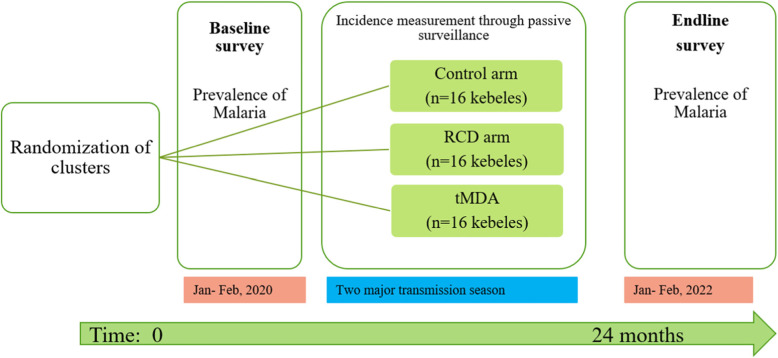
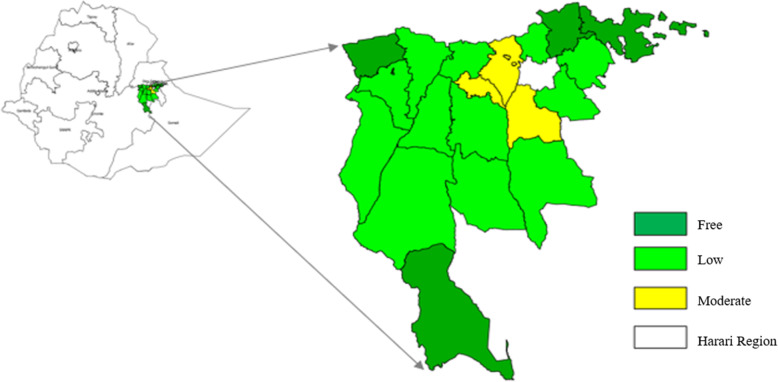
The study will be conducted in the East Hararghe zone of Ethiopia. Malaria transmission in the area is low to moderate. This study will deploy a community-based, three-arm, cluster-randomized control trial implemented over 2 years. Forty-eight clusters (16 clusters per arm) will be selected based on the annual number of confirmed malaria cases seen in the cluster. All clusters will receive the current standard of care in terms of malaria elimination interventions provided by the national malaria control program. In addition, following the identification of malaria parasite infection, individuals who reside within a 100-m radius of the index case will receive a diagnosis for malaria and treatment if positive in the RCD arm or presumptive treatment in the tMDA arm. The primary effectiveness endpoint will be measured at baseline and endline for each intervention arm and compared to the control arm using a difference in difference approach.
This randomized controlled trial will provide evidence of the impact of the proposed intervention approaches for malaria elimination.
ClinicalTrials.gov NCT04241705 . Registration date: January 27, 2020.
反应性和主动性病例检测措施在全球范围内得到了广泛应用,被各国的消除疟疾规划所采用。埃塞俄比亚决定将反应性病例检测(RCD)和有针对性的大规模药物治疗(tMDA)方法纳入其消除战略,同时进行严格的评估。本研究的目的是通过观察干预前后的年度寄生虫发病率,比较 RCD 和 tMDA 对疟疾消除的影响,研究将在埃塞俄比亚东哈勒尔地区进行。该地区的疟疾传播程度为低至中度。本研究将采用基于社区的、三臂、集群随机对照试验设计,持续 2 年。将根据每个集群中确诊疟疾病例的年度数量,选择 48 个集群(每个臂 16 个集群)。所有集群都将获得国家疟疾控制项目提供的消除疟疾干预措施的当前标准护理。此外,在确定疟原虫感染后,居住在索引病例半径 100 米范围内的个人将在 RCD 臂中接受疟疾诊断和治疗(如果阳性),或在 tMDA 臂中接受推定治疗。主要有效性终点将在基线和终点测量每个干预臂,并与对照臂进行差异比较。
这项随机对照试验将为拟议的干预措施在消除疟疾方面的影响提供证据。
ClinicalTrials.gov NCT04241705. 注册日期:2020 年 1 月 27 日。