Stone Will, Sawa Patrick, Lanke Kjerstin, Rijpma Sanna, Oriango Robin, Nyaurah Maureen, Osodo Paul, Osoti Victor, Mahamar Almahamoudou, Diawara Halimatou, Woestenenk Rob, Graumans Wouter, van de Vegte-Bolmer Marga, Bradley John, Chen Ingrid, Brown Joelle, Siciliano Giulia, Alano Pietro, Gosling Roly, Dicko Alassane, Drakeley Chris, Bousema Teun
Department of Medical Microbiology, Radboud University Medical Center, Nijmegen, The Netherlands.
Department of Immunology and Infection, London School of Hygiene and Tropical Medicine, United Kingdom.
J Infect Dis. 2017 Aug 15;216(4):457-467. doi: 10.1093/infdis/jix237.
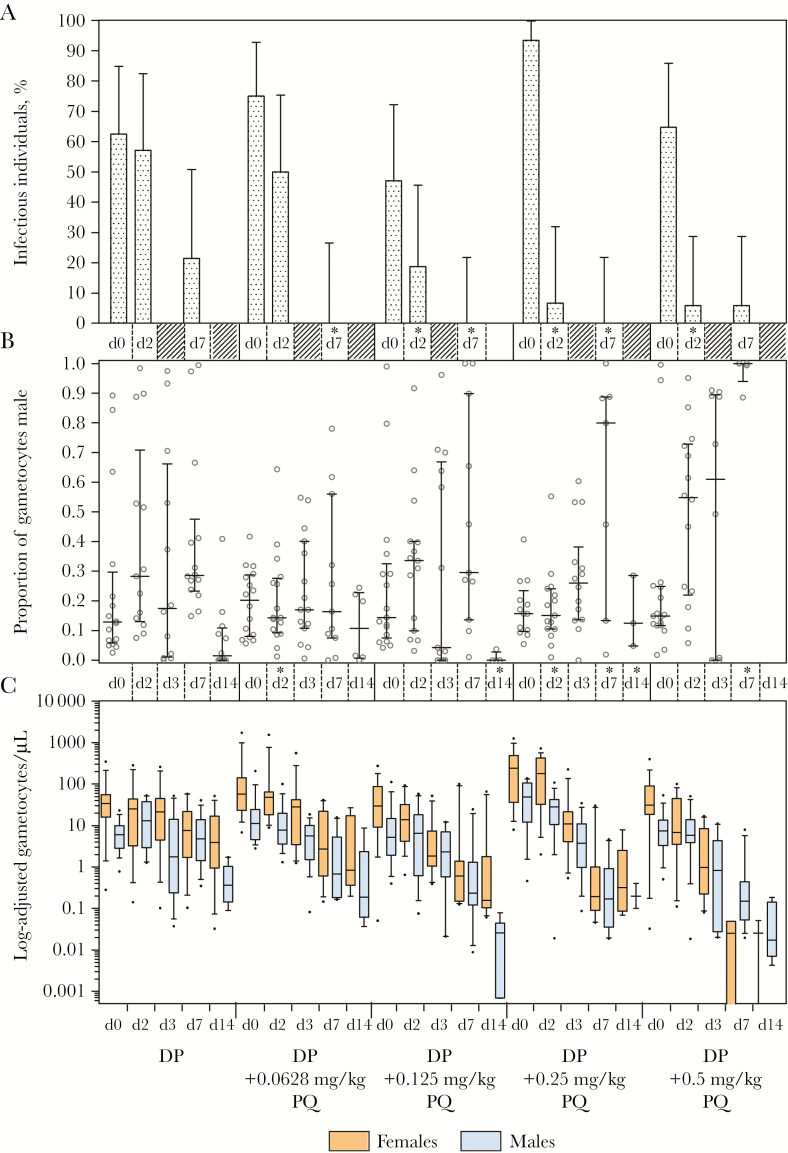
Single low-dose primaquine (PQ) reduces Plasmodium falciparum infectivity before it impacts gametocyte density. Here, we examined the effect of PQ on gametocyte sex ratio as a possible explanation for this early sterilizing effect.
Quantitative reverse-transcription polymerase chain reaction assays were developed to quantify female gametocytes (targeting Pfs25 messenger RNA [mRNA]) and male gametocytes (targeting Pf3D7_1469900 mRNA) in 2 randomized trials in Kenya and Mali, comparing dihydroartemisinin-piperaquine (DP) alone to DP with PQ. Gametocyte sex ratio was examined in relation to time since treatment and infectivity to mosquitoes.
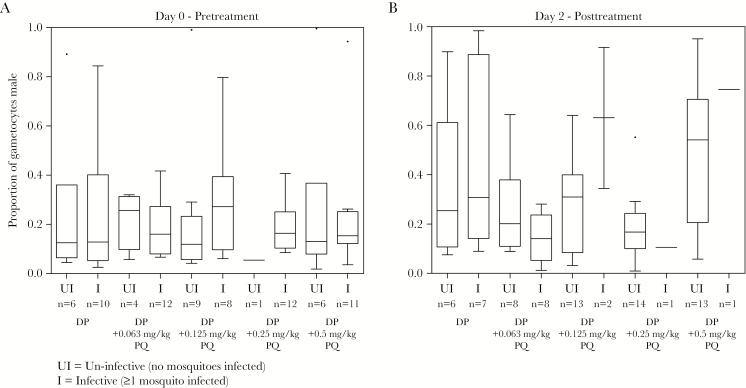
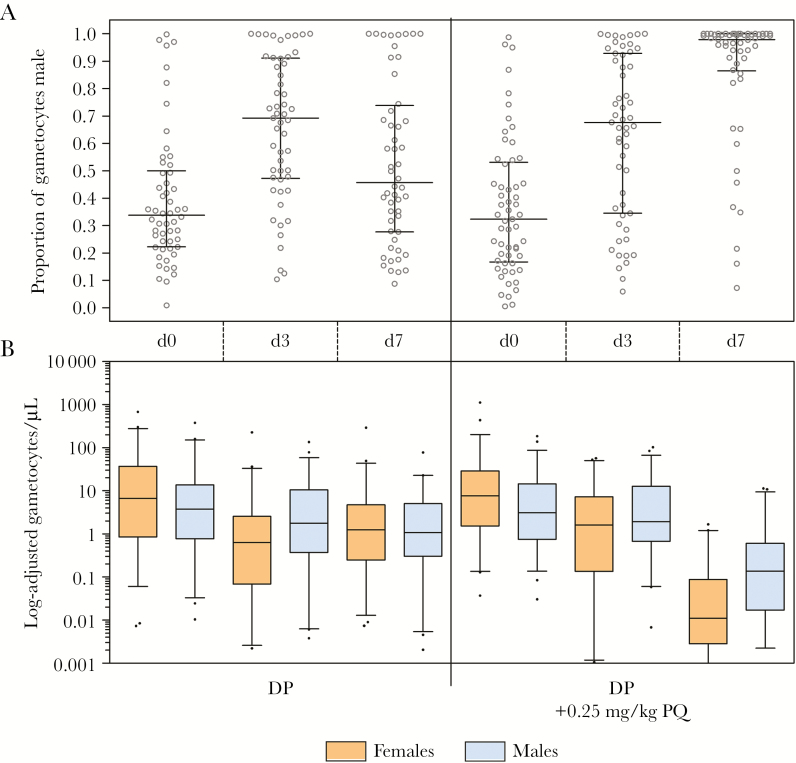
In Kenya, the median proportion of male gametocytes was 0.33 at baseline. Seven days after treatment, gametocyte density was significantly reduced in the DP-PQ arm relative to the DP arm (females: 0.05% [interquartile range {IQR}, 0.0-0.7%] of baseline; males: 3.4% [IQR, 0.4%-32.9%] of baseline; P < .001). Twenty-four hours after treatment, gametocyte sex ratio became male-biased and was not significantly different between the DP and DP-PQ groups. In Mali, there was no significant difference in sex ratio between the DP and DP-PQ groups (>0.125 mg/kg) 48 hours after treatment, and gametocyte sex ratio was not associated with mosquito infection rates.
The early sterilizing effects of PQ may not be explained by the preferential clearance of male gametocytes and may be due to an effect on gametocyte fitness.
单次低剂量伯氨喹(PQ)在影响配子体密度之前就能降低恶性疟原虫的感染性。在此,我们研究了PQ对配子体性别比例的影响,以此作为这种早期绝育效应的一种可能解释。
在肯尼亚和马里的两项随机试验中,开发了定量逆转录聚合酶链反应检测方法,以定量雌配子体(靶向Pfs25信使核糖核酸[mRNA])和雄配子体(靶向Pf3D7_1469900 mRNA),比较单独使用双氢青蒿素 - 哌喹(DP)与DP联合PQ的效果。研究了配子体性别比例与治疗后时间以及对蚊子感染性的关系。
在肯尼亚,基线时雄配子体的中位比例为0.33。治疗7天后,与DP组相比,DP - PQ组的配子体密度显著降低(雌配子体:为基线的0.05%[四分位间距{IQR},0.0 - 0.7%];雄配子体:为基线的3.4%[IQR,0.4% - 32.9%];P <.001)。治疗24小时后,配子体性别比例变为雄性偏多,且DP组和DP - PQ组之间无显著差异。在马里,治疗48小时后,DP组和DP - PQ组(>0.125 mg/kg)的性别比例无显著差异,且配子体性别比例与蚊子感染率无关。
PQ的早期绝育效应可能无法用雄配子体的优先清除来解释,可能是由于对配子体适应性的影响。