Global Health Policy Unit, Social Policy, School of Social and Political Science, University of Edinburgh, Edinburgh, UK
SPECTRUM Consortium (Shaping Public Health Policies to Reduce Inequalities and Harm), London, UK.
Tob Control. 2022 Jun;31(Suppl 1):s53-s60. doi: 10.1136/tobaccocontrol-2021-057159. Epub 2022 Apr 7.
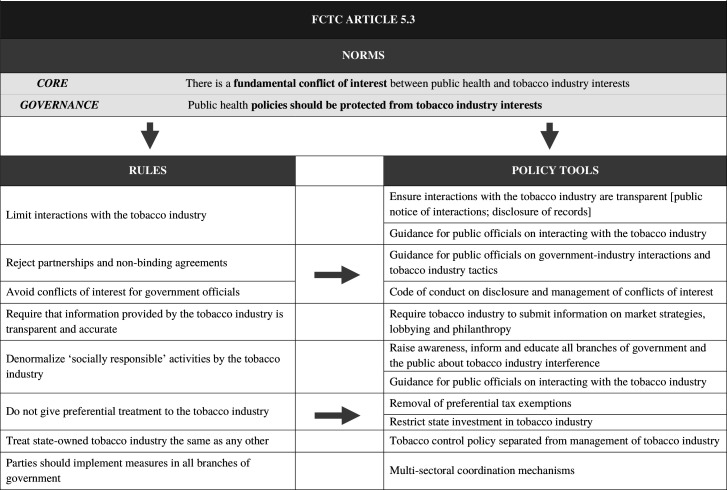
Article 5.3 of the WHO Framework Convention on Tobacco Control, elaborated via its implementation guidelines, can be understood as a policy instrument comprising norms, rules and policy tools designed to shape practices of policy making and minimise tobacco industry interference.
This qualitative research is based on in-depth interviews with officials from diverse government sectors and non-governmental organisations across countries (Ethiopia, India, Uganda) that have adopted measures to implement Article 5.3.
The data highlight varied perceptions and knowledge of Article 5.3 norms between health and non-health sectors. Health officials typically link its norm of a fundamental conflict between public health and industry interests to the norm of protecting public health policies from industry interference. While officials in sectors beyond health broadly endorsed this core norm, they exhibited more limited awareness of Article 5.3 and its model of governance. The results examine how rules to implement Article 5.3 have been codified, but identify the absence of policy tools necessary to operationalise rules and norms. This limitation, alongside restricted awareness beyond health departments, suggests that political commitments to implement Article 5.3 will have limited impact on practices of stakeholder consultation and policy engagement with the tobacco industry.
Conceptualising Article 5.3 as a policy instrument helps to explain how its rules and policy tools interact with each other and with broader governance processes. This framework has the potential to enhance understanding of Article 5.3 and help identify opportunities and constraints in its implementation.
世界卫生组织烟草控制框架公约第 5.3 条及其实施准则可被理解为一种政策工具,其中包含旨在规范决策实践和减少烟草业干扰的规范、规则和政策工具。
本研究采用定性方法,对来自不同国家(埃塞俄比亚、印度、乌干达)政府部门和非政府组织的官员进行了深入访谈,这些国家已经采取措施来实施第 5.3 条。
数据突出显示了卫生和非卫生部门对第 5.3 条规范的不同看法和认识。卫生官员通常将其规范中公共卫生和行业利益之间的根本冲突与保护公共卫生政策免受行业干扰的规范联系起来。虽然卫生部门以外的官员普遍认可这一核心规范,但他们对第 5.3 条及其治理模式的认识有限。结果检验了实施第 5.3 条的规则是如何编纂的,但也发现了实施规则和规范所需的政策工具的缺失。这种局限性以及卫生部门以外的意识受限表明,政治承诺实施第 5.3 条将对与烟草业进行利益相关者协商和政策参与的实践产生有限影响。
将第 5.3 条概念化为一种政策工具有助于解释其规则和政策工具如何相互作用以及与更广泛的治理过程相互作用。这一框架有可能增进对第 5.3 条的理解,并有助于确定其实施中的机会和限制。