
老年人重大癌症手术后的生活质量:GOSAFE 国际研究。
Quality of Life in Older Adults After Major Cancer Surgery: The GOSAFE International Study.
机构信息
Colorectal surgery Unit, Ospedale "per gli Infermi", AUSL Romagna, Faenza, Italy.
Perelman School of Medicine, Department of Surgery, Division of Colon and Rectal Surgery, University of Pennsylvania, Philadelphia, PA, USA.
出版信息
J Natl Cancer Inst. 2022 Jul 11;114(7):969-978. doi: 10.1093/jnci/djac071.
BACKGROUND
Accurate quality of life (QoL) data and functional results after cancer surgery are lacking for older patients. The international, multicenter Geriatric Oncology Surgical Assessment and Functional rEcovery after Surgery (GOSAFE) Study compares QoL before and after surgery and identifies predictors of decline in QoL.
METHODS
GOSAFE prospectively collected data before and after major elective cancer surgery on older adults (≥70 years). Frailty assessment was performed and postoperative outcomes recorded (30, 90, and 180 days postoperatively) together with QoL data by means of the three-level version of the EuroQol five-dimensional questionnaire (EQ-5D-3L), including 2 components: an index (range = 0-1) generated by 5 domains (mobility, self-care, ability to perform the usual activities, pain or discomfort, anxiety or depression) and a visual analog scale.
RESULTS
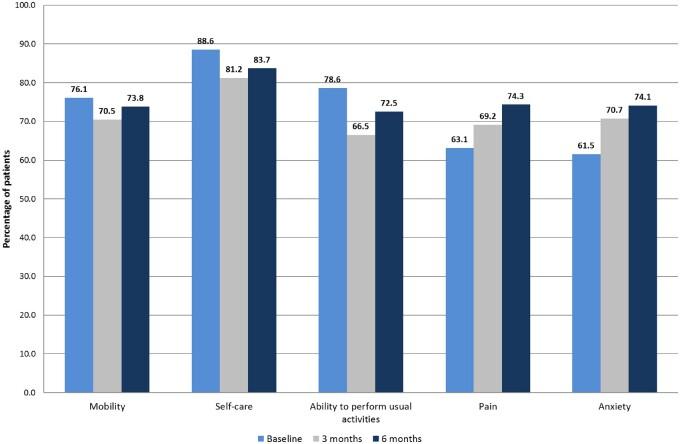
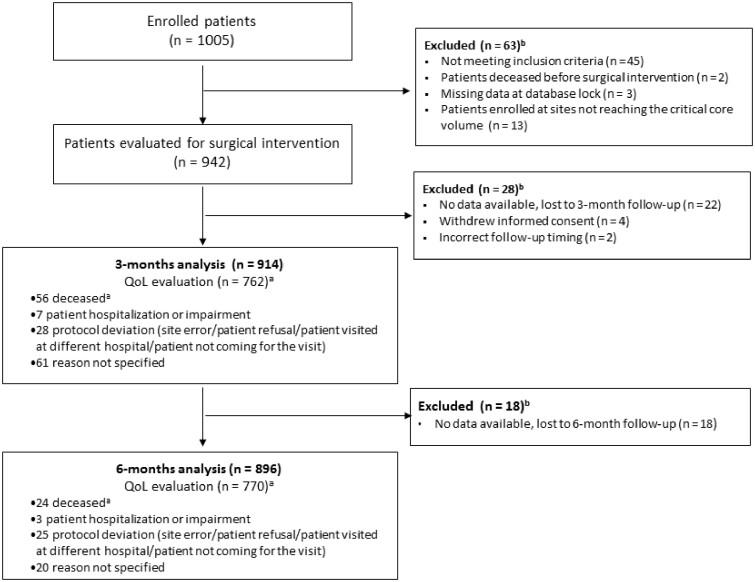
Data from 26 centers were collected (February 2017-March 2019). Complete data were available for 942/1005 consecutive patients (94.0%): 492 male (52.2%), median age 78 years (range = 70-95 years), and primary tumor was colorectal in 67.8%. A total 61.2% of all surgeries were via a minimally invasive approach. The 30-, 90-, and 180-day mortality was 3.7%, 6.3%, and 9%, respectively. At 30 and 180 days, postoperative morbidity was 39.2% and 52.4%, respectively, and Clavien-Dindo III-IV complications were 13.5% and 18.7%, respectively. The mean EQ-5D-3L index was similar before vs 3 months but improved at 6 months (0.79 vs 0.82; P < .001). Domains showing improvement were pain and anxiety or depression. A Flemish Triage Risk Screening Tool score greater than or equal to 2 (odds ratio [OR] = 1.58, 95% confidence interval [CI] = 1.13 to 2.21, P = .007), palliative surgery (OR = 2.14, 95% CI = 1.01 to 4.52, P = .046), postoperative complications (OR = 1.95, 95% CI = 1.19 to 3.18, P = .007) correlated with worsening QoL.
CONCLUSIONS
GOSAFE shows that older adults' preoperative QoL is preserved 3 months after cancer surgery, independent of their age. Frailty screening tools, patient-reported outcomes, and goals-of-care discussions can guide decisions to pursue surgery and direct patients' expectations.
背景
对于老年患者,癌症手术后准确的生活质量(QoL)数据和功能结果仍然缺乏。国际多中心老年肿瘤外科评估和手术后功能恢复研究(GOSAFE)比较了手术前后的 QoL,并确定了 QoL 下降的预测因素。
方法
GOSAFE 前瞻性地收集了年龄≥70 岁的老年患者进行重大择期癌症手术后的 QoL 数据。进行了衰弱评估,并记录了术后结果(术后 30、90 和 180 天)以及通过三级版欧洲五维健康问卷(EQ-5D-3L)获得的 QoL 数据,包括 2 个部分:由 5 个领域(移动能力、自我护理、完成日常活动的能力、疼痛或不适、焦虑或抑郁)生成的指数(范围=0-1)和视觉模拟量表。
结果
来自 26 个中心的数据被收集(2017 年 2 月至 2019 年 3 月)。连续 1005 例患者中的 942 例(94.0%)完成了完整的数据收集:492 例男性(52.2%),中位年龄为 78 岁(范围=70-95 岁),原发性肿瘤为结直肠 67.8%。所有手术中有 61.2%是通过微创方法进行的。术后 30、90 和 180 天的死亡率分别为 3.7%、6.3%和 9%。术后 30 和 180 天的发病率分别为 39.2%和 52.4%,Clavien-Dindo III-IV 并发症分别为 13.5%和 18.7%。术前与术后 3 个月的 EQ-5D-3L 指数相似,但术后 6 个月有所改善(0.79 对 0.82;P<.001)。疼痛和焦虑或抑郁的改善。 Flemish Triage Risk Screening Tool 评分≥2 分(优势比[OR] = 1.58,95%置信区间[CI] = 1.13 至 2.21,P =.007)、姑息性手术(OR = 2.14,95% CI = 1.01 至 4.52,P =.046)和术后并发症(OR = 1.95,95% CI = 1.19 至 3.18,P =.007)与 QoL 恶化相关。
结论
GOSAFE 表明,老年患者癌症手术后 3 个月时的术前 QoL 得到了保持,与年龄无关。衰弱筛查工具、患者报告的结果和目标治疗讨论可以指导手术决策,并指导患者的期望。
 Zotero 插件