Department of Psychology, Beijing Forestry University, Beijing, China.
Key Laboratory of Behavioral Science, Institute of Psychology, Chinese Academy of Sciences, Beijing, China.
J Med Internet Res. 2022 Apr 8;24(4):e36489. doi: 10.2196/36489.
The new reality of cybersuicide raises challenges to ideologies about the traditional form of suicide that does not involve the internet (offline suicide), which may lead to changes in audience's attitudes. However, knowledge on whether stigmatizing attitudes differ between cybersuicides and offline suicides remains limited.
This study aims to consider livestreamed suicide as a typical representative of cybersuicide and use social media data (Sina Weibo) to investigate the differences in stigmatizing attitudes across cybersuicides and offline suicides in terms of attitude types and linguistic characteristics.
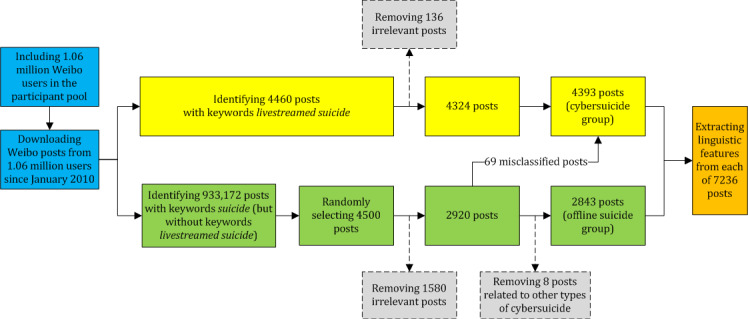
A total of 4393 cybersuicide-related and 2843 offline suicide-related Weibo posts were collected and analyzed. First, human coders were recruited and trained to perform a content analysis on the collected posts to determine whether each of them reflected stigma. Second, a text analysis tool was used to automatically extract a number of psycholinguistic features from each post. Subsequently, based on the selected features, a series of classification models were constructed for different purposes: differentiating the general stigma of cybersuicide from that of offline suicide and differentiating the negative stereotypes of cybersuicide from that of offline suicide.
In terms of attitude types, cybersuicide was observed to carry more stigma than offline suicide (χ=179.8; P<.001). Between cybersuicides and offline suicides, there were significant differences in the proportion of posts associated with five different negative stereotypes, including stupid and shallow (χ=28.9; P<.001), false representation (χ=144.4; P<.001), weak and pathetic (χ=20.4; P<.001), glorified and normalized (χ=177.6; P<.001), and immoral (χ=11.8; P=.001). Similar results were also found for different genders and regions. In terms of linguistic characteristics, the F-measure values of the classification models ranged from 0.81 to 0.85.
The way people perceive cybersuicide differs from how they perceive offline suicide. The results of this study have implications for reducing the stigma against suicide.
网络自杀带来的新现实给传统形式的自杀观念(不涉及互联网的自杀,即线下自杀)带来了挑战,这可能会导致受众态度的变化。然而,关于网络自杀者和线下自杀者之间是否存在污名化态度差异的知识仍然有限。
本研究旨在将直播自杀视为网络自杀的典型代表,并利用社交媒体数据(新浪微博)从态度类型和语言特征两个方面研究网络自杀者和线下自杀者之间的污名化态度差异。
共收集到 4393 条与网络自杀相关和 2843 条与线下自杀相关的新浪微博帖子,并进行分析。首先,招募并培训人工编码员对收集到的帖子进行内容分析,以确定它们是否反映了污名。其次,使用文本分析工具自动从每条帖子中提取一些心理语言学特征。随后,基于选定的特征,构建了一系列分类模型,用于不同的目的:区分网络自杀的一般污名和线下自杀的污名,以及区分网络自杀的负面刻板印象和线下自杀的负面刻板印象。
就态度类型而言,网络自杀被观察到比线下自杀具有更多的污名(χ²=179.8;P<.001)。在网络自杀者和线下自杀者之间,与五种不同的负面刻板印象相关的帖子比例存在显著差异,包括愚蠢和肤浅(χ²=28.9;P<.001)、虚假陈述(χ²=144.4;P<.001)、脆弱和可怜(χ²=20.4;P<.001)、美化和正常化(χ²=177.6;P<.001)和不道德(χ²=11.8;P=.001)。在不同的性别和地区也发现了类似的结果。就语言特征而言,分类模型的 F 值范围在 0.81 到 0.85 之间。
人们对网络自杀的看法与他们对线下自杀的看法不同。本研究结果对减少自杀污名化具有启示意义。