Department of Urology, Erasmus MC Cancer Institute, University Medical Center Rotterdam, Rotterdam, Netherlands.
Cancer Computational Biology Center, Erasmus MC Cancer Institute, University Medical Center Rotterdam, Rotterdam, Netherlands.
Commun Biol. 2022 Apr 8;5(1):338. doi: 10.1038/s42003-022-03249-4.
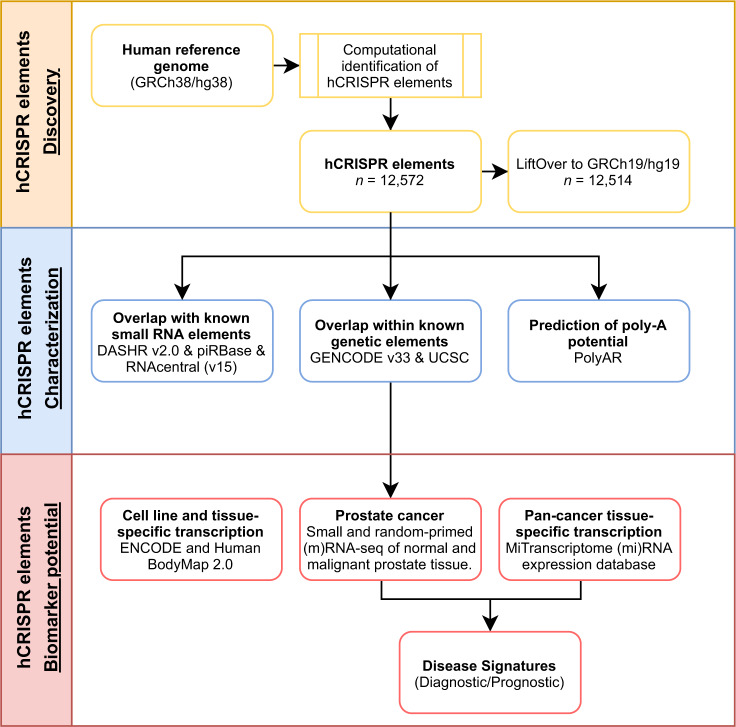
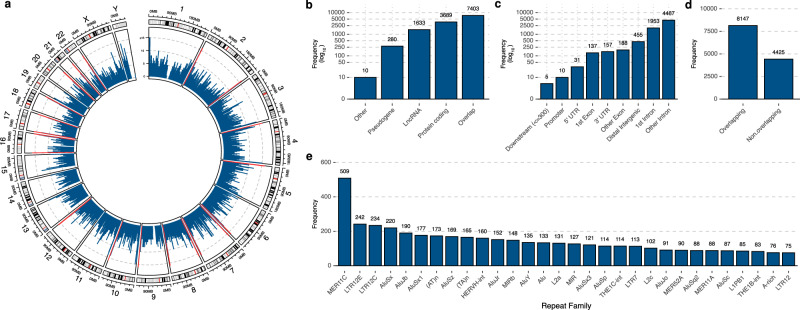
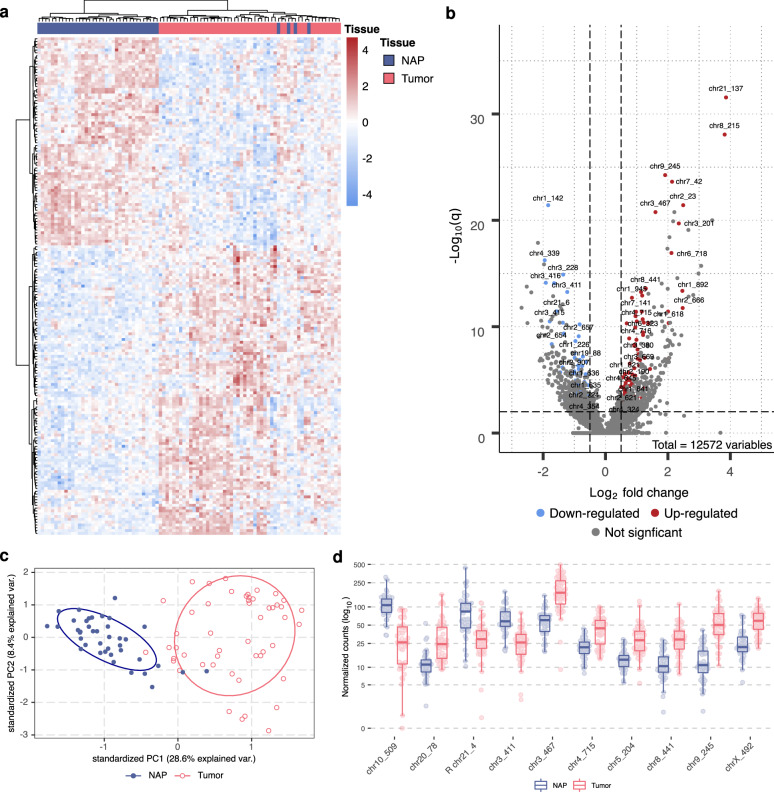
Clustered Regularly Interspaced Short Palindromic Repeats (CRISPRs) have been identified in bacteria, archaea and mitochondria of plants, but not in eukaryotes. Here, we report the discovery of 12,572 putative CRISPRs randomly distributed across the human chromosomes, which we termed hCRISPRs. By using available transcriptome datasets, we demonstrate that hCRISPRs are distinctively expressed as small non-coding RNAs (sncRNAs) in cell lines and human tissues. Moreover, expression patterns thereof enabled us to distinguish normal from malignant tissues. In prostate cancer, we confirmed the differential hCRISPR expression between normal adjacent and malignant primary prostate tissue by RT-qPCR and demonstrate that the SHERLOCK and DETECTR dipstick tools are suitable to detect these sncRNAs. We anticipate that the discovery of CRISPRs in the human genome can be further exploited for diagnostic purposes in cancer and other medical conditions, which certainly will lead to the development of point-of-care tests based on the differential expression of the hCRISPRs.
已在细菌、古菌和植物的线粒体中鉴定出了成簇的规律间隔的短回文重复序列(CRISPRs),但在真核生物中尚未发现。在这里,我们报告了在人类染色体上随机分布的 12572 个推定的 CRISPR 的发现,我们将其称为 hCRISPR。通过使用现有的转录组数据集,我们证明 hCRISPR 作为细胞系和人体组织中的小非编码 RNA(sncRNA)表现出明显的表达。此外,它们的表达模式使我们能够区分正常组织和恶性组织。在前列腺癌中,我们通过 RT-qPCR 证实了正常相邻和恶性原发性前列腺组织之间 hCRISPR 的差异表达,并证明 SHERLOCK 和 DETECTR 棒式工具适合检测这些 sncRNA。我们预计,人类基因组中 CRISPR 的发现可以进一步用于癌症和其他医疗条件的诊断目的,这肯定会导致基于 hCRISPR 差异表达的即时检测的发展。