Department of Microbiology and Immunology, School of Medicine, Kashan University of Medical Sciences, Kashan, Iran.
Student Research Committee, Sabzevar University of Medical Sciences, Sabzevar, Iran.
J Clin Lab Anal. 2022 May;36(5):e24402. doi: 10.1002/jcla.24402. Epub 2022 Apr 8.
Interest revolving around coronavirus disease 2019 (COVID-19) reinfection is escalating rapidly. By definition, reinfection denotes severe acute respiratory syndrome coronavirus 2 (SARS-CoV-2), PCR redetection, and COVID-19 recurrence within three months of the initial symptoms. The main aim of the current systematic review was to evaluate the features of COVID-19 relapse patients.
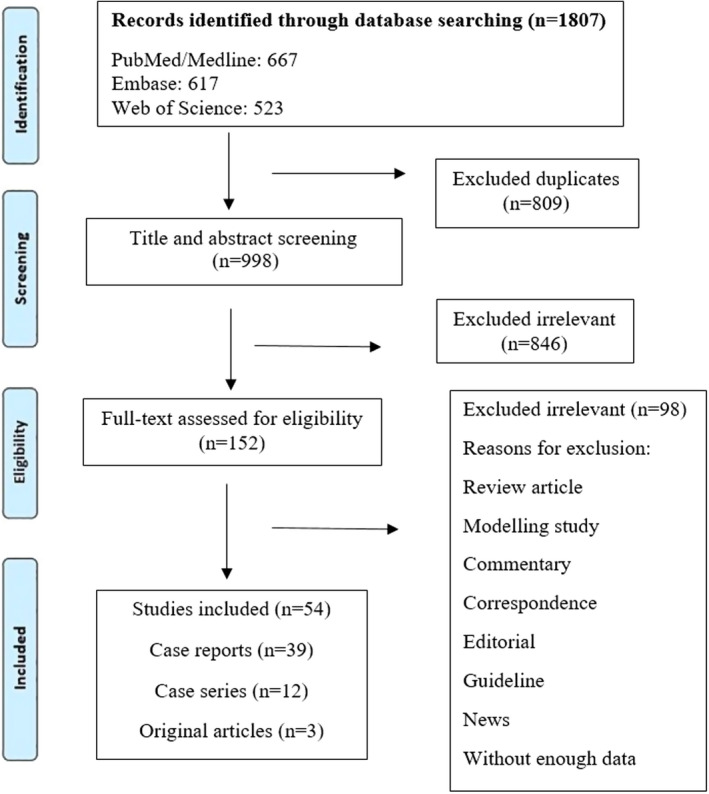
For this study, we used a string of terms developed by a skilled librarian and through a systematical search in PubMed, Web of Science, and Embase for eligible studies. Clinical surveys of any type were included from January 2019 to March 2021. Eligible studies consisted of two positive assessments separated by a negative result via RT-PCR.
Fifty-four studies included 207 cases of COVID-19 reinfection. Children were less likely to have COVID-19 relapse. However, the most patients were in the age group of 20-40 years. Asthenia (66.6%), headache (66.6%), and cough (54.7%) were prevalent symptoms in the first SARS-CoV-2 infection. Asthenia (62.9%), myalgia (62.9%), and headache (61.1%) were most frequent in the second one. The most common treatment options used in first COVID-19 infection were lopinavir/ritonavir (80%), oxygen support (69.2%), and oseltamivir (66.6). However, for the treatment of second infection, mostly antibiotics (100%), dexamethasone (100%), and remdesivir (80%) were used. In addition, obesity (32.5%), kidney failure (30.7%), and hypertension (30.1%) were the most common comorbidities. Unfortunately, approximately 4.5% of patients died.
We found the potency of COVID-19 recurrence as an outstanding issue. This feature should be regarded in the COVID-19 management. Furthermore, the first and second COVID-19 are similar in clinical features. For clinically practical comparison of the symptoms severity between two epochs of infection, uniform data of both are required. We suggest that future studies undertake a homogenous approach to establish the clinical patterns of the reinfection phenomena.
人们对 2019 年冠状病毒病(COVID-19)再感染的兴趣正在迅速升温。根据定义,再感染是指在初始症状出现三个月内,严重急性呼吸综合征冠状病毒 2(SARS-CoV-2)、PCR 再次检测和 COVID-19 复发。本系统评价的主要目的是评估 COVID-19 复发患者的特征。
为了进行这项研究,我们使用了一位熟练的图书管理员开发的词串,并在 PubMed、Web of Science 和 Embase 中进行了系统搜索,以获取合格的研究。纳入的研究类型包括 2019 年 1 月至 2021 年 3 月期间通过 RT-PCR 进行的两次阳性评估。
54 项研究共纳入 207 例 COVID-19 再感染病例。儿童不太可能出现 COVID-19 复发。然而,大多数患者年龄在 20-40 岁之间。乏力(66.6%)、头痛(66.6%)和咳嗽(54.7%)是首次 SARS-CoV-2 感染的常见症状。乏力(62.9%)、肌痛(62.9%)和头痛(61.1%)是第二次感染最常见的症状。首次 COVID-19 感染最常用的治疗方法是洛匹那韦/利托那韦(80%)、氧支持(69.2%)和奥司他韦(66.6%)。然而,对于第二次感染的治疗,主要使用抗生素(100%)、地塞米松(100%)和瑞德西韦(80%)。此外,肥胖(32.5%)、肾衰竭(30.7%)和高血压(30.1%)是最常见的合并症。不幸的是,大约有 4.5%的患者死亡。
我们发现 COVID-19 复发是一个突出的问题。在 COVID-19 管理中应考虑到这一特征。此外,首次和第二次 COVID-19 在临床特征上相似。为了对两次感染期间症状严重程度进行临床比较,需要统一的数据。我们建议未来的研究采用统一的方法来建立再感染现象的临床模式。