Sleep Research Group, Charles Perkins Centre and Northern Clinical School, Faculty of Medicine and Health, The University of Sydney, Sydney, Australia.
Department of Respiratory and Sleep Medicine, Centre for Sleep Health & Research, Level 8, Acute Services Building, Royal North Shore Hospital, St Leonards, NSW, 2065, Australia.
J Interv Card Electrophysiol. 2023 Jun;66(4):873-883. doi: 10.1007/s10840-022-01202-3. Epub 2022 Apr 9.
The autonomic nervous system may mediate acute apnoea-induced atrial fibrillation (AF). We compared cardiac autonomic function in paroxysmal atrial fibrillation (PAF) patients with and without obstructive sleep apnoea (OSA).
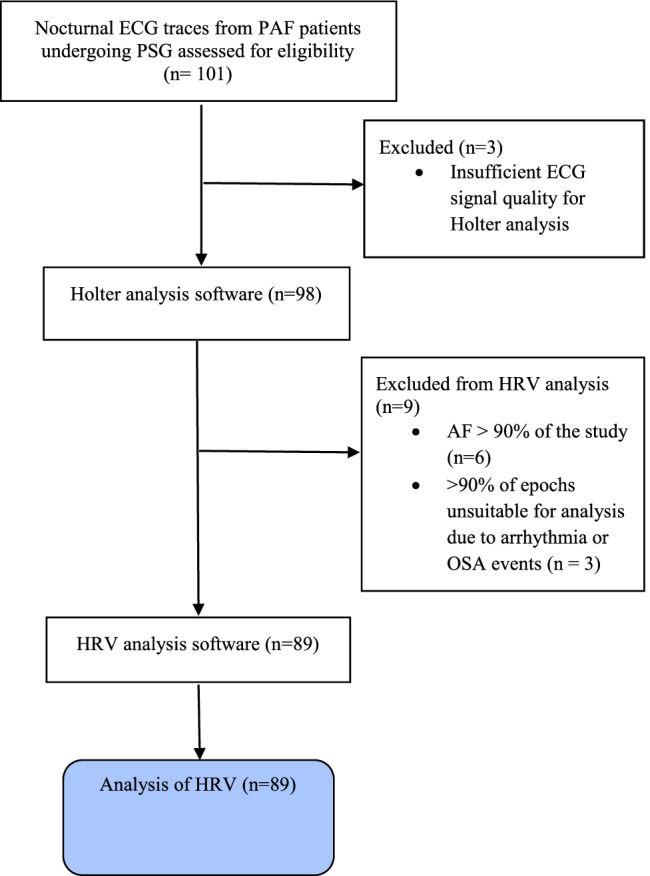
Case control study of 101 patients with PAF recruited at two tertiary centres. All patients underwent in-laboratory polysomnography. ECG signal demonstrating "steady state" sinus rhythm (i.e. with arrhythmic beats and respiratory events excluded) was included in the analysis. Cardiac autonomic function was assessed via measures of heart rate variability (HRV) and reported by sleep stage (REM vs Non-REM) for patients with and without OSA.
Sixty-five (66.3%) of patients were male, mean age 61.5 ± 11.6 years, mean BMI 27.1 ± 4.3 kg/m. Global measures of HRV (triangular index, total power) did not differ between PAF patients with and without OSA in either REM or non-REM sleep. Frequency-domain analysis during non-REM sleep in PAF patients with OSA showed increased cardiac parasympathetic modulation (HF-nu: 39.1 ± 15.7 vs 48.0 ± 14.6, p = 0.008) and reduced cardiac sympathetic modulation (LF-nu 54.1 ± 19.7 vs 43.7 ± 18.0, p = 0.012, LF/HF ratio: 2.1 ± 2.0 vs 1.2 ± 1.0, p = 0.007). Results remained significant after adjusting for age, sex, and BMI (adjusted p values 0.024, 0.045 and 0.018 respectively). There were no differences in HRV parameters during REM sleep.
This is the first study of HRV in PAF patients with and without OSA. Our results indicate limited differences in HRV between groups. However, this work suggests a chronic increase in parasympathetic nervous modulation and relative reduction in sympathetic modulation in PAF patients with OSA during steady-state non-REM sleep.
自主神经系统可能介导急性呼吸暂停引起的心房颤动(房颤)。我们比较了阵发性房颤(PAF)患者伴阻塞性睡眠呼吸暂停(OSA)和不伴 OSA 患者的心脏自主神经功能。
在两个三级中心招募了 101 名 PAF 患者的病例对照研究。所有患者均接受了实验室多导睡眠图检查。分析中纳入了心电图信号显示“稳态”窦性节律(即排除心律失常和呼吸事件)。通过心率变异性(HRV)的测量来评估心脏自主神经功能,并按是否存在 OSA 报告患者的睡眠阶段(REM 与非 REM)。
65 例(66.3%)患者为男性,平均年龄 61.5±11.6 岁,平均 BMI 27.1±4.3kg/m。在 REM 和非 REM 睡眠中,伴有或不伴有 OSA 的 PAF 患者的 HRV 整体测量(三角指数,总功率)无差异。伴有 OSA 的 PAF 患者在非 REM 睡眠期间的频域分析显示,心脏副交感神经调节增加(HF-nu:39.1±15.7 比 48.0±14.6,p=0.008),心脏交感神经调节减少(LF-nu:54.1±19.7 比 43.7±18.0,p=0.012,LF/HF 比值:2.1±2.0 比 1.2±1.0,p=0.007)。校正年龄、性别和 BMI 后,结果仍然显著(校正后 p 值分别为 0.024、0.045 和 0.018)。在 REM 睡眠期间,HRV 参数无差异。
这是 PAF 患者伴或不伴 OSA 的 HRV 研究的首次报道。我们的研究结果表明两组之间 HRV 差异有限。然而,这项工作表明,在稳态非 REM 睡眠中,伴有 OSA 的 PAF 患者的副交感神经调节持续增加,交感神经调节相对减少。