Oancea Alexandru Florinel, Jigoranu Raul Alexandru, Morariu Paula Cristina, Miftode Radu-Stefan, Trandabat Bogdan Andrei, Iov Diana Elena, Cojocaru Elena, Costache Irina Iuliana, Baroi Livia Genoveva, Timofte Daniel Vasile, Tanase Daniela Maria, Floria Mariana
Department of Internal Medicine, Faculty of Medicine, University of Medicine and Pharmacy Grigore T. Popa, 700115 Iasi, Romania.
Cardiology Clinic, St. Spiridon Emergency Hospital, 700115 Iasi, Romania.
Life (Basel). 2023 Jun 12;13(6):1370. doi: 10.3390/life13061370.
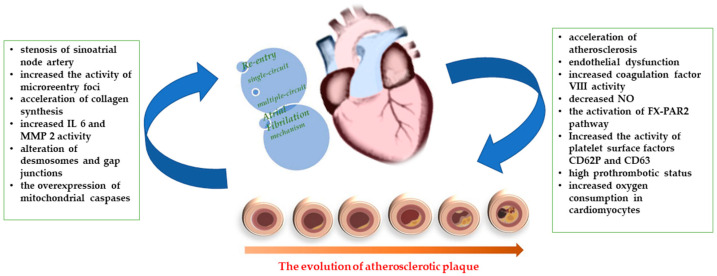
Atrial fibrillation, the most frequent arrhythmia in clinical practice and chronic coronary syndrome, is one of the forms of coronary ischemia to have a strong dual relationship. Atrial fibrillation may accelerate atherosclerosis and may increase oxygen consumption in the myocardium, creating a mismatch between supply and demand, thus promoting the development or worsening of coronary ischemia. Chronic coronary syndrome alters the structure and function of gap junction proteins, affecting the conduction of action potential and leading to ischemic necrosis of cardiomyocytes and their replacement with fibrous tissue, in this way sustaining the focal ectopic activity in atrial myocardium. They have many risk factors in common, such as hypertension, obesity, type 2 diabetes mellitus, and dyslipidemia. It is vital for the prognosis of patients to break this vicious circle by controlling risk factors, drug therapies, of which antithrombotic therapy may sometimes be challenging in terms of prothrombotic and bleeding risk, and interventional therapies (revascularization and catheter ablation).
心房颤动是临床实践中最常见的心律失常,与慢性冠状动脉综合征一样,是具有强烈双重关系的冠状动脉缺血形式之一。心房颤动可能会加速动脉粥样硬化,并可能增加心肌的氧消耗,造成供需不匹配,从而促进冠状动脉缺血的发展或恶化。慢性冠状动脉综合征会改变缝隙连接蛋白的结构和功能,影响动作电位的传导,导致心肌细胞缺血坏死并被纤维组织替代,从而维持心房肌的局灶性异位活动。它们有许多共同的危险因素,如高血压、肥胖、2型糖尿病和血脂异常。通过控制危险因素、药物治疗(其中抗血栓治疗在血栓形成和出血风险方面有时可能具有挑战性)以及介入治疗(血运重建和导管消融)来打破这种恶性循环对患者的预后至关重要。