The National Research Centre for the Working Environment, 105 Lersø Parkallé, DK-2100, Copenhagen, Denmark.
BMC Public Health. 2022 Apr 9;22(1):697. doi: 10.1186/s12889-022-13105-z.
The cost of mental ill health in the EU-28 nations has been estimated at approximately 4.1% of the total gross domestic products (GDP). Improved rates of return to sustainable employment among people who are sick-listed due to mental ill health would decrease spending on welfare benefits. The present cohort study provides statistical information that may be helpful in the design and prioritizing of efforts aimed at reducing the burden of sickness absence due to mental ill health among employees in the general working population of Denmark. Our primary aim was to estimate odds of being i) deceased or recipient of health related welfare benefits and ii) recipient non-health related welfare benefits, compared to being alive and self-reliant at 1, 3 and 5 years after first visit to a jobs and benefits office due to mental health related sickness absence, as a function of industrial sector and job group skill level at baseline. A secondary aim was to analyze these odds as a function of baseline age, gender, type of mental ill health, family type and employment status.
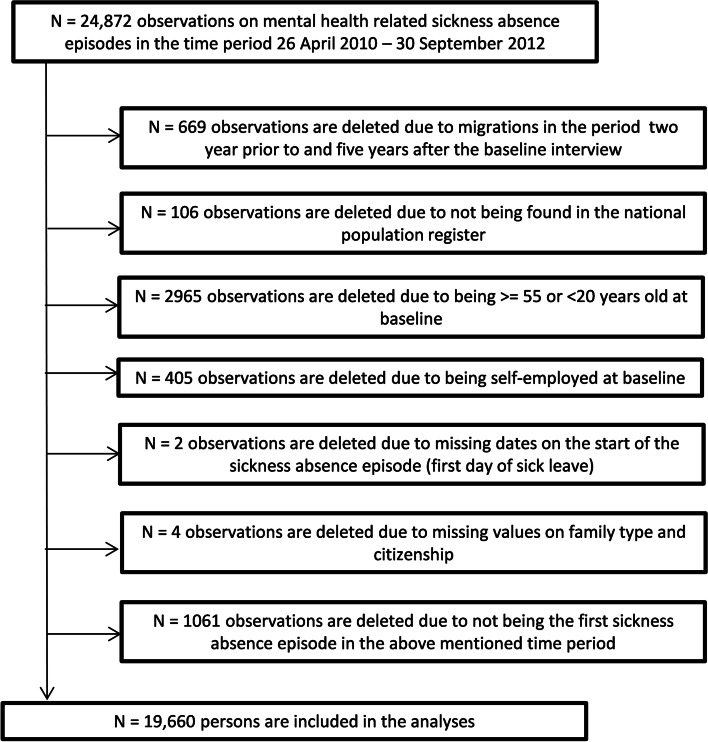
The study population consisted of 20-54 year-old persons on long-term sickness absence due to mental health problems in 21 Danish municipalities in 2010-2012 (N = 19,660). Odds ratios were estimated by use of multinomial logistic regression. The outcomes were ascertained through national registers.
We did not find any statistically significant association between baseline industrial sector or job group skill level and welfare dependency at follow-up. In the secondary analyses, the estimated odds of health and non-health related welfare dependencies at follow-up tended to increase with unemployment, age, being single and being on sick leave due to self-reported anxiety or depression versus stress/burnout at baseline.
The present study does not support that industry and job group skill level predict welfare dependency after health related sickness absence, after adjustment for relevant covariates, in the general population of Denmark. It suggests, however, that the vulnerability lies in population groups characterized by unemployment, older age, being single and being on sick leave due to self-reported anxiety or depression versus stress/burnout.
欧盟 28 个国家的精神健康不良成本约占国内生产总值(GDP)的 4.1%。改善因精神健康不良而请病假的人的可持续就业回报率将减少福利支出。本队列研究提供了统计信息,这些信息可能有助于设计和优先考虑努力,以减少丹麦普通工作人口中因精神健康不良而导致的病假负担。我们的主要目的是估计在因精神健康相关疾病缺勤首次前往工作和福利办公室后 1、3 和 5 年内,与存活且自理相比,处于以下状态的可能性:i)死亡或接受与健康相关的福利,ii)接受非健康相关的福利,这是一个功能的工业部门和工作小组技能水平在基线。次要目的是分析这些可能性作为基线年龄、性别、精神健康状况类型、家庭类型和就业状况的函数。
研究人群包括 2010-2012 年丹麦 21 个市因精神健康问题长期请病假的 20-54 岁人群(N=19660)。使用多项逻辑回归估计优势比。结果通过国家登记册确定。
我们没有发现基线工业部门或工作小组技能水平与随访时的福利依赖之间存在任何统计学显著关联。在二次分析中,与因压力/倦怠相比,基线时失业、年龄较大、单身和因自我报告的焦虑或抑郁而请病假,与健康和非健康相关的福利依赖的估计几率往往更高。
本研究表明,在调整了相关协变量后,丹麦普通人群中,因健康相关疾病缺勤后,行业和工作小组技能水平并不预示着福利依赖,然而,脆弱性在于失业、年龄较大、单身和因自我报告的焦虑或抑郁而请病假的人群。