
组装伴侣蛋白 Pba1 和 Pba2 对蛋白酶体门控调节的机制。
Mechanism of proteasome gate modulation by assembly chaperones Pba1 and Pba2.
机构信息
Department of Pathology, Harvard Medical School and Brigham and Women's Hospital, Boston, Massachusetts, USA.
Harvard Cryo-Electron Microscopy Center for Structural Biology, Harvard Medical School, Boston, Massachusetts, USA; Department of Biological Chemistry and Molecular Pharmacology, Blavatnik Institute, Harvard Medical School, Boston, Massachusetts, USA.
出版信息
J Biol Chem. 2022 May;298(5):101906. doi: 10.1016/j.jbc.2022.101906. Epub 2022 Apr 6.
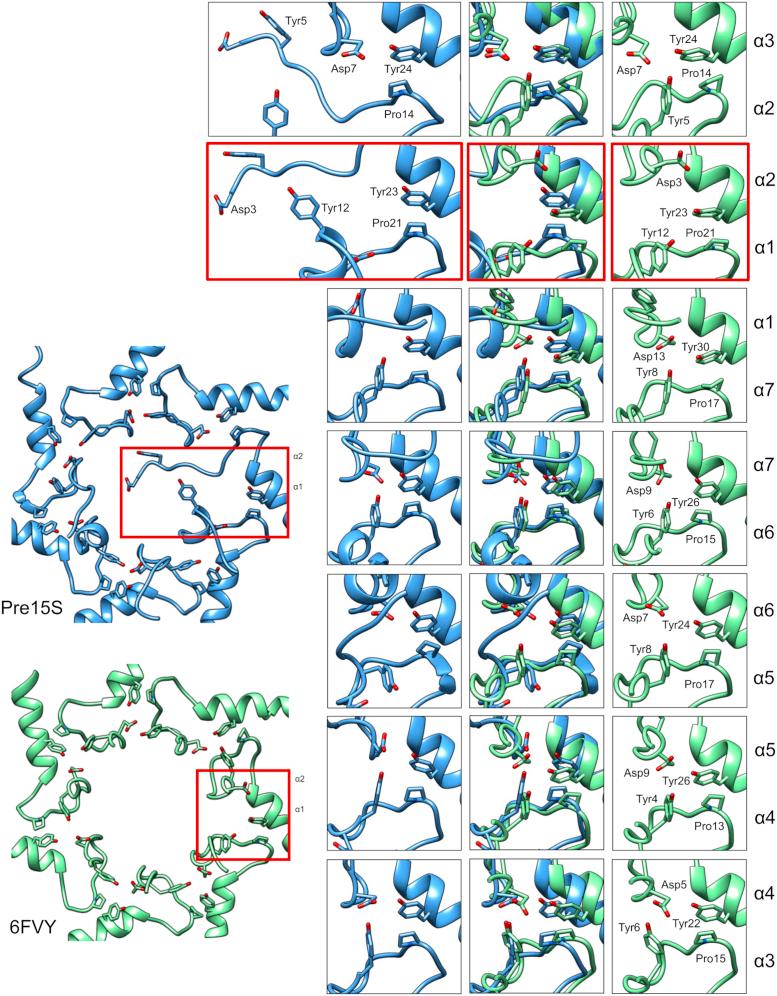
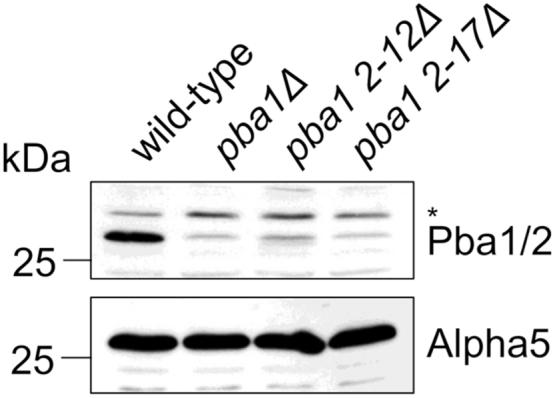
The active sites of the proteasome are housed within its central core particle (CP), a barrel-shaped chamber of four stacked heptameric rings, and access of substrates to the CP interior is mediated by gates at either axial end. These gates are constitutively closed and may be opened by the regulatory particle (RP), which binds the CP and facilitates substrate degradation. We recently showed that the heterodimeric CP assembly chaperones Pba1/2 also mediate gate opening through an unexpected structural arrangement that facilitates the insertion of the N terminus of Pba1 into the CP interior; however, the full mechanism of Pba1/2-mediated gate opening is unclear. Here, we report a detailed analysis of CP gate modulation by Pba1/2. The clustering of key residues at the interface between neighboring α-subunits is a critical feature of RP-mediated gate opening, and we find that Pba1/2 recapitulate this strategy. Unlike RP, which inserts at six α-subunit interfaces, Pba1/2 insert at only two α-subunit interfaces. Nevertheless, Pba1/2 are able to regulate six of the seven interfacial clusters, largely through direct interactions. The N terminus of Pba1 also physically interacts with the center of the gate, disrupting the intersubunit contacts that maintain the closed state. This novel mechanism of gate modulation appears to be unique to Pba1/2 and therefore likely occurs only during proteasome assembly. Our data suggest that release of Pba1/2 at the conclusion of assembly is what allows the nascent CP to assume its mature gate conformation, which is primarily closed, until activated by RP.
蛋白酶体的活性部位位于其中心核心颗粒 (CP) 内,CP 是一个由四个堆叠的七聚体环组成的桶形腔室,底物进入 CP 内部是由两端的门控来介导的。这些门是默认关闭的,可以被调节颗粒 (RP) 打开,RP 与 CP 结合并促进底物降解。我们最近表明,异源二聚体 CP 组装伴侣 Pba1/2 也通过一种意想不到的结构排列来介导门的打开,这种结构排列促进了 Pba1 的 N 端插入 CP 内部;然而,Pba1/2 介导的门打开的完整机制尚不清楚。在这里,我们报告了对 Pba1/2 调节 CP 门的详细分析。相邻 α 亚基之间界面上关键残基的聚集是 RP 介导的门打开的一个关键特征,我们发现 Pba1/2 再现了这一策略。与插入六个 α 亚基界面的 RP 不同,Pba1/2 仅插入两个 α 亚基界面。然而,Pba1/2 能够调节七个界面簇中的六个,主要通过直接相互作用。Pba1 的 N 端还与门的中心发生物理相互作用,破坏了维持关闭状态的亚基间接触。这种门调节的新机制似乎是 Pba1/2 所特有的,因此可能只在蛋白酶体组装过程中发生。我们的数据表明,组装完成时 Pba1/2 的释放允许新生的 CP 采用其成熟的门构象,该构象主要是关闭的,直到被 RP 激活。




 Zotero 插件