Perkins Edward J, Woolard E Alice, Garcia-Reyero Natàlia
Environmental Laboratory, US Army Engineering Research and Development Center, Vicksburg, MS, United States.
UNC School of Medicine, University of North Carolina Chapel Hill, Chapel Hill, NC, United States.
Front Toxicol. 2022 Mar 24;4:786057. doi: 10.3389/ftox.2022.786057. eCollection 2022.
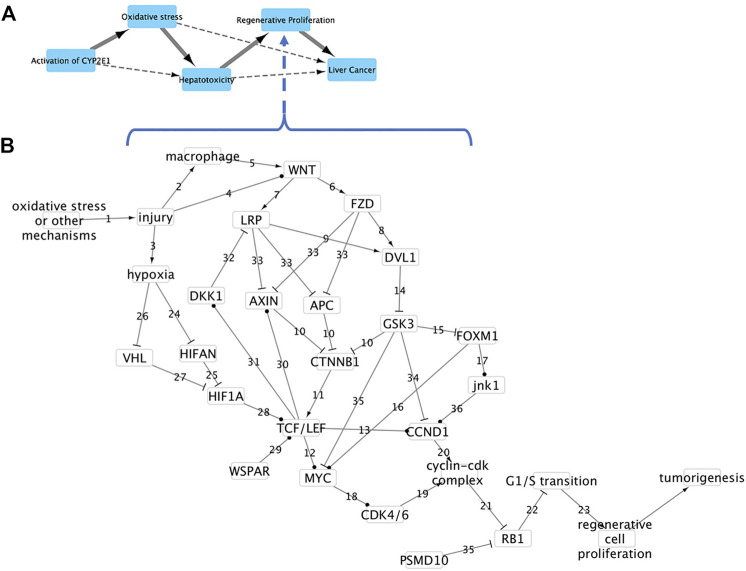
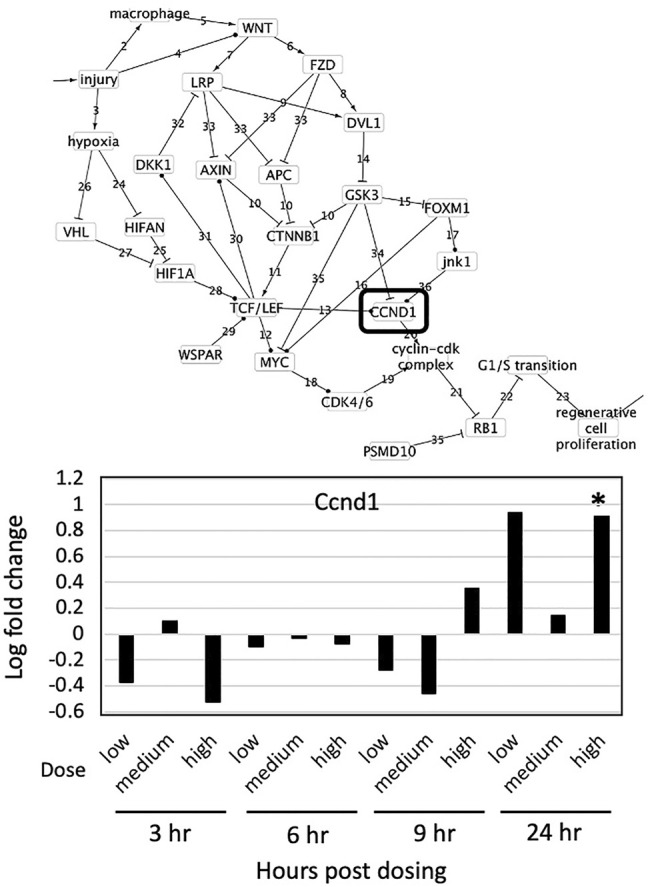
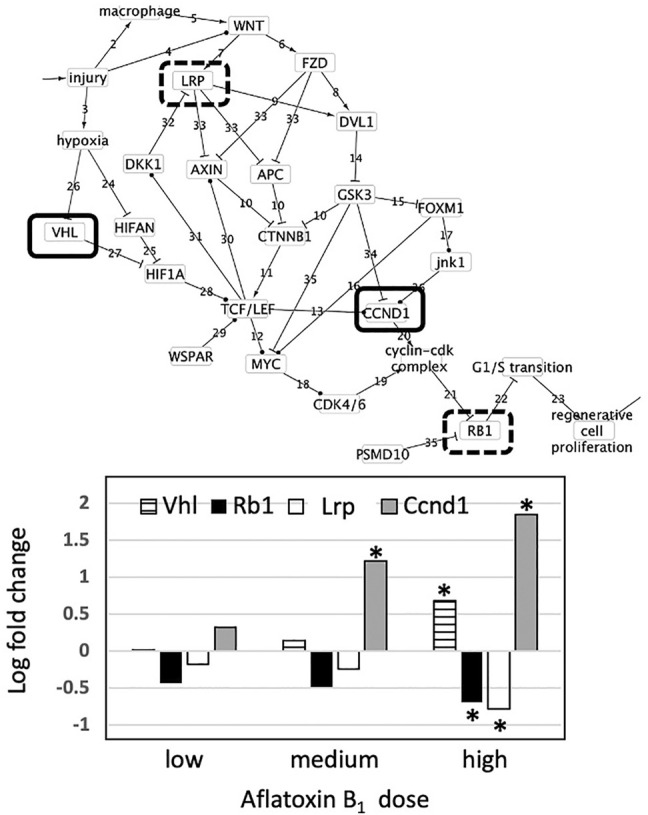
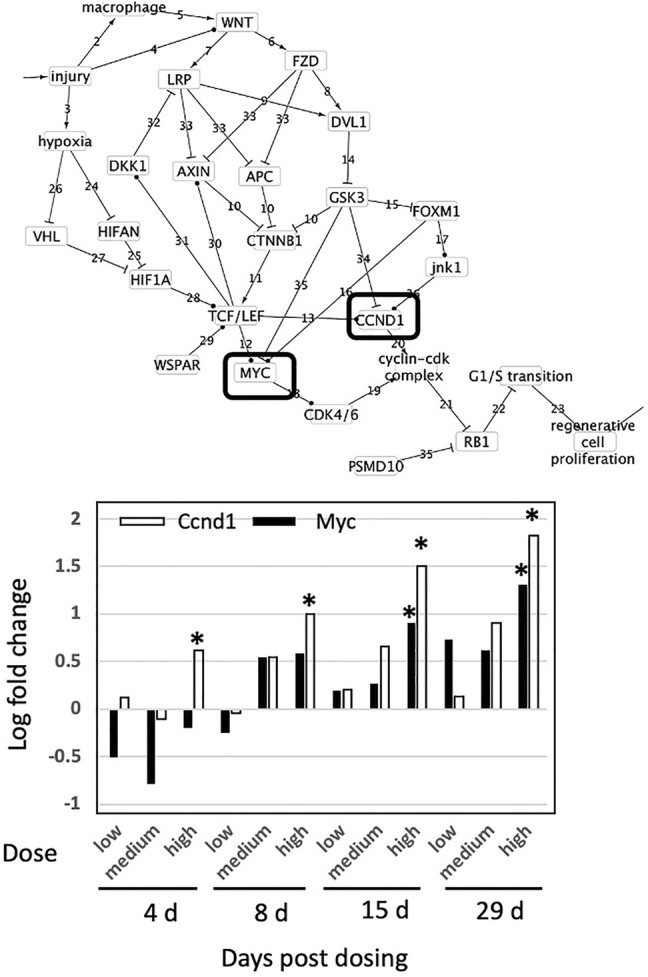
Several approaches have been used in an attempt to simplify and codify the events that lead to adverse effects of chemicals including systems biology, 'omics, assays and frameworks such as the Adverse Outcome Pathway (AOP). However, these approaches are generally not integrated despite their complementary nature. Here we propose to integrate toxicogenomics data, systems biology information and AOPs using causal biological networks to define Key Events in AOPs. We demonstrate this by developing a causal subnetwork of 28 nodes that represents the Key Event of regenerative proliferation - a critical event in AOPs for liver cancer. We then assessed the effects of three chemicals known to cause liver injury and cell proliferation (carbon tetrachloride, aflatoxin B, thioacetamide) and two with no known cell proliferation effects (diazepam, simvastatin) on the subnetwork using rat liver gene expression data from the toxicogenomic database Open TG-GATEs. Cyclin D1 (Ccnd1), a gene both causally linked to and sufficient to infer regenerative proliferation activity, was overexpressed after exposures to carbon tetrachloride, aflatoxin B and thioacetamide, but not in exposures to diazepam and simvastatin. These results were consistent with known effects on rat livers and liver pathology of exposed rats. Using these approaches, we demonstrate that transcriptomics, AOPs and systems biology can be applied to examine the presence and progression of AOPs in order to better understand the hazards of chemical exposure.
为了简化和编纂导致化学物质产生不良反应的事件,人们采用了多种方法,包括系统生物学、“组学”、检测方法以及诸如不良结局途径(AOP)等框架。然而,尽管这些方法具有互补性,但它们通常并未整合起来。在此,我们提议利用因果生物网络整合毒理基因组学数据、系统生物学信息和AOPs,以定义AOPs中的关键事件。我们通过构建一个由28个节点组成的因果子网来证明这一点,该子网代表再生性增殖这一关键事件——这是肝癌AOPs中的一个关键事件。然后,我们利用来自毒理基因组数据库Open TG-GATEs的大鼠肝脏基因表达数据,评估了三种已知会导致肝损伤和细胞增殖的化学物质(四氯化碳、黄曲霉毒素B、硫代乙酰胺)以及两种已知无细胞增殖作用的化学物质(地西泮、辛伐他汀)对该子网的影响。细胞周期蛋白D1(Ccnd1)是一个与再生性增殖活动因果相关且足以推断其活性的基因,在暴露于四氯化碳、黄曲霉毒素B和硫代乙酰胺后其表达上调,但在暴露于地西泮和辛伐他汀后则没有。这些结果与已知的对大鼠肝脏以及暴露大鼠肝脏病理学的影响一致。通过这些方法,我们证明了转录组学、AOPs和系统生物学可用于检查AOPs的存在和进展情况,以便更好地理解化学物质暴露的危害。