Ren Xiuying, Lin Zhi, Yuan Wensu
School of Life Sciences, Tianjin University, Tianjin, China.
Front Pharmacol. 2022 Mar 24;13:836614. doi: 10.3389/fphar.2022.836614. eCollection 2022.
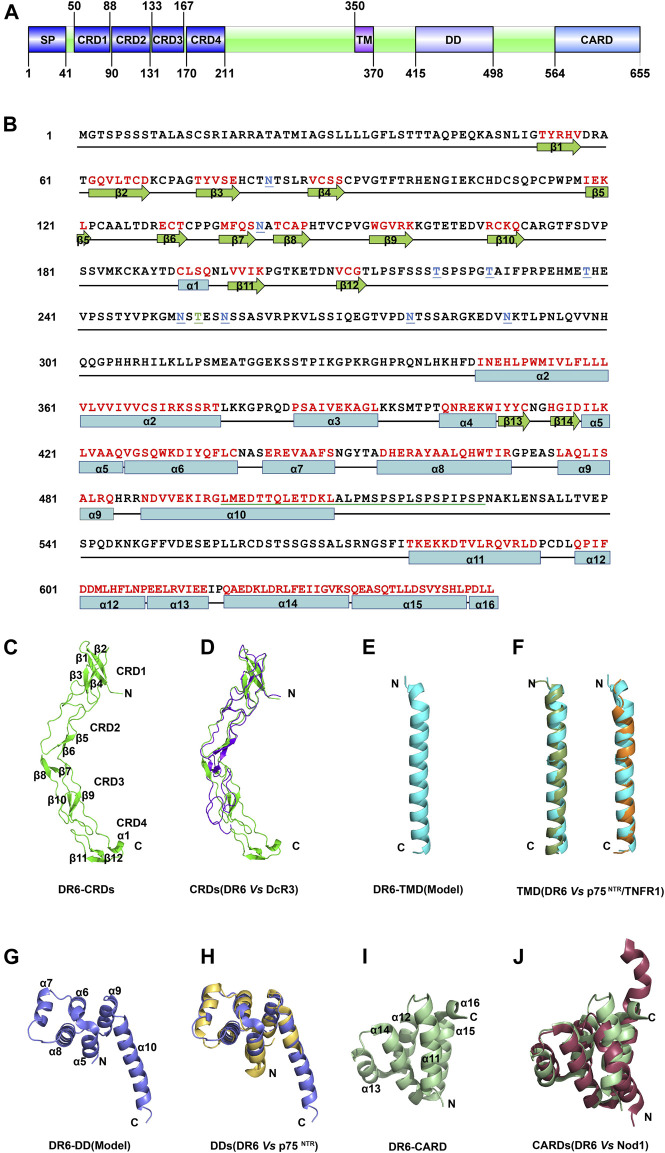
As a member of the tumor necrosis factor receptor superfamily (TNFRSF), death receptor 6 (DR6) has a similar structural architecture to other family members. The extracellular region of DR6 contains four cysteine-rich domains, followed by a single-pass transmembrane domain and an intracellular region. Since its discovery, DR6 has become an orphan receptor ubiquitously expressed to transduce unique signaling pathways. Although the free ectodomains of β-amyloid precursor protein (APP) can bind to DR6 to induce apoptotic signals, the natural ligands of DR6 still remain largely unknown. In this review, we focus on recent research progress of structural and functional studies on DR6 for better understanding DR6-mediated signaling and the treatment of DR6-related diseases.
作为肿瘤坏死因子受体超家族(TNFRSF)的成员,死亡受体6(DR6)具有与其他家族成员相似的结构架构。DR6的细胞外区域包含四个富含半胱氨酸的结构域,随后是一个单次跨膜结构域和一个细胞内区域。自发现以来,DR6已成为一种普遍表达的孤儿受体,可转导独特的信号通路。尽管β-淀粉样前体蛋白(APP)的游离胞外域可与DR6结合以诱导凋亡信号,但DR6的天然配体在很大程度上仍然未知。在本综述中,我们重点关注DR6结构和功能研究的最新进展,以便更好地理解DR6介导的信号传导以及DR6相关疾病的治疗。