Verschoor Jo-Anne, Kusumawardhani Hadiastri, Ram Arthur F J, de Winde Johannes H
Molecular Biotechnology, Institute of Biology, Leiden University, Leiden, Netherlands.
Department of Fundamental Microbiology, University of Lausanne, Lausanne, Switzerland.
Front Microbiol. 2022 Mar 23;13:821629. doi: 10.3389/fmicb.2022.821629. eCollection 2022.
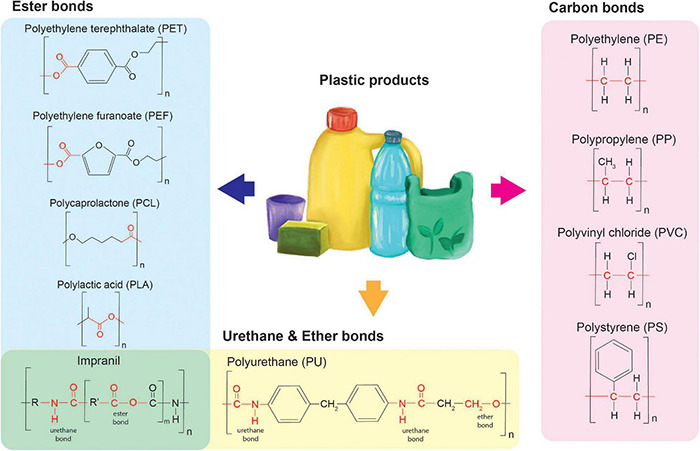
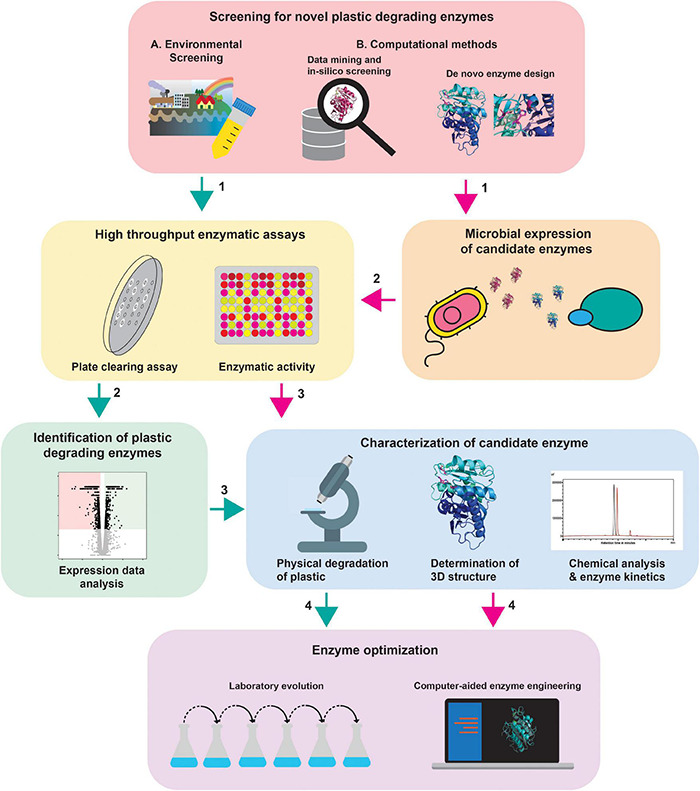
Annually, 400 Mt of plastics are produced of which roughly 40% is discarded within a year. Current plastic waste management approaches focus on applying physical, thermal, and chemical treatments of plastic polymers. However, these methods have severe limitations leading to the loss of valuable materials and resources. Another major drawback is the rapid accumulation of plastics into the environment causing one of the biggest environmental threats of the twenty-first century. Therefore, to complement current plastic management approaches novel routes toward plastic degradation and upcycling need to be developed. Enzymatic degradation and conversion of plastics present a promising approach toward sustainable recycling of plastics and plastics building blocks. However, the quest for novel enzymes that efficiently operate in cost-effective, large-scale plastics degradation poses many challenges. To date, a wide range of experimental set-ups has been reported, in many cases lacking a detailed investigation of microbial species exhibiting plastics degrading properties as well as of their corresponding plastics degrading enzymes. The apparent lack of consistent approaches compromises the necessary discovery of a wide range of novel enzymes. In this review, we discuss prospects and possibilities for efficient enzymatic degradation, recycling, and upcycling of plastics, in correlation with their wide diversity and broad utilization. Current methods for the identification and optimization of plastics degrading enzymes are compared and discussed. We present a framework for a standardized workflow, allowing transparent discovery and optimization of novel enzymes for efficient and sustainable plastics degradation in the future.
每年生产40亿吨塑料,其中约40%在一年内被丢弃。目前的塑料废物管理方法侧重于对塑料聚合物进行物理、热和化学处理。然而,这些方法存在严重局限性,导致宝贵材料和资源的流失。另一个主要缺点是塑料在环境中的迅速积累,这成为21世纪最大的环境威胁之一。因此,为了补充当前的塑料管理方法,需要开发新的塑料降解和升级回收途径。塑料的酶促降解和转化为塑料的可持续回收利用和塑料构建块提供了一种有前景的方法。然而,寻找能够在具有成本效益的大规模塑料降解中有效发挥作用的新型酶面临许多挑战。迄今为止,已经报道了广泛的实验装置,在许多情况下,缺乏对表现出塑料降解特性的微生物物种及其相应的塑料降解酶进行详细研究。明显缺乏一致的方法阻碍了发现大量新型酶的必要进程。在本综述中,我们讨论了塑料高效酶促降解、回收和升级回收的前景和可能性,以及它们的广泛多样性和广泛用途。比较并讨论了目前鉴定和优化塑料降解酶的方法。我们提出了一个标准化工作流程的框架,以便在未来能够透明地发现和优化用于高效和可持续塑料降解的新型酶。