Bellis Emily S, Hashem Ahmed A, Causey Jason L, Runkle Benjamin R K, Moreno-García Beatriz, Burns Brayden W, Green V Steven, Burcham Timothy N, Reba Michele L, Huang Xiuzhen
Department of Computer Science, Arkansas State University, Jonesboro, AR, United States.
Center for No-Boundary Thinking, Arkansas State University, Jonesboro, AR, United States.
Front Plant Sci. 2022 Mar 23;13:716506. doi: 10.3389/fpls.2022.716506. eCollection 2022.
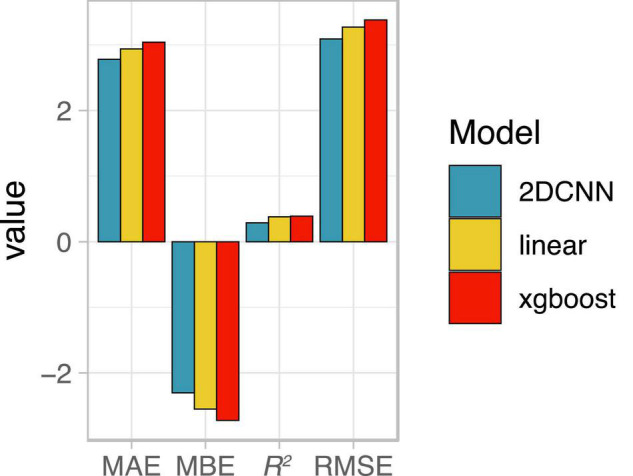
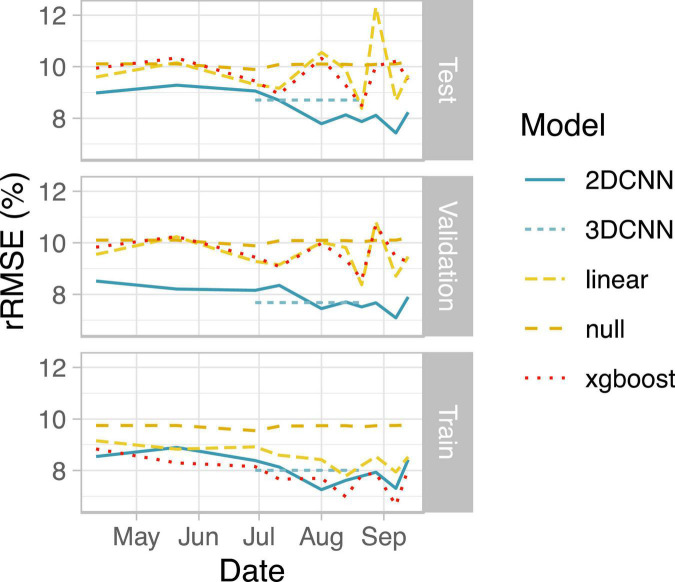
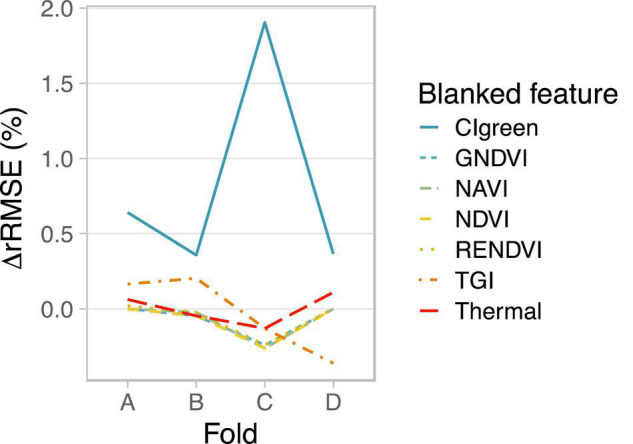
Unmanned aerial vehicles (UAVs) equipped with multispectral sensors offer high spatial and temporal resolution imagery for monitoring crop stress at early stages of development. Analysis of UAV-derived data with advanced machine learning models could improve real-time management in agricultural systems, but guidance for this integration is currently limited. Here we compare two deep learning-based strategies for early warning detection of crop stress, using multitemporal imagery throughout the growing season to predict field-scale yield in irrigated rice in eastern Arkansas. Both deep learning strategies showed improvements upon traditional statistical learning approaches including linear regression and gradient boosted decision trees. First, we explicitly accounted for variation across developmental stages using a 3D convolutional neural network (CNN) architecture that captures both spatial and temporal dimensions of UAV images from multiple time points throughout one growing season. 3D-CNNs achieved low prediction error on the test set, with a Root Mean Squared Error (RMSE) of 8.8% of the mean yield. For the second strategy, a 2D-CNN, we considered only spatial relationships among pixels for image features acquired during a single flyover. 2D-CNNs trained on images from a single day were most accurate when images were taken during booting stage or later, with RMSE ranging from 7.4 to 8.2% of the mean yield. A primary benefit of convolutional autoencoder-like models (based on analyses of prediction maps and feature importance) is the spatial denoising effect that corrects yield predictions for individual pixels based on the values of vegetation index and thermal features for nearby pixels. Our results highlight the promise of convolutional autoencoders for UAV-based yield prediction in rice.
配备多光谱传感器的无人机可提供高空间和时间分辨率的图像,用于监测作物生长早期阶段的胁迫情况。使用先进的机器学习模型分析无人机获取的数据,可改善农业系统中的实时管理,但目前关于这种整合的指导有限。在此,我们比较了两种基于深度学习的作物胁迫预警检测策略,利用整个生长季节的多时相图像来预测阿肯色州东部灌溉水稻的田间尺度产量。两种深度学习策略均比包括线性回归和梯度提升决策树在内的传统统计学习方法有改进。首先,我们使用一种3D卷积神经网络(CNN)架构明确考虑了不同发育阶段的变化,该架构捕捉了一个生长季节中多个时间点的无人机图像的空间和时间维度。3D-CNN在测试集上实现了低预测误差,均方根误差(RMSE)为平均产量的8.8%。对于第二种策略,即2D-CNN,我们仅考虑了单次飞越期间获取的图像特征中像素之间的空间关系。当在孕穗期或更晚拍摄图像时,基于单日图像训练的2D-CNN最为准确,RMSE范围为平均产量的7.4%至8.2%。卷积自动编码器类模型的一个主要优点(基于预测图和特征重要性分析)是空间去噪效果,它根据附近像素的植被指数和热特征值对单个像素的产量预测进行校正。我们的结果突出了卷积自动编码器在基于无人机的水稻产量预测方面的前景。