Borosha Shaon, Ratri Anamika, Ghosh Subhra, Malcom Carrie A, Chakravarthi V Praveen, Vivian Jay L, Fields Timothy A, Rumi M A Karim, Fields Patrick E
Department of Pathology and Laboratory Medicine, University of Kansas Medical Center, Kansas City, KS, United States.
Front Genet. 2022 Mar 23;13:828086. doi: 10.3389/fgene.2022.828086. eCollection 2022.
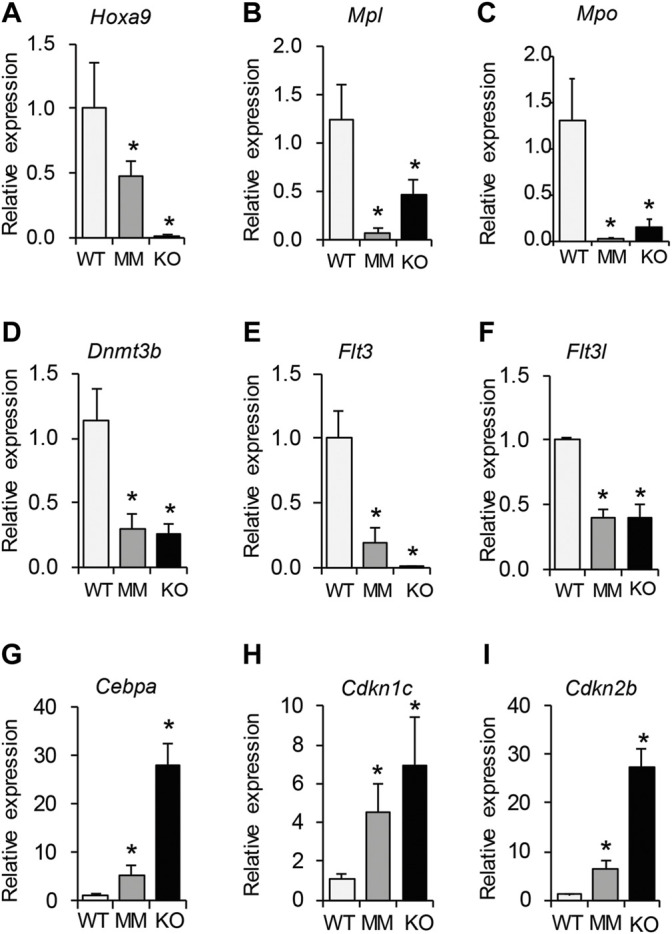
DOT1L is essential for embryonic hematopoiesis but the precise mechanisms of its action remain unclear. The only recognized function of DOT1L is histone H3 lysine 79 (H3K79) methylation, which has been implicated in both transcriptional activation and repression. We observed that deletion of the mouse gene (KO) or selective mutation of its methyltransferase domain (MM) can differentially affect early embryonic erythropoiesis. However, both mutations result in embryonic lethality by mid-gestation and growth of hematopoietic progenitor cells (HPCs) is similarly affected in extensively self-renewing erythroblast (ESRE) cultures established from yolk sac cells. To understand DOT1L-mediated gene regulation and to clarify the role of H3K79 methylation, we analyzed whole transcriptomes of wildtype and -mutant ESRE cells. We observed that more than 80% of the differentially expressed genes (DEGs) were upregulated in the mutant ESRE cells either lacking the DOT1L protein or the DOT1L methyltransferase activity. However, approximately 45% of the DEGs were unique to either mutant group, indicating that DOT1L possesses both methyltransferase-dependent and -independent gene regulatory functions. Analyses of Gene Ontology and signaling pathways for the DEGs were consistent, with DEGs that were found to be common or unique to either mutant group. Genes related to proliferation of HPCs were primarily impacted in KO cells, while genes related to HPC development were affected in the MM cells. A subset of genes related to differentiation of HPCs were affected in both mutant groups of ESREs. Our findings suggest that DOT1L primarily acts to repress gene expression in HPCs, and this function can be independent of its methyltransferase activity.
DOT1L对胚胎造血至关重要,但其具体作用机制仍不清楚。DOT1L唯一被认可的功能是组蛋白H3赖氨酸79(H3K79)甲基化,这与转录激活和抑制均有关。我们观察到,小鼠基因缺失(KO)或其甲基转移酶结构域的选择性突变(MM)可不同程度地影响早期胚胎红细胞生成。然而,两种突变都会导致妊娠中期胚胎致死,并且在从卵黄囊细胞建立的广泛自我更新的成红细胞(ESRE)培养物中,造血祖细胞(HPC)的生长受到类似影响。为了了解DOT1L介导的基因调控并阐明H3K79甲基化的作用,我们分析了野生型和突变型ESRE细胞的全转录组。我们观察到,在缺乏DOT1L蛋白或DOT1L甲基转移酶活性的突变型ESRE细胞中,超过80%的差异表达基因(DEG)上调。然而,约45%的DEG是任一突变组所特有的,这表明DOT1L具有甲基转移酶依赖性和非依赖性基因调控功能。对DEG的基因本体论和信号通路分析是一致的,发现DEG在任一突变组中是常见的或特有的。与HPC增殖相关的基因主要在KO细胞中受到影响,而与HPC发育相关的基因在MM细胞中受到影响。与HPC分化相关的一部分基因在ESRE的两个突变组中均受到影响。我们的研究结果表明,DOT1L主要作用是抑制HPC中的基因表达,并且该功能可以独立于其甲基转移酶活性。