Mendelson Monique, Chacaroun Samarmar, Baillieul Sébastien, Doutreleau Stéphane, Guinot Michel, Wuyam Bernard, Tamisier Renaud, Pépin Jean-Louis, Estève François, Tessier Damien, Vergès Samuel, Flore Patrice
Univ. Grenoble Alpes, Inserm, CHU Grenoble Alpes, HP2, 38000, Grenoble, France.
Inserm - UA07 - Rayonnement Synchrotron pour la Recherche Biomédicale (STROBE) ID17 Installation Européenne du Rayonnement Synchrotron (ESRF), CHU Grenoble Alpes, CLUNI, SCRIMM-Sud, 38000, Grenoble, France.
J Exerc Sci Fit. 2022 Apr;20(2):172-181. doi: 10.1016/j.jesf.2022.03.001. Epub 2022 Mar 19.
Considering the potential greater cardiocirculatory effects of high intensity interval training (HIIT), we hypothesized that a 2-month supervised high volume short interval HIIT would induce greater improvements in CRF and cardiometabolic risk and increase long-term maintenance to physical activity compared to isocaloric moderate intensity continuous training (MICT) in overweight/obesity.
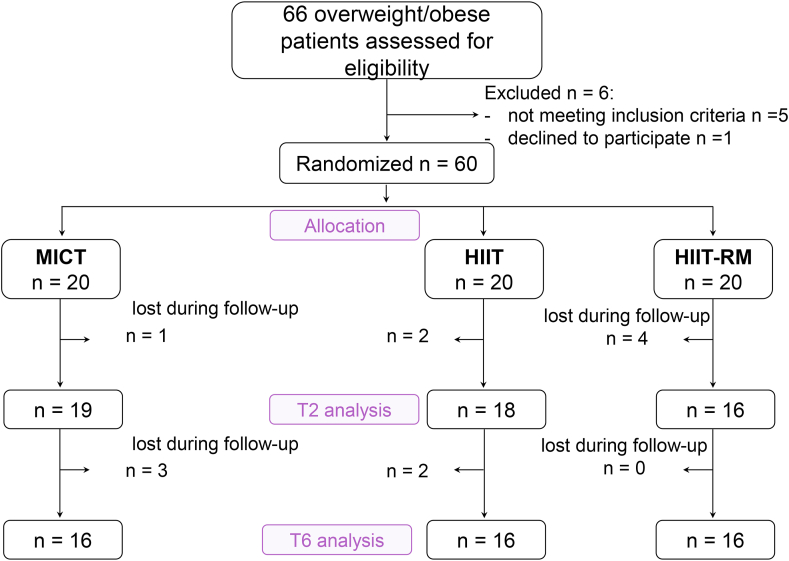
Sixty (19 females) subjects with overweight/obesity were randomized to three training programs (3 times/week for 2 months): MICT (45 min, 50% peak power output-PPO), HIIT (22 × 1-min cycling at 100% PPO/1-min passive recovery) and HIIT-RM (RM: recovery modulation, i.e. subjects adjusted passive recovery duration between 30s and 2 min). After the intervention, participants no longer benefited from supervised physical activity and were instructed to maintain the same exercise modalities on their own. We assessed anthropometrics, body composition, CRF, fat oxidation, lipid profile, glycemic balance, low-grade inflammation, vascular function, spontaneous physical activity and motivation for eating at three time points: baseline (T0), 4 days after the end of the 2-month supervised training program (T2) and 4 months after the end of the training program (T6).
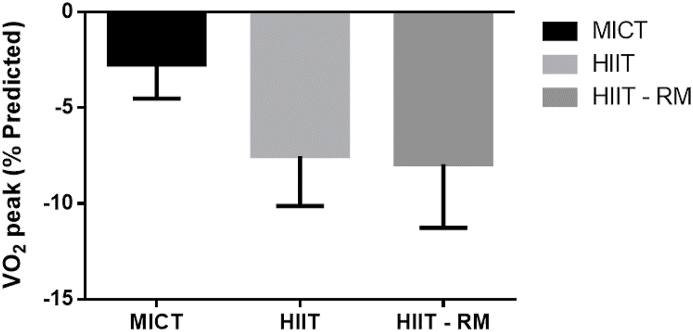
HIIT/HIIT-RM induced greater improvement in VO (between +14% and +17%), power output at ventilatory thresholds and at maximal fat oxidation rate (+25%) and waist circumference (-1.53 cm) compared to MICT and tended to decrease insulin resistance. During the four-month follow-up period during which exercise in autonomy was prescribed, HIIT induced a greater preservation of CRF, decreases in total and abdominal fat masses and total cholesterol/HDL.
We have shown greater short-term benefits induced by a high volume short interval (1 min) HIIT on cardiorespiratory fitness and cardiometabolic risk over an isocaloric moderate intensity continuous exercise in persons with overweight/obesity. We also showed greater long-term effects (i.e. after 4 months) of this exercise modality on the maintenance of CRF, decreases in total and abdominal fat masses and total cholesterol/HDL.
考虑到高强度间歇训练(HIIT)可能对心脏循环系统产生更大影响,我们假设,与等热量中等强度持续训练(MICT)相比,为期2个月的有监督的高运动量短间歇HIIT能使超重/肥胖者的心肺适能(CRF)和心血管代谢风险得到更大改善,并提高长期身体活动的维持率。
60名(19名女性)超重/肥胖受试者被随机分为三个训练项目(每周3次,共2个月):MICT(45分钟,峰值功率输出[PPO]的50%)、HIIT(22次1分钟骑行,功率为100%PPO/1分钟被动恢复)和HIIT-RM(RM:恢复调节,即受试者将被动恢复时间调整为30秒至2分钟)。干预结束后,参与者不再接受有监督的体育活动,并被要求自行保持相同的运动方式。我们在三个时间点评估了人体测量学指标、身体成分、CRF、脂肪氧化、血脂谱、血糖平衡、低度炎症、血管功能、自发身体活动和进食动机:基线(T0)、为期2个月的有监督训练项目结束后4天(T2)和训练项目结束后4个月(T6)。
与MICT相比,HIIT/HIIT-RM使VO(提高14%至17%)、通气阈值和最大脂肪氧化率时的功率输出(提高25%)以及腰围(减少1.53厘米)有更大改善,并倾向于降低胰岛素抵抗。在规定自主锻炼的四个月随访期内,HIIT能更好地维持CRF,减少总体脂肪和腹部脂肪量以及总胆固醇/高密度脂蛋白。
我们已经表明,与等热量中等强度持续运动相比,高运动量短间歇(1分钟)HIIT对超重/肥胖者的心肺适能和心血管代谢风险有更大的短期益处。我们还表明,这种运动方式对CRF的维持、总体脂肪和腹部脂肪量的减少以及总胆固醇/高密度脂蛋白有更大的长期影响(即4个月后)。