Department of Gynecology, Cancer Hospital of China Medical University, Liaoning Cancer Hospital & Institute, Shenyang, 110042 Liaoning, China.
Comput Math Methods Med. 2022 Apr 1;2022:1906769. doi: 10.1155/2022/1906769. eCollection 2022.
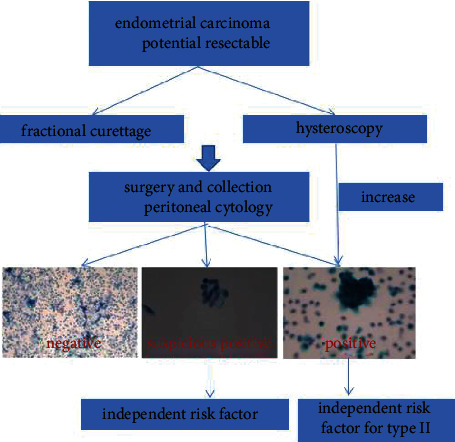
Endometrial carcinoma (EC) is one of the most common gynecological malignancies. Its incidence rate has been increasing year by year. The prognostic factors and treatment strategies of EC have aroused wide concern. The effects of peritoneal cytology on the prognosis and treatment of EC remain controversial. Some factors, such as differentiation degree, muscle invasion, and tumor size, are related to positive peritoneal cytology. Hysteroscopy is commonly used in the diagnosis and treatment of endometrial cancer, but hysteroscopic surgery may cause the tumor to spread into the abdominal cavity, resulting in positive peritoneal cytology. In this review, we discuss the factors related to positive peritoneal cytology and the influence of positive peritoneal cytology on the prognosis of endometrial cancer. Suspicious positive peritoneal cytology may be an independent risk factor for endometrial cancer. The positive rate of peritoneal tumor cells in type II endometrial cancer is higher than other cells and is an independent risk factor for type II endometrial cancer. We also discuss the effects of peritoneal cytology on treatment decisions. Aggressive treatments seem to be more beneficial for patients with positive ascites cytology, but there is a lack of large-scale prospective clinical studies on their effectiveness and safety. The application of peritoneal cytology for endometrial cancer has been decreased in recent years. We believe that peritoneal cytology is necessary for this type of cancer. However, more studies on peritoneal cytology in endometrial cancer should be carried out.
子宫内膜癌 (EC) 是最常见的妇科恶性肿瘤之一。其发病率逐年上升。EC 的预后因素和治疗策略引起了广泛关注。腹膜细胞学对 EC 的预后和治疗的影响仍存在争议。一些因素,如分化程度、肌肉浸润和肿瘤大小,与阳性腹膜细胞学有关。宫腔镜检查常用于子宫内膜癌的诊断和治疗,但宫腔镜手术可能导致肿瘤扩散到腹腔,导致阳性腹膜细胞学。在这篇综述中,我们讨论了与阳性腹膜细胞学相关的因素,以及阳性腹膜细胞学对子宫内膜癌预后的影响。可疑的阳性腹膜细胞学可能是子宫内膜癌的独立危险因素。Ⅱ型子宫内膜癌的腹膜肿瘤细胞阳性率高于其他细胞,是Ⅱ型子宫内膜癌的独立危险因素。我们还讨论了腹膜细胞学对治疗决策的影响。对于腹水细胞学阳性的患者,积极治疗似乎更有益,但对于其有效性和安全性的大规模前瞻性临床研究仍缺乏。近年来,腹膜细胞学在子宫内膜癌中的应用有所减少。我们认为,腹膜细胞学对于这种癌症是必要的。然而,应该对子宫内膜癌的腹膜细胞学进行更多的研究。