Xia Lei, Han Qing, Duan Xuehui, Zhu Yinjie, Pan Jiahua, Dong Baijun, Xia Weiliang, Xue Wei, Sha Jianjun
Department of Urology, Ren Ji Hospital, School of Medicine, Shanghai Jiao Tong University, Shanghai 200001, People's Republic of China.
School of Biomedical Engineering, Shanghai Jiao Tong University, Shanghai 200001, People's Republic of China.
Mol Ther Nucleic Acids. 2022 Mar 15;28:219-230. doi: 10.1016/j.omtn.2022.03.008. eCollection 2022 Jun 14.
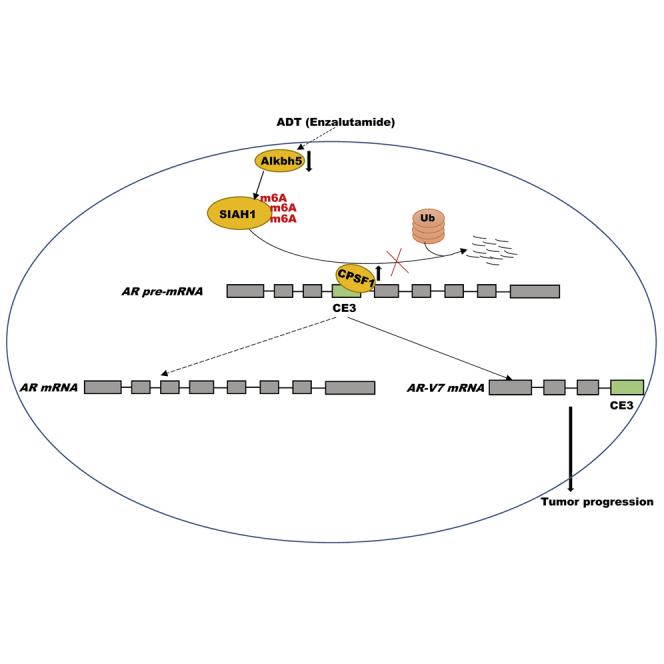
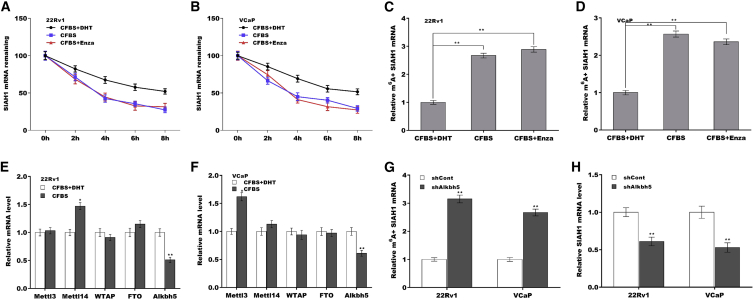
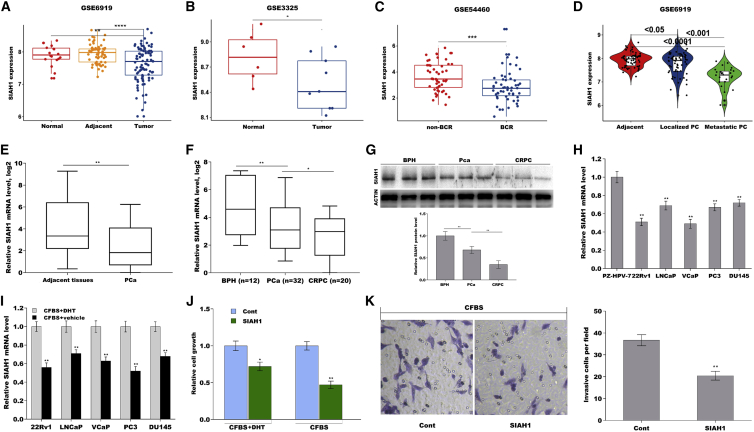
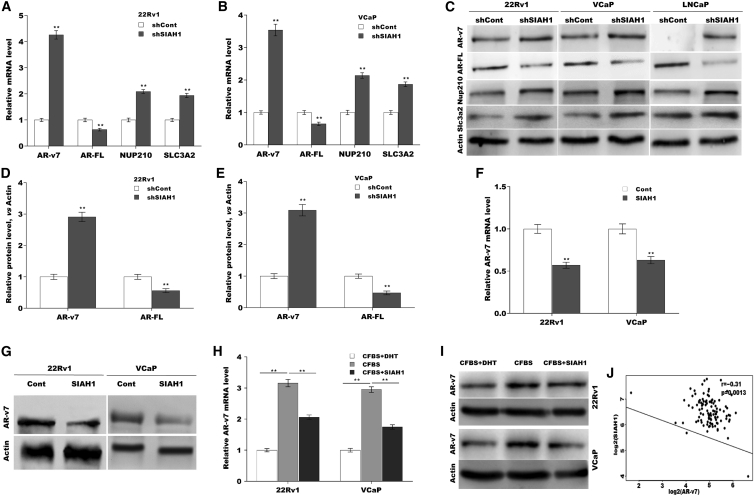
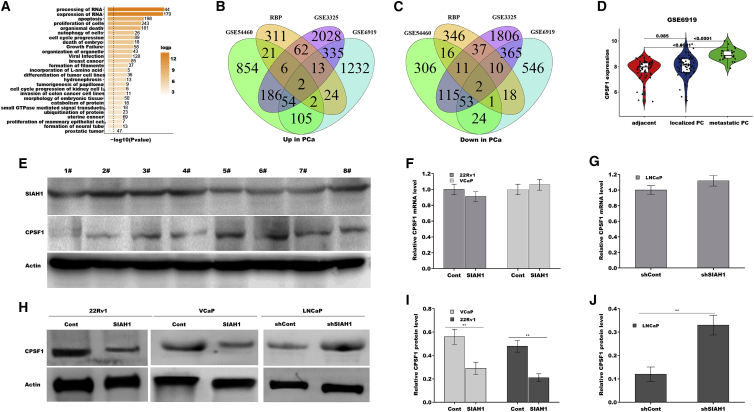
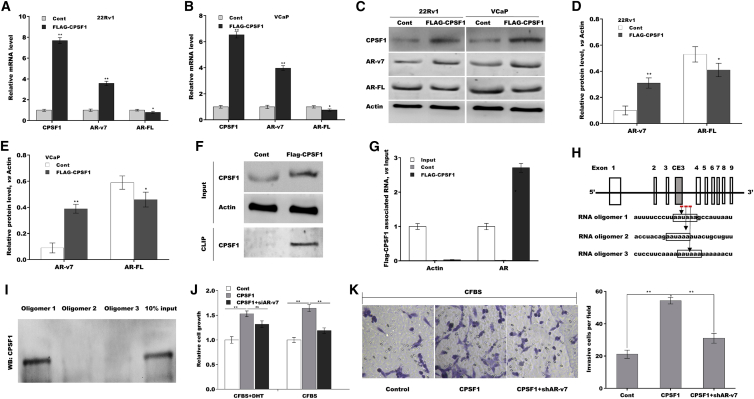
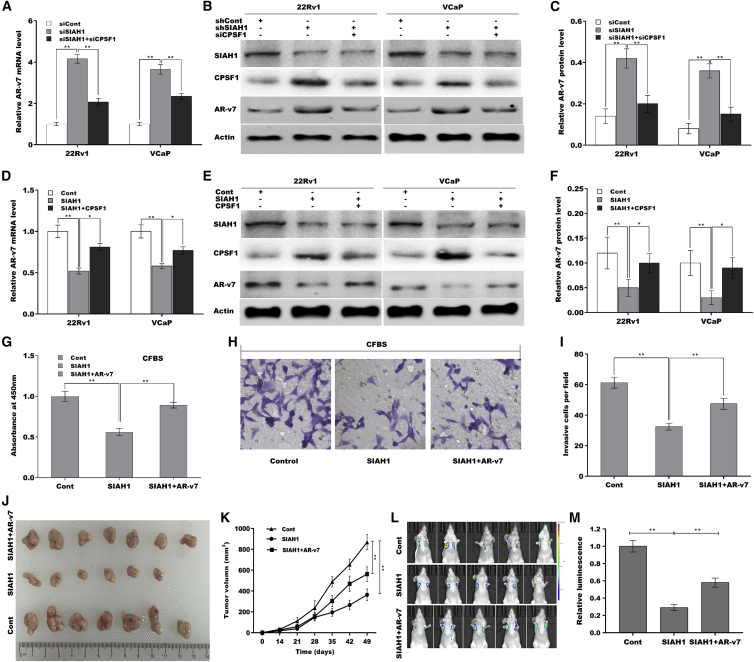
Androgen receptor splice variant 7 (AR-v7), a constitutively active transcription factor, plays a crucial role in the progression of castration-resistant prostate cancer (CRPC). Here, we found that the cleavage and polyadenylation specificity factor 1 (CPSF1) (the largest subunit of the multi-protein cleavage and polyadenylation specificity complex), regulated by the E3 ubiquitin ligases SIAH1, promoted AR-v7 expression. The data from microarray-based analysis and clinical specimen-based analysis showed that SIAH1 expression was decreased in PCa and was negatively correlated with aggressive phenotypes of PCa. SIAH1 repressed PCa cell growth and invasion under castrate conditions. SIAH1 directly interacted with CPSF1 and promoted ubiquitination and degradation of CPSF1. CPSF1 expression was negatively correlated with SIAH1 expression, but positively with PCa progression. CPSF1 overexpression switched the AR splicing pattern and facilitated the generation of the oncogenic isoform (AR-v7) by binding to the AAUAAA polyadenylation signal contained in AR-cryptic exon CE3. Functionally, SIAH1 acted as a tumor suppressor in PCa pathogenesis by repressing CPSF1-mediated AR-v7 generation. Finally, we demonstrated that mA methylation was concerned with the repression of SIAH1 in PCa. Our results define SIAH1/CPSF1/AR-v7 axis as a regulatory factor of PCa progression, providing a promising target for treating PCa.
雄激素受体剪接变体7(AR-v7)是一种组成型活性转录因子,在去势抵抗性前列腺癌(CRPC)的进展中起关键作用。在此,我们发现由E3泛素连接酶SIAH1调控的切割和聚腺苷酸化特异性因子1(CPSF1)(多蛋白切割和聚腺苷酸化特异性复合物的最大亚基)促进了AR-v7的表达。基于微阵列分析和基于临床标本分析的数据表明,SIAH1在前列腺癌中的表达降低,并且与前列腺癌的侵袭性表型呈负相关。在去势条件下,SIAH1抑制前列腺癌细胞的生长和侵袭。SIAH1直接与CPSF1相互作用,并促进CPSF1的泛素化和降解。CPSF1的表达与SIAH1的表达呈负相关,但与前列腺癌进展呈正相关。CPSF1的过表达改变了AR剪接模式,并通过与AR隐蔽外显子CE3中包含的AAUAAA聚腺苷酸化信号结合促进了致癌异构体(AR-v7)的产生。在功能上,SIAH1通过抑制CPSF1介导的AR-v7产生,在前列腺癌发病机制中发挥肿瘤抑制作用。最后,我们证明了甲基化与前列腺癌中SIAH1的抑制有关。我们的结果将SIAH1/CPSF1/AR-v7轴定义为前列腺癌进展的调节因子,为治疗前列腺癌提供了一个有前景的靶点。