Li Ying-Zi, Chen Bo, Lin Xiao-Yi, Zhang Guo-Chun, Lai Jian-Guo, Li Cheukfai, Lin Jia-Li, Guo Li-Ping, Xiao Wei-Kai, Mok Hsiaopei, Ren Chong-Yang, Wen Ling-Zhu, Cao Fang-Rong, Lin Xin, Qi Xiao-Fang, Liu Yang, Liao Ning
Department of Breast, Guangdong Provincial People's Hospital, Guangdong Academy of Medical Sciences, Guangzhou, China.
Medical College, Shantou University, Shantou, China.
Front Oncol. 2022 Mar 25;12:830124. doi: 10.3389/fonc.2022.830124. eCollection 2022.
Triple-negative breast cancer (TNBC) is refractory and heterogeneous, comprising various entities with divergent phenotype, biology, and clinical presentation. As an aggressive subtype, Chinese TNBC patients with special morphologic patterns (STs) were restricted to its incidence of 10-15% in total TNBC population.
We recruited 89 patients with TNBC at Guangdong Provincial People's Hospital (GDPH) from October 2014 to May 2021, comprising 72 cases of invasive ductal carcinoma of no-special type (NSTs) and 17 cases of STs. The clinical data of these patients was collected and statistically analyzed. Formalin-fixed, paraffin-embedded (FFPE) tumor tissues and matched blood samples were collected for targeted next-generation sequencing (NGS) with cancer-related, 520- or 33-gene assay. Immunohistochemical analysis of FFPE tissue sections was performed using anti-programmed cell death-ligand 1(PD-L1) and anti-androgen receptor antibodies.
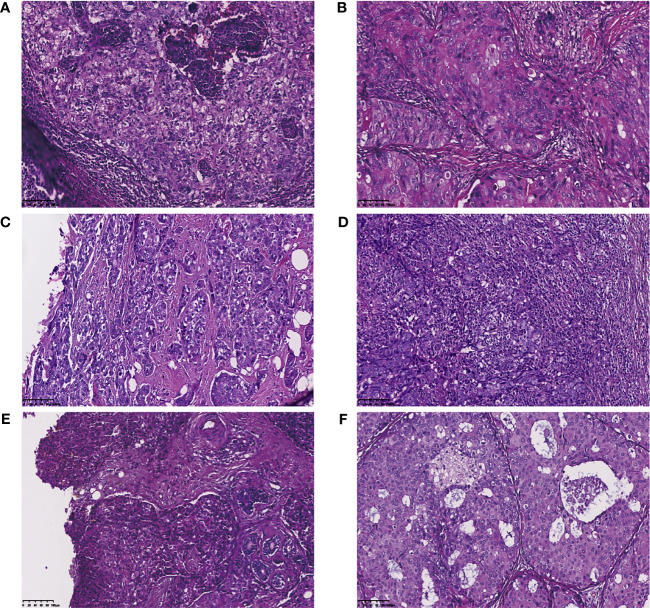
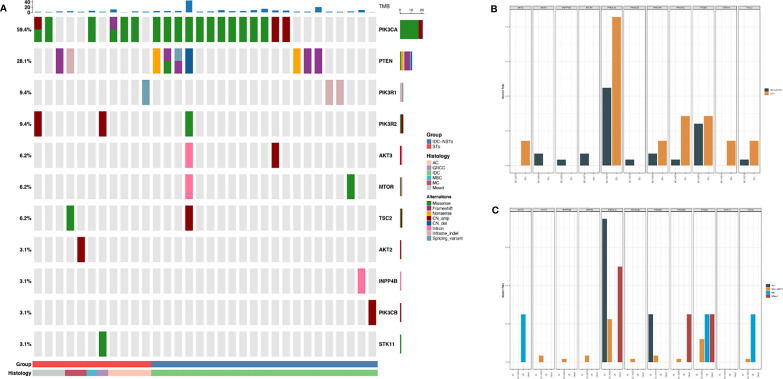
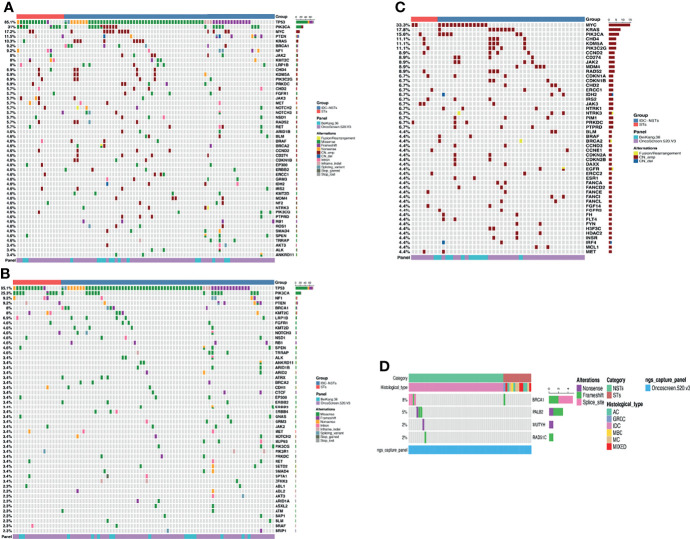
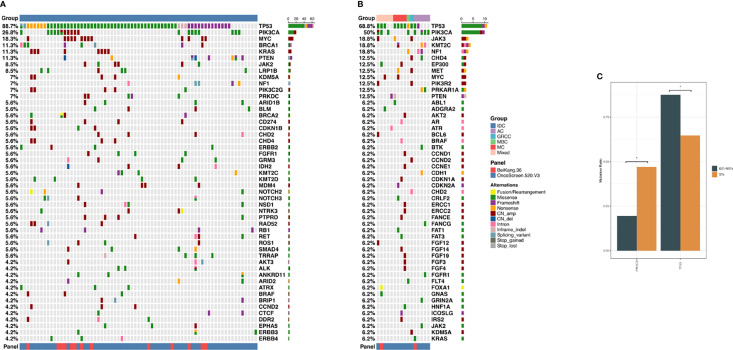
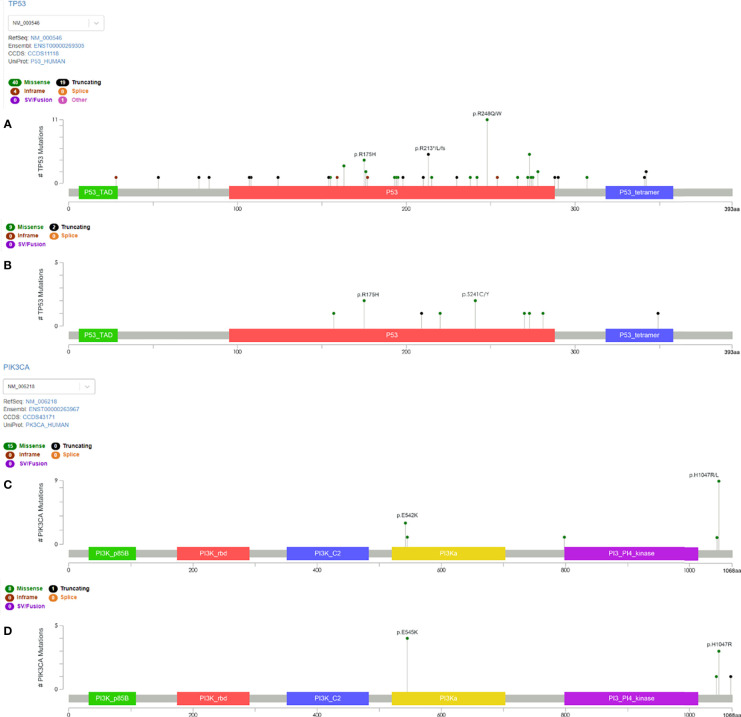
Cases with NSTs presented with higher histologic grade and Ki-67 index rate than ST patients (NSTs to STs: grade I/II/III 1.4%, 16.7%,81.9% vs 0%, 29.4%, 58.8%; p<0.05; Ki-67 ≥30%: 83.3% vs. 58.8%, p<0.05), while androgen receptor (AR) and PD-L1 positive (combined positive score≥10) rates were lower than of STs cases (AR: 11.1% vs. 47.1%; PD-L1: 9.6% vs. 33.3%, p<0.05). The most commonly altered genes were (88.7%), (26.8%), (18.3%) in NSTs, and (68.8%), (50%), (18.8%), (18.8%) in STs respectively. Compared with NSTs, and mutation frequency showed difference in STs (47.1% vs 19.4%, p=0.039; 64.7% vs 87.5%, p=0.035).
In TNBC patients with STs, decrease in histologic grade and ki-67 index, as well as increase in PD-L1 and AR expression were observed when compared to those with NSTs, suggesting that TNBC patients with STs may better benefit from immune checkpoint inhibitors and/or AR inhibitors. Additionally, lower TP53 and higher PIK3CA mutation rates were also found in STs patients, providing genetic evidence for deciphering at least partly potential mechanism of action.
三阴性乳腺癌(TNBC)难治且具有异质性,由具有不同表型、生物学特性和临床表现的多种实体组成。作为一种侵袭性亚型,具有特殊形态模式(STs)的中国TNBC患者在TNBC总人群中的发病率为10%-15%。
2014年10月至2021年5月,我们在广东省人民医院(GDPH)招募了89例TNBC患者,其中包括72例非特殊类型浸润性导管癌(NSTs)和17例STs。收集这些患者的临床资料并进行统计分析。收集福尔马林固定、石蜡包埋(FFPE)肿瘤组织和配对血样,用于癌症相关的520基因或33基因检测的靶向二代测序(NGS)。使用抗程序性细胞死亡配体1(PD-L1)和抗雄激素受体抗体对FFPE组织切片进行免疫组化分析。
NSTs病例的组织学分级和Ki-67指数率高于STs患者(NSTs与STs:I/II/III级1.4%、16.7%、81.9%对0%、29.4%、58.8%;p<0.05;Ki-67≥30%:83.3%对58.8%,p<0.05),而雄激素受体(AR)和PD-L1阳性(联合阳性评分≥10)率低于STs病例(AR:11.1%对47.1%;PD-L1:9.6%对33.3%,p<0.05)。NSTs中最常发生改变的基因分别是(88.7%)、(26.8%)、(18.3%),STs中分别是(68.8%)、(50%)、(18.8%)、(18.8%)。与NSTs相比,STs中的和突变频率存在差异(47.1%对19.4%,p=0.039;64.7%对87.5%,p=0.035)。
与NSTs患者相比,STs的TNBC患者组织学分级和ki-67指数降低,PD-L1和AR表达增加,这表明STs的TNBC患者可能从免疫检查点抑制剂和/或AR抑制剂中获益更多。此外,STs患者中还发现较低的TP53和较高的PIK3CA突变率,为至少部分解释潜在作用机制提供了遗传学证据。