Yamada Shuntaro, Yassin Mohammed A, Schwarz Thomas, Mustafa Kamal, Hansmann Jan
Centre of Translational Oral Research, Tissue Engineering Group, Department of Clinical Dentistry, University of Bergen, Bergen, Norway.
Translational Centre Regenerative Therapies, Fraunhofer Institute for Silicate Research ISC, Würzburg, Germany.
Front Bioeng Biotechnol. 2022 Mar 25;10:811942. doi: 10.3389/fbioe.2022.811942. eCollection 2022.
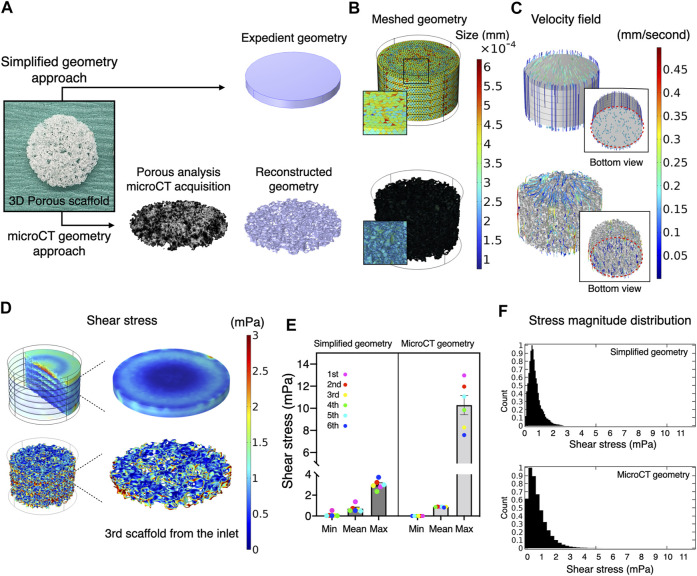
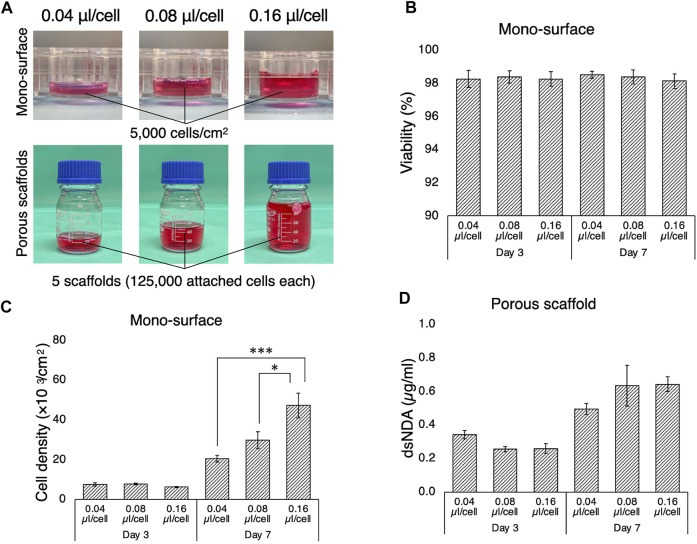
Various perfusion bioreactor systems have been designed to improve cell culture with three-dimensional porous scaffolds, and there is some evidence that fluid force improves the osteogenic commitment of the progenitors. However, because of the unique design concept and operational configuration of each study, the experimental setups of perfusion bioreactor systems are not always compatible with other systems. To reconcile results from different systems, the thorough optimization and validation of experimental configuration are required in each system. In this study, optimal experimental conditions for a perfusion bioreactor were explored in three steps. First, an modeling was performed using a scaffold geometry obtained by microCT and an expedient geometry parameterized with porosity and permeability to assess the accuracy of calculated fluid shear stress and computational time. Then, environmental factors for cell culture were optimized, including the volume of the medium, bubble suppression, and medium evaporation. Further, by combining the findings, it was possible to determine the optimal flow rate at which cell growth was supported while osteogenic differentiation was triggered. Here, we demonstrated that fluid shear stress up to 15 mPa was sufficient to induce osteogenesis, but cell growth was severely impacted by the volume of perfused medium, the presence of air bubbles, and medium evaporation, all of which are common concerns in perfusion bioreactor systems. This study emphasizes the necessity of optimization of experimental variables, which may often be underreported or overlooked, and indicates steps which can be taken to address issues common to perfusion bioreactors for bone tissue engineering.
人们设计了各种灌注生物反应器系统,以利用三维多孔支架改善细胞培养,并且有证据表明流体力可促进祖细胞的成骨定向分化。然而,由于每项研究独特的设计理念和操作配置,灌注生物反应器系统的实验设置并不总是与其他系统兼容。为了协调不同系统的结果,每个系统都需要对实验配置进行全面优化和验证。在本研究中,分三步探索了灌注生物反应器的最佳实验条件。首先,使用通过微型计算机断层扫描(microCT)获得的支架几何形状以及用孔隙率和渗透率参数化的便捷几何形状进行建模,以评估计算出的流体剪切应力的准确性和计算时间。然后,优化细胞培养的环境因素,包括培养基体积、气泡抑制和培养基蒸发。此外,通过结合这些发现,可以确定在支持细胞生长同时触发成骨分化的最佳流速。在此,我们证明高达15毫帕的流体剪切应力足以诱导成骨,但细胞生长受到灌注培养基体积、气泡的存在以及培养基蒸发的严重影响,而这些都是灌注生物反应器系统中常见的问题。本研究强调了优化实验变量的必要性,这些变量可能经常未被充分报道或被忽视,并指出了可以采取的步骤来解决骨组织工程灌注生物反应器常见的问题。