Noor Rashed
Department of Life Sciences (DLS), School of Environment and Life Sciences (SELS), Independent University, Bangladesh (IUB), Plot 16, Block B, Aftabuddin Ahmed Road, Bashundhara, Dhaka-1229 Bangladesh.
SN Compr Clin Med. 2022;4(1):88. doi: 10.1007/s42399-022-01168-3. Epub 2022 Apr 1.
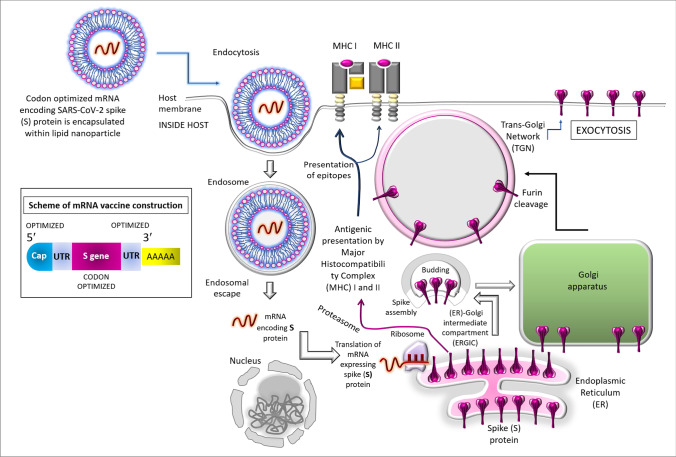
Among the currently used COVID-19 vaccines, the mRNA-based vaccines drew the interest of the scientists because of its potent and versatile nature in mitigating the disease efficiently through increased translation as well as the robust modulation of the innate and adaptive immune responses within the host. The naked or lipid encapsulated mRNAs are usually optimized in order to formulate the vaccine. One of the interesting advantage of using mRNA vaccines is that such platform can even be used to mitigate other infectious diseases like influenza, zika, and rabies. However, the leading COVID-19 mRNA vaccines, i.e., mRNA-1273 and BNT162b2, have already been noticed to possess around 95% efficacy in provoking both the humoral and cell mediated immunity against the severe acute respiratory syndrome coronavirus 2 (SARS-CoV-2) infection, causing the ongoing COVID-19 pandemic.
在目前使用的新冠疫苗中,基于信使核糖核酸(mRNA)的疫苗引起了科学家们的关注,因为它在通过增加翻译以及对宿主内先天和适应性免疫反应进行强有力调节来有效减轻疾病方面具有强大且通用的特性。裸mRNA或脂质包裹的mRNA通常会经过优化以制备疫苗。使用mRNA疫苗的一个有趣优势是,这样的平台甚至可用于减轻其他传染病,如流感、寨卡病毒病和狂犬病。然而,领先的新冠mRNA疫苗,即mRNA-1273和BNT162b2,已被注意到在激发针对严重急性呼吸综合征冠状病毒2(SARS-CoV-2)感染的体液免疫和细胞介导免疫方面具有约95%的效力,正是这种感染导致了当前的新冠大流行。