Department of Pharmacology and Toxicology, University of Graz, Graz, Austria.
Department of Dermatology, Skin and Endothelium Research Division, Medical University of Vienna, Vienna, Austria.
Curr Atheroscler Rep. 2022 Jun;24(6):483-492. doi: 10.1007/s11883-022-01023-9. Epub 2022 Apr 11.
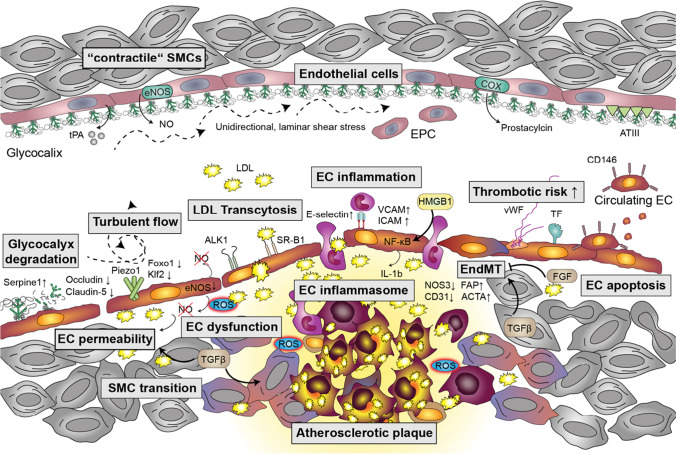
In this review, we summarize current insights into the versatile roles of endothelial cells in atherogenesis.
The vascular endothelium represents the first barrier that prevents the entry of lipoproteins and leukocytes into the vessel wall, thereby controlling two key events in the pathogenesis of atherosclerosis. Disturbance of endothelial homeostasis increases vascular permeability, inflammation, and cellular trans-differentiation, which not only promotes the build-up of atherosclerotic plaques but is also involved in life-threatening thromboembolic complications such as plaque rupture and erosion. In this review, we focus on recent findings on endothelial lipoprotein transport, inflammation, cellular transitions, and barrier function. By using cutting-edge technologies such as single-cell sequencing, epigenetics, and cell fate mapping, novel regulatory mechanisms and endothelial cell phenotypes have been discovered, which have not only challenged established concepts of endothelial activation, but have also led to a different view of the disease.
在这篇综述中,我们总结了目前对内皮细胞在动脉粥样硬化发病机制中多种作用的深入了解。
血管内皮作为第一道屏障,可防止脂蛋白和白细胞进入血管壁,从而控制动脉粥样硬化发病机制中的两个关键事件。内皮细胞稳态的破坏会增加血管通透性、炎症和细胞转分化,这不仅会促进动脉粥样硬化斑块的形成,而且还会涉及到危及生命的血栓栓塞并发症,如斑块破裂和侵蚀。在这篇综述中,我们重点介绍了内皮细胞脂蛋白转运、炎症、细胞转化和屏障功能的最新发现。通过使用单细胞测序、表观遗传学和细胞命运映射等前沿技术,发现了新的调节机制和内皮细胞表型,这些不仅挑战了内皮细胞激活的既定概念,而且对该疾病也有了不同的看法。