• 文献检索
  • 文档翻译
  • 深度研究
  • 学术资讯
  • Suppr Zotero 插件Zotero 插件
  • 邀请有礼
  • 套餐&价格
  • 历史记录
应用&插件
Suppr Zotero 插件Zotero 插件浏览器插件Mac 客户端Windows 客户端微信小程序
定价
高级版会员购买积分包购买API积分包
服务
文献检索文档翻译深度研究API 文档MCP 服务
关于我们
关于 Suppr公司介绍联系我们用户协议隐私条款
关注我们

Suppr 超能文献

核心技术专利:CN118964589B侵权必究
粤ICP备2023148730 号-1Suppr @ 2026

文献检索

告别复杂PubMed语法,用中文像聊天一样搜索,搜遍4000万医学文献。AI智能推荐,让科研检索更轻松。

立即免费搜索

文件翻译

保留排版,准确专业,支持PDF/Word/PPT等文件格式,支持 12+语言互译。

免费翻译文档

深度研究

AI帮你快速写综述,25分钟生成高质量综述,智能提取关键信息,辅助科研写作。

立即免费体验

针对 SARS-CoV-2 的计算药物再利用揭示了细胞膜胆固醇耗竭是抗病毒药物活性的关键因素。

Computational drug repurposing against SARS-CoV-2 reveals plasma membrane cholesterol depletion as key factor of antiviral drug activity.

机构信息

Semmelweis University, Faculty of Medicine, Department of Physiology, Budapest, Hungary.

National Laboratory of Virology, University of Pécs, Pécs, Hungary.

出版信息

PLoS Comput Biol. 2022 Apr 11;18(4):e1010021. doi: 10.1371/journal.pcbi.1010021. eCollection 2022 Apr.

DOI:10.1371/journal.pcbi.1010021
PMID:35404937
原文链接:https://pmc.ncbi.nlm.nih.gov/articles/PMC9022874/
Abstract

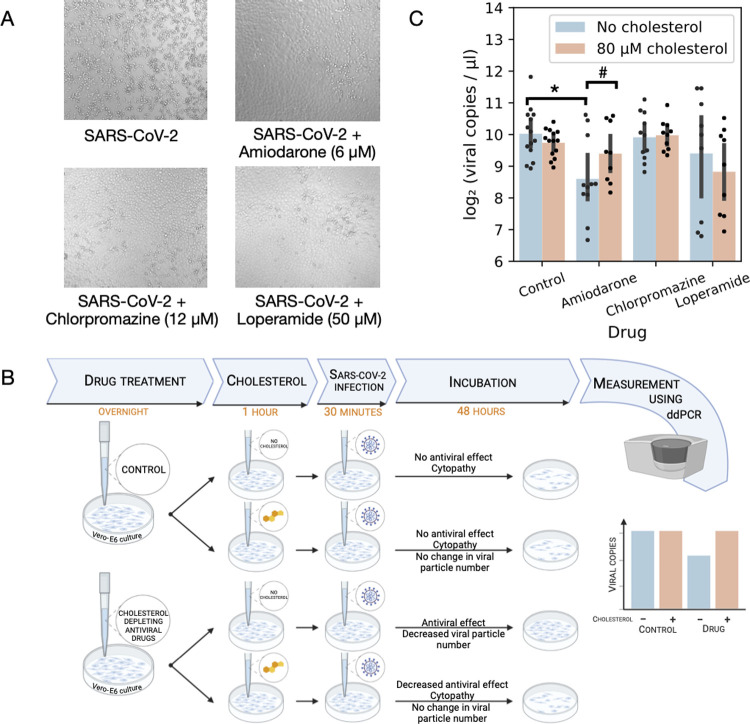
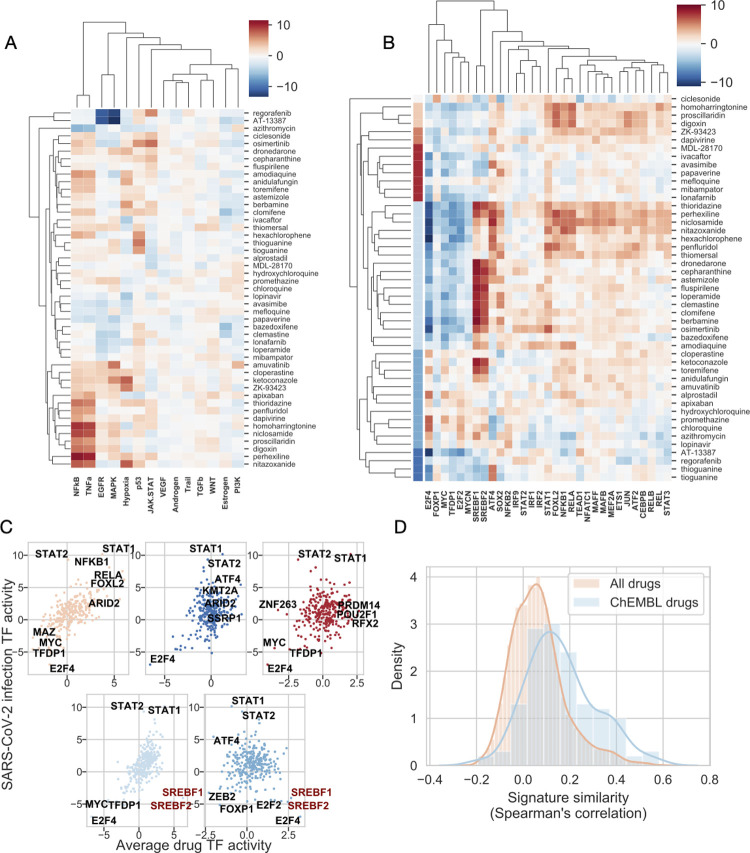
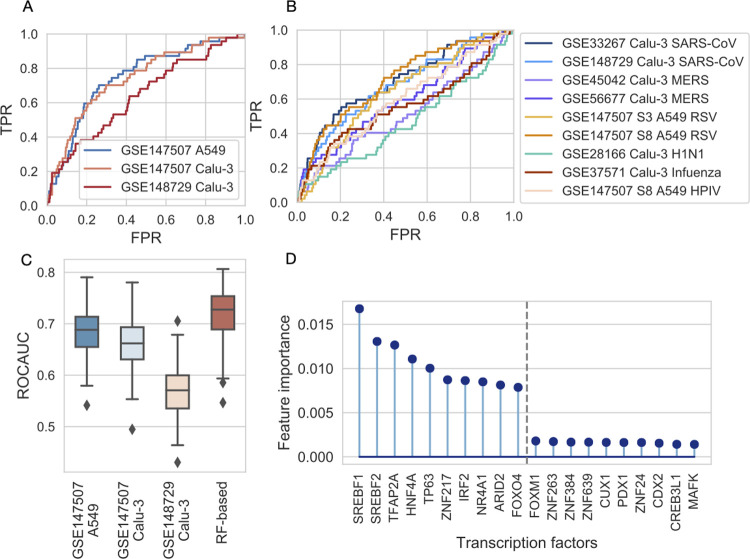
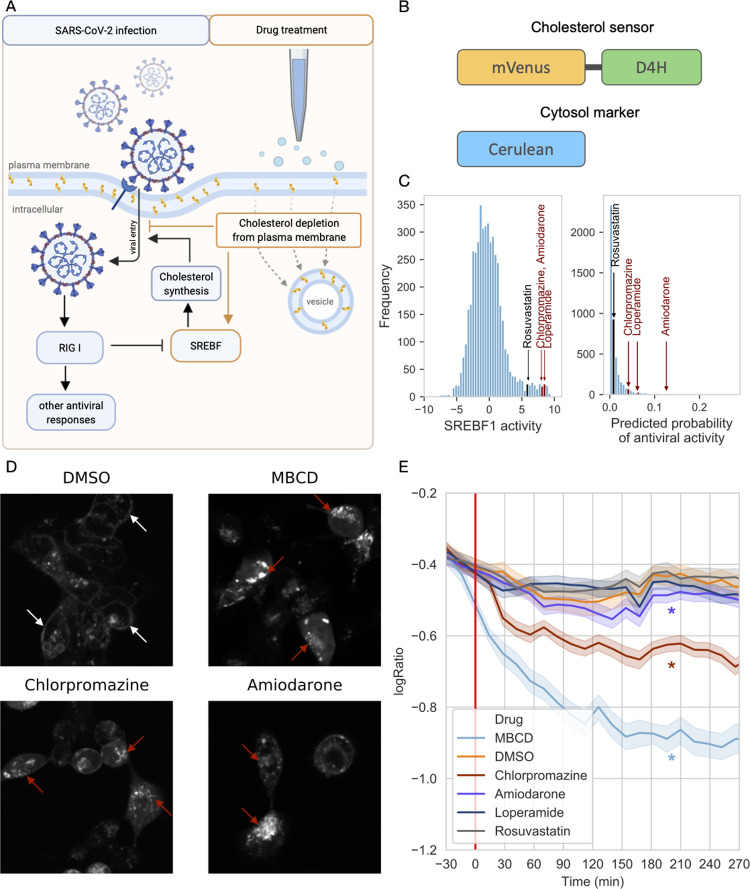
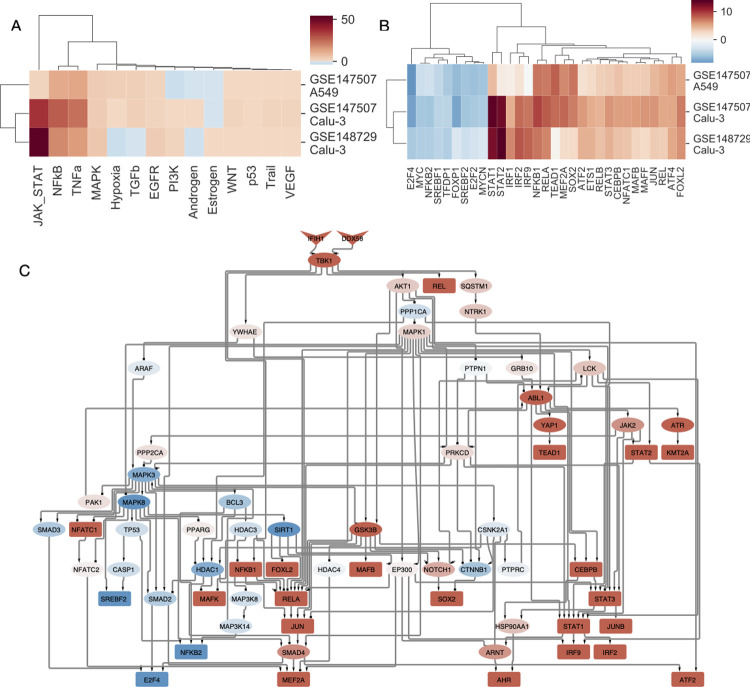
Comparing SARS-CoV-2 infection-induced gene expression signatures to drug treatment-induced gene expression signatures is a promising bioinformatic tool to repurpose existing drugs against SARS-CoV-2. The general hypothesis of signature-based drug repurposing is that drugs with inverse similarity to a disease signature can reverse disease phenotype and thus be effective against it. However, in the case of viral infection diseases, like SARS-CoV-2, infected cells also activate adaptive, antiviral pathways, so that the relationship between effective drug and disease signature can be more ambiguous. To address this question, we analysed gene expression data from in vitro SARS-CoV-2 infected cell lines, and gene expression signatures of drugs showing anti-SARS-CoV-2 activity. Our extensive functional genomic analysis showed that both infection and treatment with in vitro effective drugs leads to activation of antiviral pathways like NFkB and JAK-STAT. Based on the similarity-and not inverse similarity-between drug and infection-induced gene expression signatures, we were able to predict the in vitro antiviral activity of drugs. We also identified SREBF1/2, key regulators of lipid metabolising enzymes, as the most activated transcription factors by several in vitro effective antiviral drugs. Using a fluorescently labeled cholesterol sensor, we showed that these drugs decrease the cholesterol levels of plasma-membrane. Supplementing drug-treated cells with cholesterol reversed the in vitro antiviral effect, suggesting the depleting plasma-membrane cholesterol plays a key role in virus inhibitory mechanism. Our results can help to more effectively repurpose approved drugs against SARS-CoV-2, and also highlights key mechanisms behind their antiviral effect.

摘要

比较 SARS-CoV-2 感染诱导的基因表达谱与药物治疗诱导的基因表达谱是一种有前途的生物信息学工具,可以重新利用现有的药物来对抗 SARS-CoV-2。基于特征的药物再利用的一般假设是,与疾病特征具有相反相似性的药物可以逆转疾病表型,因此对其有效。然而,在 SARS-CoV-2 等病毒感染性疾病的情况下,感染细胞也会激活适应性抗病毒途径,因此有效药物与疾病特征之间的关系可能更加模糊。为了解决这个问题,我们分析了体外 SARS-CoV-2 感染细胞系的基因表达数据,以及表现出抗 SARS-CoV-2 活性的药物的基因表达特征。我们广泛的功能基因组分析表明,感染和用体外有效药物治疗都会导致 NFkB 和 JAK-STAT 等抗病毒途径的激活。基于药物和感染诱导的基因表达特征之间的相似性,而不是相反的相似性,我们能够预测药物的体外抗病毒活性。我们还确定了 SREBF1/2,脂质代谢酶的关键调节因子,作为几种体外有效抗病毒药物激活的转录因子。使用荧光标记的胆固醇传感器,我们表明这些药物降低了质膜的胆固醇水平。用胆固醇补充药物处理的细胞可逆转体外抗病毒作用,表明消耗质膜胆固醇在病毒抑制机制中起着关键作用。我们的研究结果可以帮助更有效地重新利用现有的抗 SARS-CoV-2 药物,同时也突出了其抗病毒作用的关键机制。
https://cdn.ncbi.nlm.nih.gov/pmc/blobs/3dae/9022874/2cb338409ade/pcbi.1010021.g005.jpg
https://cdn.ncbi.nlm.nih.gov/pmc/blobs/3dae/9022874/672ebef9bd74/pcbi.1010021.g001.jpg
https://cdn.ncbi.nlm.nih.gov/pmc/blobs/3dae/9022874/a2edb844b798/pcbi.1010021.g002.jpg
https://cdn.ncbi.nlm.nih.gov/pmc/blobs/3dae/9022874/1ea49cebe402/pcbi.1010021.g003.jpg
https://cdn.ncbi.nlm.nih.gov/pmc/blobs/3dae/9022874/19d0ecaa70bb/pcbi.1010021.g004.jpg
https://cdn.ncbi.nlm.nih.gov/pmc/blobs/3dae/9022874/2cb338409ade/pcbi.1010021.g005.jpg
https://cdn.ncbi.nlm.nih.gov/pmc/blobs/3dae/9022874/672ebef9bd74/pcbi.1010021.g001.jpg
https://cdn.ncbi.nlm.nih.gov/pmc/blobs/3dae/9022874/a2edb844b798/pcbi.1010021.g002.jpg
https://cdn.ncbi.nlm.nih.gov/pmc/blobs/3dae/9022874/1ea49cebe402/pcbi.1010021.g003.jpg
https://cdn.ncbi.nlm.nih.gov/pmc/blobs/3dae/9022874/19d0ecaa70bb/pcbi.1010021.g004.jpg
https://cdn.ncbi.nlm.nih.gov/pmc/blobs/3dae/9022874/2cb338409ade/pcbi.1010021.g005.jpg

相似文献

1
Computational drug repurposing against SARS-CoV-2 reveals plasma membrane cholesterol depletion as key factor of antiviral drug activity.针对 SARS-CoV-2 的计算药物再利用揭示了细胞膜胆固醇耗竭是抗病毒药物活性的关键因素。
PLoS Comput Biol. 2022 Apr 11;18(4):e1010021. doi: 10.1371/journal.pcbi.1010021. eCollection 2022 Apr.
2
Cysteamine with In Vitro Antiviral Activity and Immunomodulatory Effects Has the Potential to Be a Repurposing Drug Candidate for COVID-19 Therapy.具有体外抗病毒活性和免疫调节作用的半胱胺有可能成为治疗 COVID-19 的重新定位药物候选物。
Cells. 2021 Dec 24;11(1):52. doi: 10.3390/cells11010052.
3
Drug repurposing for COVID-19 based on an integrative meta-analysis of SARS-CoV-2 induced gene signature in human airway epithelium.基于 SARS-CoV-2 诱导的人呼吸道上皮细胞基因特征的综合荟萃分析的 COVID-19 药物再利用。
PLoS One. 2021 Sep 28;16(9):e0257784. doi: 10.1371/journal.pone.0257784. eCollection 2021.
4
Network analysis and molecular mapping for SARS-CoV-2 to reveal drug targets and repurposing of clinically developed drugs.针对严重急性呼吸综合征冠状病毒2(SARS-CoV-2)的网络分析和分子图谱绘制,以揭示药物靶点和临床开发药物的重新利用。
Virology. 2021 Mar;555:10-18. doi: 10.1016/j.virol.2020.12.006. Epub 2020 Dec 30.
5
Discovery of new drug indications for COVID-19: A drug repurposing approach.发现针对 COVID-19 的新药物适应证:药物再利用方法。
PLoS One. 2022 May 24;17(5):e0267095. doi: 10.1371/journal.pone.0267095. eCollection 2022.
6
Identification of SARS-CoV-2-induced pathways reveals drug repurposing strategies.鉴定 SARS-CoV-2 诱导的通路揭示了药物再利用策略。
Sci Adv. 2021 Jun 30;7(27). doi: 10.1126/sciadv.abh3032. Print 2021 Jun.
7
Identification of candidate repurposable drugs to combat COVID-19 using a signature-based approach.基于特征的方法鉴定用于抗击 COVID-19 的候选再利用药物。
Sci Rep. 2021 Feb 24;11(1):4495. doi: 10.1038/s41598-021-84044-9.
8
Identification of potential pan-coronavirus therapies using a computational drug repurposing platform.利用计算药物再利用平台鉴定潜在的泛冠状病毒治疗方法。
Methods. 2022 Jul;203:214-225. doi: 10.1016/j.ymeth.2021.11.002. Epub 2021 Nov 9.
9
Repurposing of anisomycin and oleandomycin as a potential anti-(SARS-CoV-2) virus targeting key enzymes using virtual computational approaches.利用虚拟计算方法将放线菌酮和土霉素重新用于针对关键酶的抗(SARS-CoV-2)病毒的潜在药物。
Cell Mol Biol (Noisy-le-grand). 2022 Feb 4;67(5):387-398. doi: 10.14715/cmb/2021.67.5.51.
10
Drugs repurposing for SARS-CoV-2: new insight of COVID-19 druggability.用于严重急性呼吸综合征冠状病毒2(SARS-CoV-2)的药物重新利用:2019冠状病毒病(COVID-19)药物可及性的新见解
Expert Rev Anti Infect Ther. 2022 Sep;20(9):1187-1204. doi: 10.1080/14787210.2022.2082944. Epub 2022 Jun 6.

引用本文的文献

1
Application of perturbation gene expression profiles in drug discovery-From mechanism of action to quantitative modelling.扰动基因表达谱在药物发现中的应用——从作用机制到定量建模
Front Syst Biol. 2023 Feb 9;3:1126044. doi: 10.3389/fsysb.2023.1126044. eCollection 2023.
2
The antiarrhythmic drugs amiodarone and dronedarone inhibit intoxication of cells with pertussis toxin.抗心律失常药物胺碘酮和决奈达隆抑制百日咳毒素对细胞的中毒作用。
Naunyn Schmiedebergs Arch Pharmacol. 2024 Dec;397(12):9991-10003. doi: 10.1007/s00210-024-03247-9. Epub 2024 Jul 3.
3
Exploring the inhibitory potential of the antiarrhythmic drug amiodarone against toxins TcdA and TcdB.

本文引用的文献

1
The Anti-Histamine Azelastine, Identified by Computational Drug Repurposing, Inhibits Infection by Major Variants of SARS-CoV-2 in Cell Cultures and Reconstituted Human Nasal Tissue.通过药物重新利用计算鉴定出的抗组胺药氮卓斯汀,在细胞培养和重组人鼻组织中可抑制严重急性呼吸综合征冠状病毒2(SARS-CoV-2)主要变体的感染。
Front Pharmacol. 2022 Jun 30;13:861295. doi: 10.3389/fphar.2022.861295. eCollection 2022.
2
A systems-level study reveals host-targeted repurposable drugs against SARS-CoV-2 infection.系统水平研究揭示了针对 SARS-CoV-2 感染的靶向宿主的可再利用药物。
Mol Syst Biol. 2021 Aug;17(8):e10239. doi: 10.15252/msb.202110239.
3
探讨抗心律失常药物胺碘酮对 TcdA 和 TcdB 毒素的抑制潜力。
Gut Microbes. 2023 Dec;15(2):2256695. doi: 10.1080/19490976.2023.2256695. Epub 2023 Sep 25.
4
Microbead-based extracorporeal immuno-affinity virus capture: a feasibility study to address the SARS-CoV-2 pandemic.基于微珠的体外免疫亲和病毒捕获:应对 SARS-CoV-2 大流行的可行性研究。
Mikrochim Acta. 2023 Feb 18;190(3):95. doi: 10.1007/s00604-023-05671-9.
5
DRaW: prediction of COVID-19 antivirals by deep learning-an objection on using matrix factorization.DRaW:深度学习预测 COVID-19 抗病毒药物——对使用矩阵分解的反对意见。
BMC Bioinformatics. 2023 Feb 15;24(1):52. doi: 10.1186/s12859-023-05181-8.
6
Ganoderma microsporum immunomodulatory protein acts as a multifunctional broad-spectrum antiviral against SARS-CoV-2 by interfering virus binding to the host cells and spike-mediated cell fusion.灵芝免疫调节蛋白通过干扰病毒与宿主细胞的结合以及刺突介导的细胞融合,发挥针对 SARS-CoV-2 的多功能广谱抗病毒作用。
Biomed Pharmacother. 2022 Nov;155:113766. doi: 10.1016/j.biopha.2022.113766. Epub 2022 Sep 28.
Drug-induced phospholipidosis confounds drug repurposing for SARS-CoV-2.
药物诱导的磷脂沉积症使 SARS-CoV-2 的药物再利用变得复杂。
Science. 2021 Jul 30;373(6554):541-547. doi: 10.1126/science.abi4708. Epub 2021 Jun 22.
4
SARS-CoV-2 immune evasion by the B.1.427/B.1.429 variant of concern.关注变异株 B.1.427/B.1.429 逃避 SARS-CoV-2 免疫。
Science. 2021 Aug 6;373(6555):648-654. doi: 10.1126/science.abi7994. Epub 2021 Jul 1.
5
Network medicine framework for identifying drug-repurposing opportunities for COVID-19.用于识别新冠病毒药物再利用机会的网络医学框架。
Proc Natl Acad Sci U S A. 2021 May 11;118(19). doi: 10.1073/pnas.2025581118.
6
SARS-CoV-2 requires cholesterol for viral entry and pathological syncytia formation.SARS-CoV-2 病毒进入宿主细胞和病理性合胞体的形成都需要胆固醇。
Elife. 2021 Apr 23;10:e65962. doi: 10.7554/eLife.65962.
7
Integrated intra- and intercellular signaling knowledge for multicellular omics analysis.用于细胞内和细胞间信号传递的综合知识进行多细胞组学分析。
Mol Syst Biol. 2021 Mar;17(3):e9923. doi: 10.15252/msb.20209923.
8
SARS-CoV-2 Causes a Different Cytokine Response Compared to Other Cytokine Storm-Causing Respiratory Viruses in Severely Ill Patients.SARS-CoV-2 引起的细胞因子反应与其他严重感染患者中导致细胞因子风暴的呼吸道病毒不同。
Front Immunol. 2021 Mar 1;12:629193. doi: 10.3389/fimmu.2021.629193. eCollection 2021.
9
A SARS-CoV-2 cytopathicity dataset generated by high-content screening of a large drug repurposing collection.通过对大型药物重定位化合物库进行高通量筛选获得的 SARS-CoV-2 细胞病变数据集。
Sci Data. 2021 Feb 26;8(1):70. doi: 10.1038/s41597-021-00848-4.
10
Transcriptomic profiling of SARS-CoV-2 infected human cell lines identifies HSP90 as target for COVID-19 therapy.对感染SARS-CoV-2的人类细胞系进行转录组分析确定HSP90为COVID-19治疗靶点。
iScience. 2021 Mar 19;24(3):102151. doi: 10.1016/j.isci.2021.102151. Epub 2021 Feb 6.