Couturier Chloé, Bortolamiol Sarah, Ortmann Sylvia, Okimat John-Paul, Asalu Edward, Krief Sabrina
Eco-Anthropologie (EA), Musée de l'Homme, Muséum National d'Histoire Naturelle, CNRS, Université de Paris, 17 Place du Trocadéro, 75116 Paris, France.
Great Ape Conservation Project (GACP), Sebitoli Research Station, Kibale National Park, Fort Portal, Uganda.
Animals (Basel). 2022 Mar 22;12(7):806. doi: 10.3390/ani12070806.
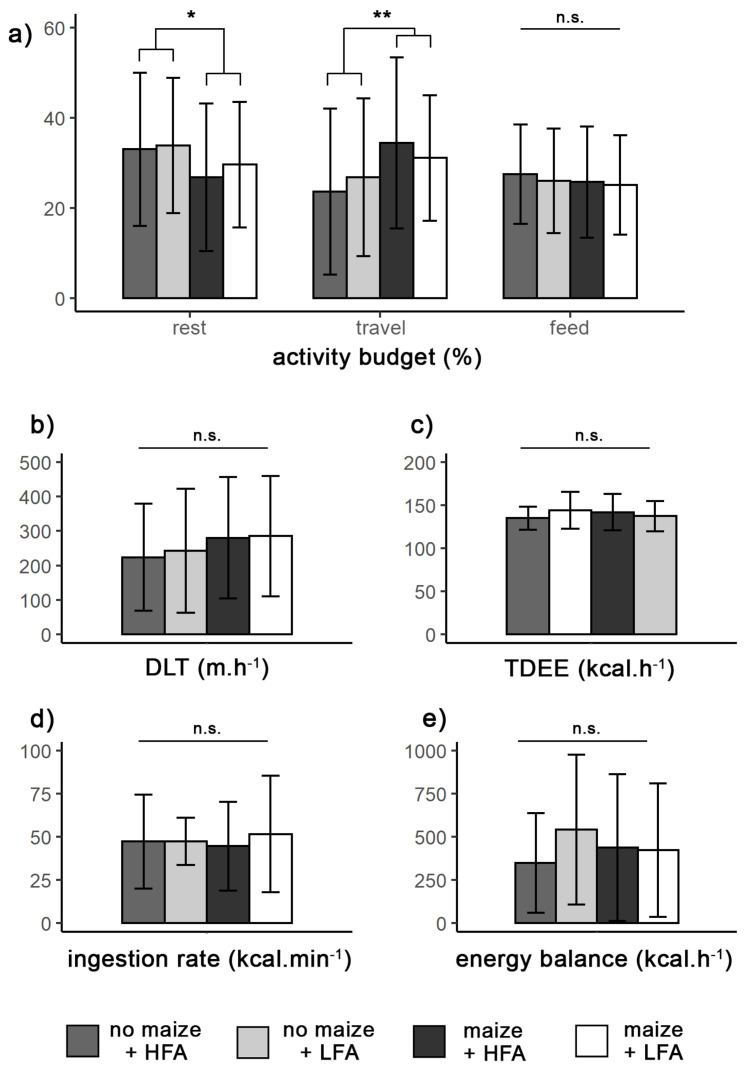
Frugivorous primates have developed several strategies to deal with wild fruit scarcity, such as modifying their activity budget or enlarging their diet. Agricultural expansion threatens primate habitats and populations (e.g., disease transmission, agrochemical exposure), but it also increases crop feeding opportunities. We aimed at understanding whether maize presence close to the natural habitat of chimpanzees, a threatened species, would lead to significant behavioral modifications. We monitored 20 chimpanzees over 37 months in Kibale National Park, Uganda, with maize gardens at the forest edge. Based on focal nest-to-nest data, we analyzed their diet, activity budget, and energy balance depending on wild fruit and maize availability. We found that the Sebitoli area is a highly nutritive habitat for chimpanzees, with large and caloric wild fruits available all year long. The chimpanzees opportunistically consume maize and exploit it by resting less during maize season. However, no significant variation was found in daily paths and energy expenditures according to maize availability. No behavioral or energy modification was observed regarding wild resources either. Despite the availability of nutritious domestic resources, chimpanzees still exploit wild fruits and do not limit their movements. Thus, their contribution to seed dispersal and forest regeneration in this area is not affected.
食果灵长类动物已经发展出多种策略来应对野生水果稀缺的问题,比如调整它们的活动预算或扩大饮食范围。农业扩张威胁着灵长类动物的栖息地和种群数量(例如疾病传播、接触农用化学品),但同时也增加了它们取食农作物的机会。我们旨在了解靠近受威胁物种黑猩猩自然栖息地的玉米种植是否会导致其行为发生显著改变。我们在乌干达基巴莱国家公园对20只黑猩猩进行了为期37个月的监测,该公园森林边缘有玉米种植园。基于从一个巢穴到另一个巢穴的重点数据,我们根据野生水果和玉米的可获取情况分析了它们的饮食、活动预算和能量平衡。我们发现,塞比托利地区对黑猩猩来说是一个营养丰富的栖息地,全年都有大量高热量的野生水果。黑猩猩会 opportunistically 食用玉米,并在玉米季节通过减少休息来利用它。然而,根据玉米的可获取情况,它们的日常路径和能量消耗并未发现显著变化。在野生资源方面也未观察到行为或能量方面的改变。尽管有营养丰富的家养资源,但黑猩猩仍然会利用野生水果,并且不会限制它们的活动范围。因此,它们在该地区对种子传播和森林再生的贡献并未受到影响。 (注:原文中“opportunistically”未准确翻译,可理解为“机会性地” )