Department of Post Baccalaureate Medicine, Kaohsiung Medical University, Kaohsiung 807, Taiwan.
Department of Neurology, Kaohsiung Medical University Hospital, Kaohsiung Medical University, Kaohsiung 807, Taiwan.
Nutrients. 2022 Mar 23;14(7):1339. doi: 10.3390/nu14071339.
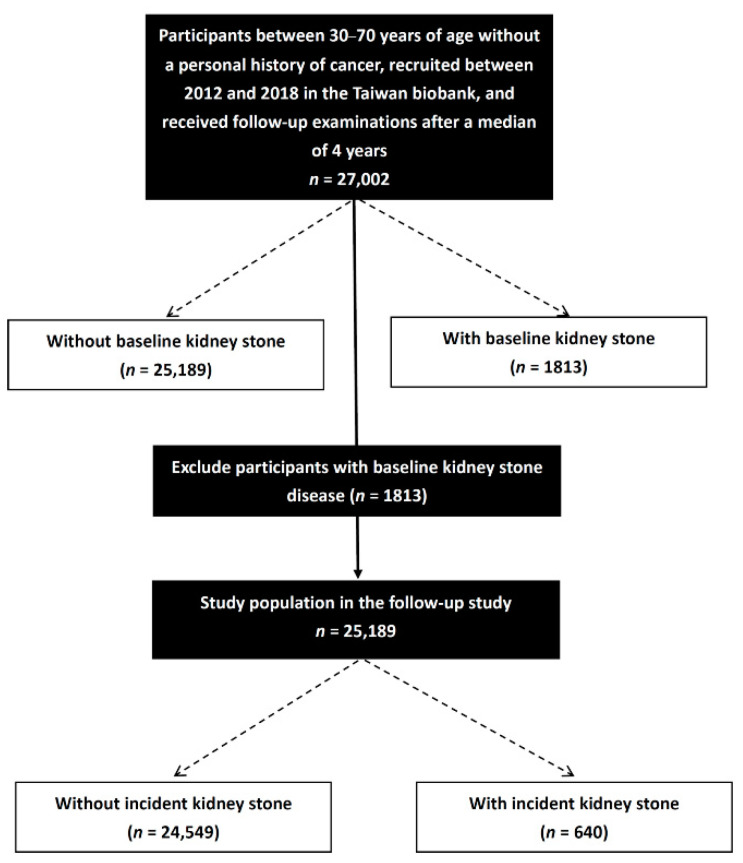
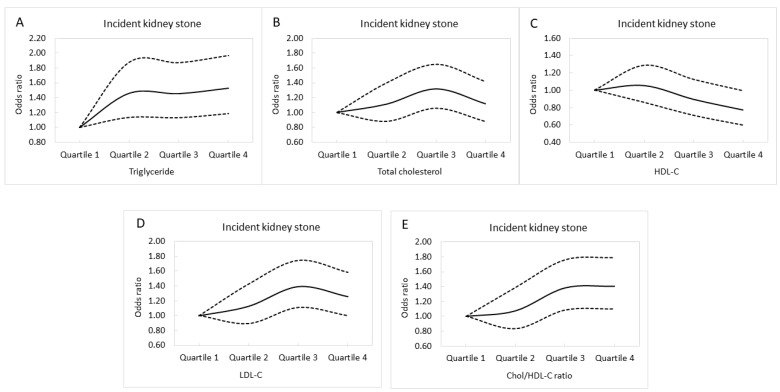
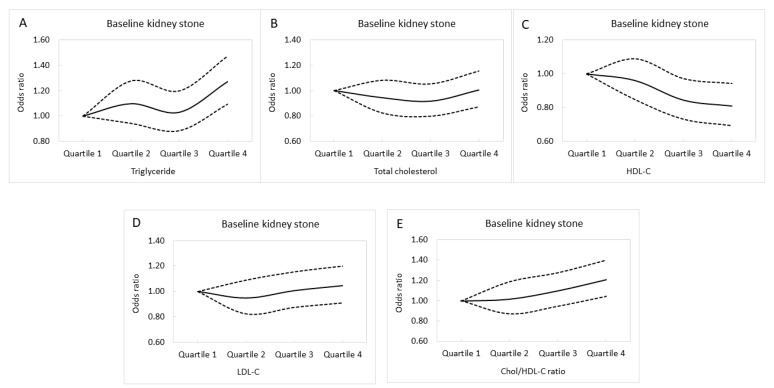
The prevalence and incidence rates of kidney stone disease (KSD) in Taiwan are high; however, the association between lipid profile and KSD has yet to be investigated. The aim of this longitudinal study was to investigate the association between lipid profile with baseline and incident KSD in a large Taiwanese cohort. A total of 27,002 people enrolled in the Taiwan Biobank (TWB) were followed for a median of 4 years and classified into two groups according to whether they had (n = 1813; 6.7%) or did not have (n = 25,189; 93.3%) KSD at baseline. The presence of KSD was defined according to a self-reported history of kidney stones. The participants with baseline KSD (n = 1813) were excluded from the follow-up study, and the remaining participants were classified into two groups consisting of those who had (n = 640; 2.5%) or did not have (n = 24,549; 97.5%) incident KSD. After multivariable analysis, compared to quartile 1 of lipid profile, the participants in quartile 4 of triglycerides, quartiles 3 and 4 of high-density lipoprotein cholesterol (HDL-C), and quartile 4 of total cholesterol (Chol)/HDL-C ratio were significantly associated with baseline KSD. In the follow-up study, the participants in quartiles 2, 3, and 4 of triglycerides; quartile 2 of Chol; quartile 4 of HDL-C; quartile 3 of LDL-C; and quartiles 3 and 4 of Chol/HDL-C ratio were significantly associated with incident KSD. Our results showed that hypertriglyceridemia (67−93 mg/dL) was associated with a 1.463-fold increased risk of incident KSD and that low HDL-C (>63 mg/dL) protected against incident KSD formation. In addition, a Chol/HDL-C ratio larger than 3.64 was associated with a 1.381-fold increased risk of incident KSD. Our findings may imply that the optimal management of dyslipidemia may be associated with a lower risk of developing kidney stones.
台湾地区肾结石疾病(KSD)的患病率和发病率较高;然而,血脂状况与 KSD 之间的关联尚未得到研究。本纵向研究的目的是在一个大型的台湾队列中研究血脂状况与基线和新发 KSD 之间的关联。共有 27002 人参加了台湾生物库(TWB),中位随访时间为 4 年,并根据基线时是否患有(n=1813;6.7%)或不患有 KSD(n=25189;93.3%)将其分为两组。KSD 的存在根据肾结石的自述病史来定义。将基线时患有 KSD(n=1813)的参与者排除在随访研究之外,其余参与者分为两组,一组有(n=640;2.5%)或没有(n=24549;97.5%)新发 KSD。经过多变量分析,与血脂谱四分位 1 相比,四分位 4 的甘油三酯、四分位 3 和 4 的高密度脂蛋白胆固醇(HDL-C)和四分位 4 的总胆固醇(Chol)/HDL-C 比值与基线 KSD 显著相关。在随访研究中,四分位 2、3 和 4 的甘油三酯;四分位 2 的 Chol;四分位 4 的 HDL-C;四分位 3 的 LDL-C;以及四分位 3 和 4 的 Chol/HDL-C 比值与新发 KSD 显著相关。我们的研究结果表明,高甘油三酯血症(67-93mg/dL)与新发 KSD 的风险增加 1.463 倍相关,而高 HDL-C(>63mg/dL)可预防新发 KSD 的形成。此外,Chol/HDL-C 比值大于 3.64 与新发 KSD 的风险增加 1.381 倍相关。我们的研究结果可能意味着血脂异常的最佳管理可能与肾结石发生风险降低有关。