Regional Institute for Population Studies, University of Ghana, Legon P.O. Box LG 96, Ghana.
Department of Nutrition and Food Science, University of Ghana, Legon P.O. Box LG 134, Ghana.
Nutrients. 2022 Mar 29;14(7):1427. doi: 10.3390/nu14071427.
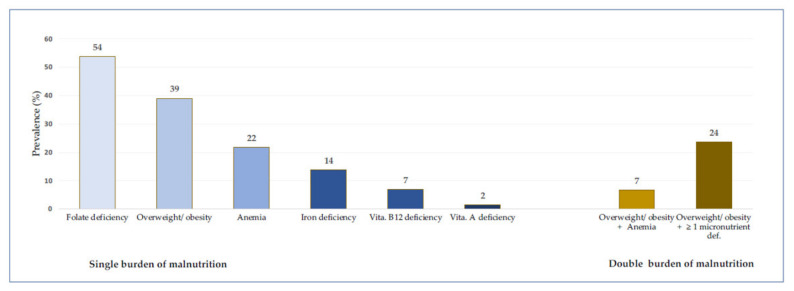
Overweight/obesity (OWOB) often co-occurs with anemia or micronutrient deficiencies (MNDs) among women of reproductive age (WRA) in Ghana; identifying the risk factors of these conditions is essential for prevention. We aimed to examine the prevalence of OWOB, anemia, and MNDs and their co-occurrence and risk factors among non-pregnant women 15-49 years of age in Ghana. Data were from a 2017 two-stage national survey of 1063 women. We estimated the weighted prevalence of single and co-occurring malnutrition, and used logistic regression to explore risk factors. The prevalence of OWOB, anemia, and ≥1 MND was 39%, 22%, and 62%, respectively; that of OWOB co-occurring with anemia was 6.7%, and OWOB co-occurring with ≥1 MND was 23.6%. There was no significant difference between observed and expected prevalence of co-occurrence OWOB with anemia or MND. Risk factors were: living in southern (vs. northern) belt, high- (vs. low-) wealth household, being ≥ 25 years old, and being married (vs. single) for OWOB, and living in northern (vs. southern) belt and medium- (vs. low-) wealth household for anemia and ≥1 MND, respectively. Different interventions are required for addressing OWOB in WRA than those for anemia and MNDs.
超重/肥胖(OWOB)常与加纳育龄妇女(WRA)的贫血或微量营养素缺乏症(MND)同时发生;确定这些情况的危险因素对于预防至关重要。我们旨在研究加纳 15-49 岁未怀孕妇女中 OWOB、贫血和 MND 的流行情况及其共存情况和危险因素。数据来自于 2017 年对 1063 名妇女进行的两阶段全国调查。我们估计了单一和共存营养不良的加权患病率,并使用逻辑回归来探讨危险因素。OWOB、贫血和≥1 种 MND 的患病率分别为 39%、22%和 62%;OWOB 与贫血共存的患病率为 6.7%,OWOB 与≥1 种 MND 共存的患病率为 23.6%。OWOB 与贫血或 MND 共存的观察患病率与预期患病率无显著差异。危险因素包括:居住在南部(北部)地带、高(低)财富家庭、年龄≥25 岁和已婚(单身),以及居住在北部(南部)地带和中(低)财富家庭贫血和≥1 种 MND。针对 WRA 的 OWOB 所需的干预措施与贫血和 MND 不同。