Song Qinghua, Liu Weiping, Chen Jiping, Zhao Dacheng, Yi Cheng, Liu Ruili, Geng Yi, Yang Yang, Zheng Yizhu, Yuan Yuhui
Composites Center, COMAC Shanghai Aircraft Manufacturing Co., Ltd., Shanghai 201324, China.
College of Material Science and Engineering, Donghua University, Shanghai 201620, China.
Polymers (Basel). 2022 Mar 30;14(7):1401. doi: 10.3390/polym14071401.
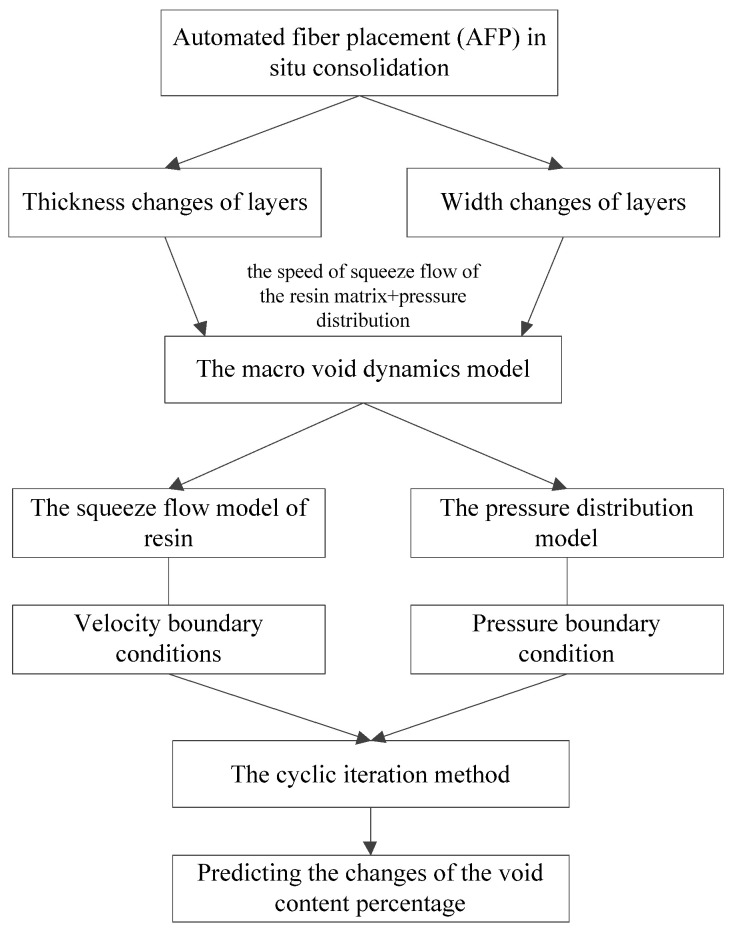
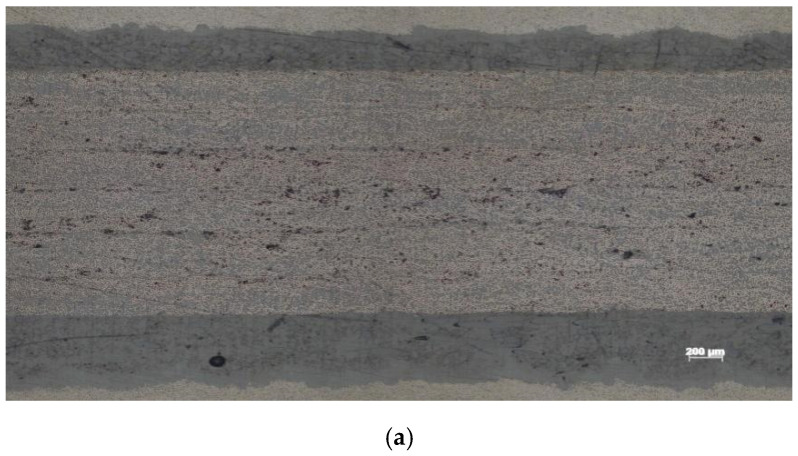
Automated fiber placement (AFP) in situ consolidation of continuous CF/high-performance thermoplastic composite is the key technology for efficient and low-cost manufacturing of large thermoplastic composites. However, the void in the in situ composite is difficult to eliminate because of the high pressure and the short consolidation time; the void content percentage consequently is the important defect that determines the performance of the thermoplastic composite parts. In this paper, based on the two-dimensional Newtonian fluid extrusion flow model, the void dynamics model and boundary conditions were established. The changes of the void content percentage were predicted by the cyclic iteration method. It was found that the void content percentage increased gradually along the direction of the layers' thickness. With the increasing of the laying speed, the void content percentage increased gradually. With the increasing of the pressure of the roller, the void content percentage gradually decreased. When the AFP speed was 11 m/min and the pressure of the compaction roller reached 2000 N, the void content percentage of the layers fell below 2%. It was verified by the AFP test that the measured results of the layers' thickness were in good agreement with the predicted results of the model, and the test results of the void content percentage were basically equivalent to the predicted results at different AFP speeds, which indicates that the kinetic model established in this paper is representative to predict the void content percentage. According to the metallographic observation, it was also found that the repeated pressure of the roller was helpful to reduce the void content percentage.
连续碳纤维/高性能热塑性复合材料的自动纤维铺放(AFP)原位固结是大型热塑性复合材料高效低成本制造的关键技术。然而,由于压力高且固结时间短,原位复合材料中的孔隙难以消除;孔隙率因此成为决定热塑性复合材料部件性能的重要缺陷。本文基于二维牛顿流体挤出流动模型,建立了孔隙动力学模型及边界条件。采用循环迭代法预测孔隙率的变化。研究发现,孔隙率沿层厚方向逐渐增加。随着铺放速度的增加,孔隙率逐渐增大。随着压实辊压力的增加,孔隙率逐渐降低。当AFP速度为11 m/min且压实辊压力达到2000 N时,各层的孔隙率降至2%以下。AFP试验验证了层厚测量结果与模型预测结果吻合良好,不同AFP速度下孔隙率的试验结果与预测结果基本相当,表明本文建立的动力学模型对预测孔隙率具有代表性。根据金相观察,还发现辊子的反复施压有助于降低孔隙率。