Boon Yi Di, Joshi Sunil Chandrakant, Bhudolia Somen Kumar
School of Mechanical and Aerospace Engineering, Nanyang Technological University, 50 Nanyang Avenue, Singapore 639798, Singapore.
Polymers (Basel). 2021 Jun 11;13(12):1951. doi: 10.3390/polym13121951.
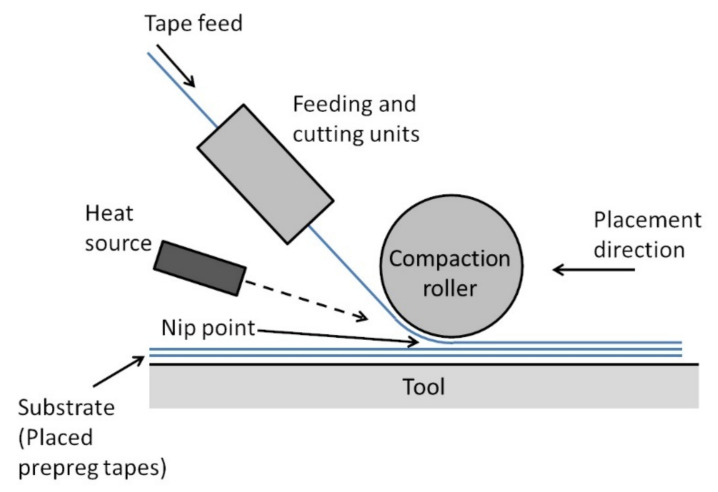
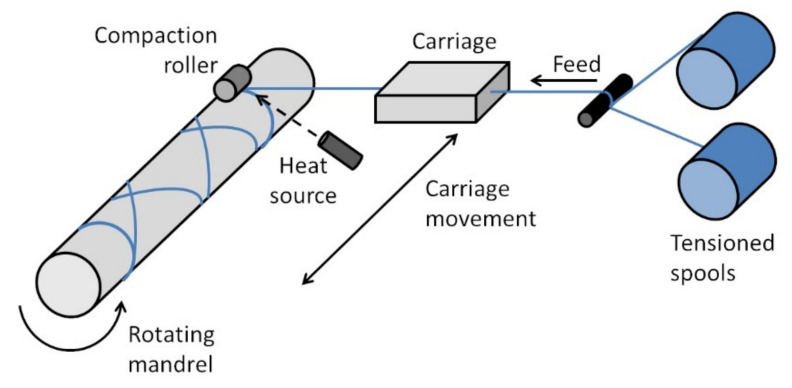
Fiber reinforced thermoplastic composites are gaining popularity in many industries due to their short consolidation cycles, among other advantages over thermoset-based composites. Computer aided manufacturing processes, such as filament winding and automated fiber placement, have been used conventionally for thermoset-based composites. The automated processes can be adapted to include in situ consolidation for the fabrication of thermoplastic-based composites. In this paper, a detailed literature review on the factors affecting the in situ consolidation process is presented. The models used to study the various aspects of the in situ consolidation process are discussed. The processing parameters that gave good consolidation results in past studies are compiled and highlighted. The parameters can be used as reference points for future studies to further improve the automated manufacturing processes.
纤维增强热塑性复合材料因其固化周期短等优点,相比热固性复合材料在许多行业中越来越受欢迎。诸如纤维缠绕和自动纤维铺放等计算机辅助制造工艺,传统上一直用于热固性复合材料。这些自动化工艺可加以调整,纳入原位固化以制造热塑性基复合材料。本文对影响原位固化过程的因素进行了详细的文献综述。讨论了用于研究原位固化过程各个方面的模型。汇总并突出了过去研究中能产生良好固化效果的加工参数。这些参数可作为未来研究的参考点,以进一步改进自动化制造工艺。