Schulz Martin S, Wolf Sebastian, Struck Vera, Thomas Niklas, Husman Gabriele, Zeuzem Stefan, Koch Christine, Trojan Jörg, Schnitzbauer Andreas Anton, Bechstein Wolf Otto, Waidmann Oliver
Department of Internal Medicine I, University Hospital Frankfurt, Goethe University, 60590 Frankfurt, Germany.
Department of Internal Medicine II, University Hospital Frankfurt, Goethe University, 0590 Frankfurt, Germany.
Cancers (Basel). 2022 Mar 24;14(7):1641. doi: 10.3390/cancers14071641.
In patients with () wild-type metastatic colorectal cancer (mCRC), anti-epidermal growth factor receptor (EGFR) antibodies have been established in first- and further therapy lines. Due to limited treatment options upon disease progression, anti-EGFR re-exposure is increasingly employed in real-world oncology. The aim of this study was to assess clinical implementation and utility of anti-EGFR retreatment strategies in real-world mCRC patients.
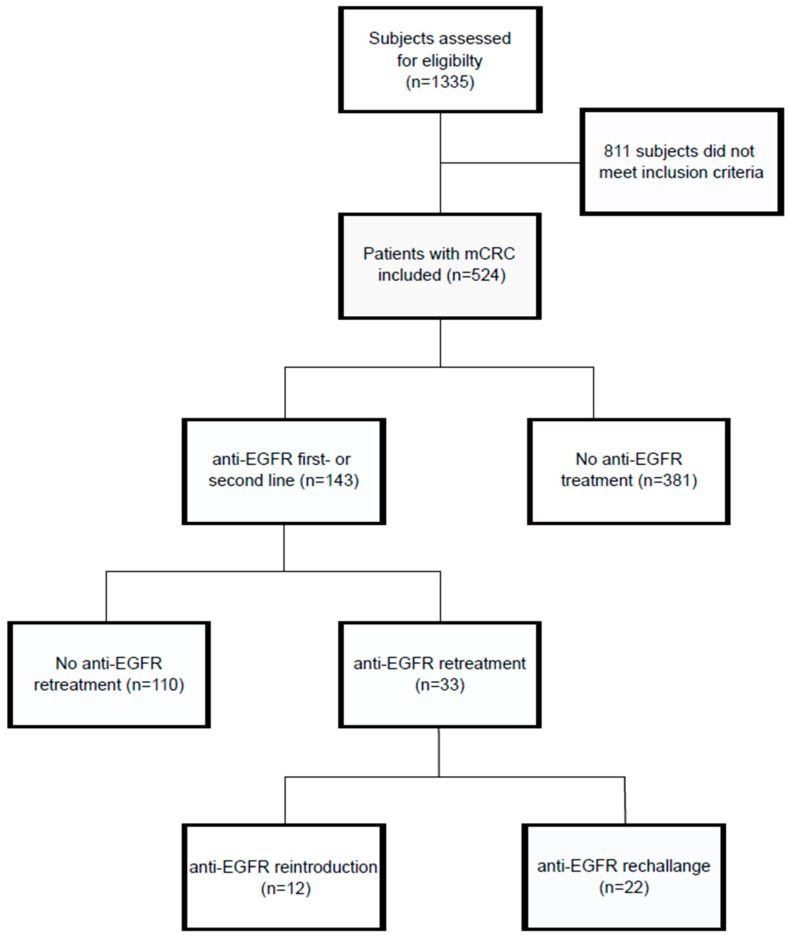
In this monocentric retrospective study, we included 524 patients with CRC and identified patients who received an anti-EGFR-based treatment as well as anti-EGFR rechallenge (progression on first-line anti-EGFR therapy) or reintroduction (discontinuation due to intolerance/toxicity/other).
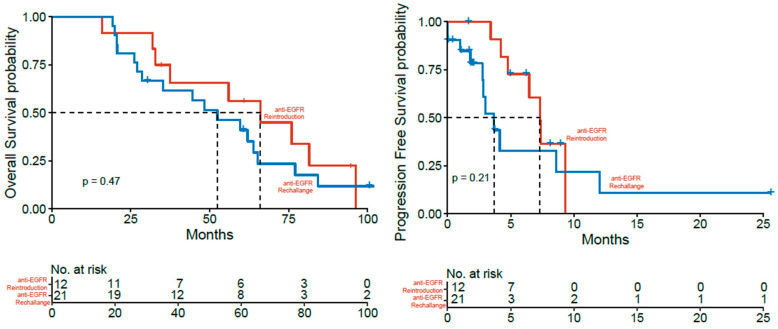
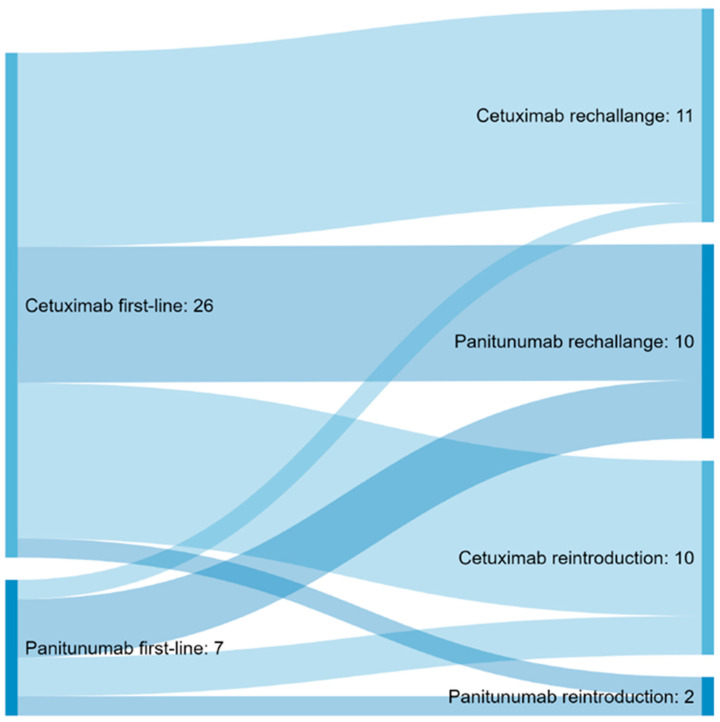
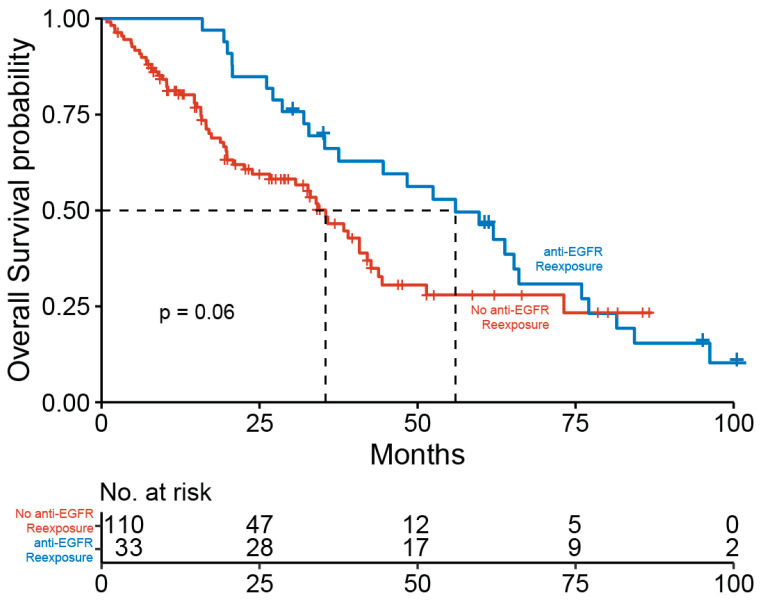
In total, 143 patients received an anti-EGFR-based first- or second-line treatment, showing a similar overall survival (OS) compared to the non-anti-EGFR treatment group (38.3 vs. 39.6 months, = 0.88). Thirty-three patients met the inclusion criteria for anti-EGFR re-exposure and were either assigned to rechallenge ( = 21) or reintroduction ( = 12) subgroups. The median FU after re-exposure was 45.8 months. Cetuximab and Panitumumab were used in 21 and 12 patients, respectively, and the main chemotherapy at re-exposure was FOLFIRI in 39.4%. Anti-EGFR re-exposure was associated with a distinct trend towards a better outcome (median OS 56.0 vs. 35.4 months, = 0.06). In a subgroup comparison, reintroduction was associated with a higher OS and PFS in trend compared to the rechallenge (mOS 66 vs. 52.4, n.s., mPFS 7.33 vs. 3.68 months, n.s.).
This retrospective study provides real-world evidence underscoring that anti-EGFR re-exposure strategies might benefit patients independently of the reason for prior discontinuation.
在野生型转移性结直肠癌(mCRC)患者中,抗表皮生长因子受体(EGFR)抗体已被确立用于一线及后续治疗。由于疾病进展后治疗选择有限,抗EGFR再暴露在实际肿瘤治疗中应用越来越多。本研究旨在评估抗EGFR再治疗策略在实际mCRC患者中的临床应用及效用。
在这项单中心回顾性研究中,我们纳入了524例CRC患者,并确定了接受基于抗EGFR治疗以及抗EGFR再挑战(一线抗EGFR治疗进展)或重新引入(因不耐受/毒性/其他原因停药)的患者。
共有143例患者接受了基于抗EGFR的一线或二线治疗,与非抗EGFR治疗组相比,总体生存期(OS)相似(38.3个月对39.6个月,P = 0.88)。33例患者符合抗EGFR再暴露的纳入标准,被分配到再挑战(n = 21)或重新引入(n = 12)亚组。再暴露后的中位随访时间为45.8个月。西妥昔单抗和帕尼单抗分别用于21例和12例患者,再暴露时主要化疗方案为FOLFIRI的占39.4%。抗EGFR再暴露与更好的预后有明显趋势相关(中位OS 56.0个月对35.4个月,P = 0.06)。在亚组比较中,与再挑战相比,重新引入在趋势上与更高的OS和无进展生存期(PFS)相关(中位OS 66个月对52.4个月,无显著性差异,中位PFS 7.33个月对3.68个月,无显著性差异)。
这项回顾性研究提供了实际证据,强调抗EGFR再暴露策略可能使患者受益,而与先前停药的原因无关。