Frood Russell, Clark Matthew, Burton Cathy, Tsoumpas Charalampos, Frangi Alejandro F, Gleeson Fergus, Patel Chirag, Scarsbrook Andrew F
Department of Nuclear Medicine, Leeds Teaching Hospitals NHS Trust, Leeds LS2 9JT, UK.
Department of Radiology, Leeds Teaching Hospitals NHS Trust, Leeds LS2 9JT, UK.
Cancers (Basel). 2022 Mar 28;14(7):1711. doi: 10.3390/cancers14071711.
Approximately 30% of patients with diffuse large B-cell lymphoma (DLBCL) will have recurrence. The aim of this study was to develop a radiomic based model derived from baseline PET/CT to predict 2-year event free survival (2-EFS).
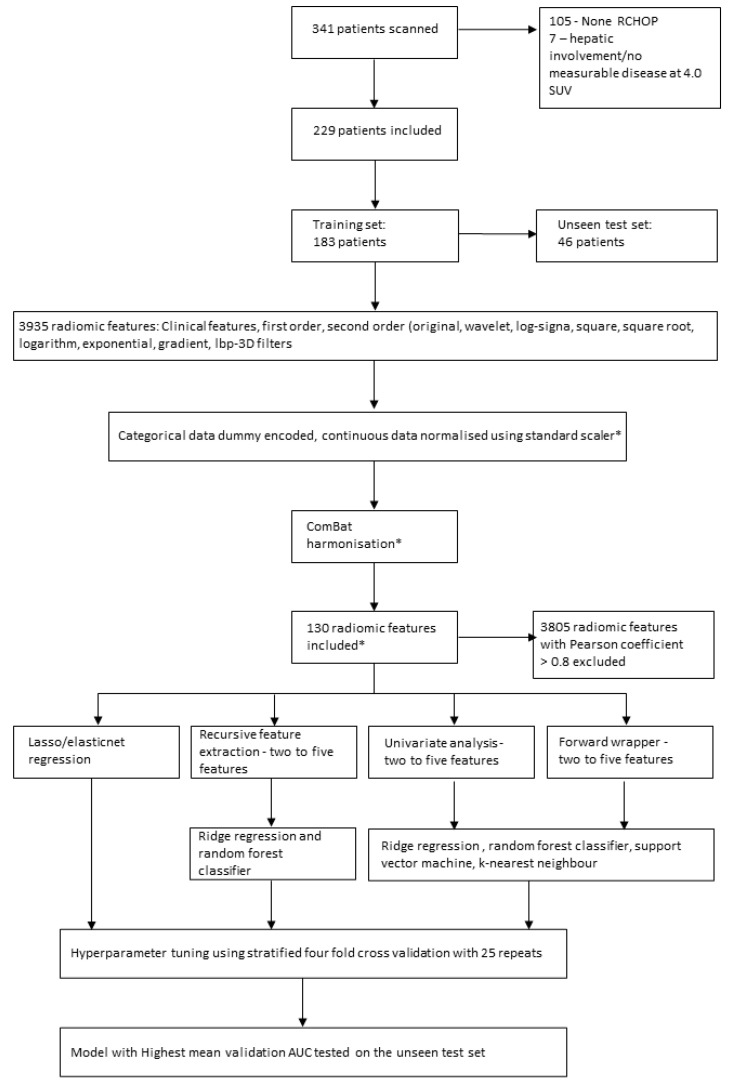
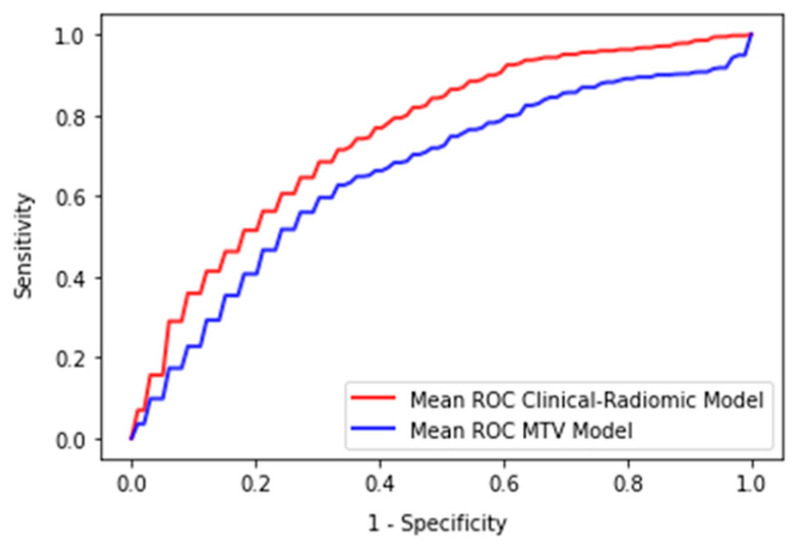
Patients with DLBCL treated with R-CHOP chemotherapy undergoing pre-treatment PET/CT between January 2008 and January 2018 were included. The dataset was split into training and internal unseen test sets (ratio 80:20). A logistic regression model using metabolic tumour volume (MTV) and six different machine learning classifiers created from clinical and radiomic features derived from the baseline PET/CT were trained and tuned using four-fold cross validation. The model with the highest mean validation receiver operator characteristic (ROC) curve area under the curve (AUC) was tested on the unseen test set.
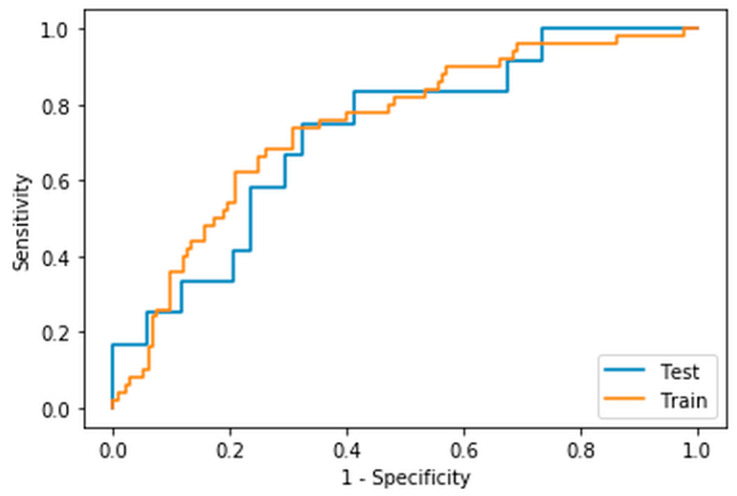
229 DLBCL patients met the inclusion criteria with 62 (27%) having 2-EFS events. The training cohort had 183 patients with 46 patients in the unseen test cohort. The model with the highest mean validation AUC combined clinical and radiomic features in a ridge regression model with a mean validation AUC of 0.75 ± 0.06 and a test AUC of 0.73.
Radiomics based models demonstrate promise in predicting outcomes in DLBCL patients.
约30%的弥漫性大B细胞淋巴瘤(DLBCL)患者会复发。本研究的目的是开发一种基于放射组学的模型,该模型源自基线PET/CT,用于预测2年无事件生存期(2-EFS)。
纳入2008年1月至2018年1月期间接受R-CHOP化疗并在治疗前接受PET/CT检查的DLBCL患者。数据集被分为训练集和内部不可见测试集(比例为80:20)。使用代谢肿瘤体积(MTV)以及从基线PET/CT得出的临床和放射组学特征创建的六个不同机器学习分类器构建逻辑回归模型,并使用四重交叉验证进行训练和调整。在不可见测试集上测试曲线下平均验证接收者操作特征(ROC)曲线面积(AUC)最高的模型。
229例DLBCL患者符合纳入标准,其中62例(27%)发生2-EFS事件。训练队列有183例患者,不可见测试队列有46例患者。在岭回归模型中,结合临床和放射组学特征且平均验证AUC最高的模型,其平均验证AUC为0.75±0.06,测试AUC为0.73。
基于放射组学的模型在预测DLBCL患者的预后方面显示出前景。