Department of Nuclear Medicine and PET Center, The Second Affiliated Hospital of Zhejiang University School of Medicine, 88 Jiefang Road, Hangzhou, 310009, Zhejiang, China.
Key Laboratory of Medical Molecular Imaging of Zhejiang Province, Hangzhou, China.
Eur J Nucl Med Mol Imaging. 2022 Mar;49(4):1298-1310. doi: 10.1007/s00259-021-05572-0. Epub 2021 Oct 15.
This study aimed to develop a novel analytic approach based on 2-deoxy-2-[F]fluoro-D-glucose positron emission tomography/computed tomography ([F]FDG PET/CT) radiomic signature (RS) and International Prognostic Index (IPI) to predict the progression-free survival (PFS) and overall survival (OS) of patients with diffuse large B-cell lymphoma (DLBCL).
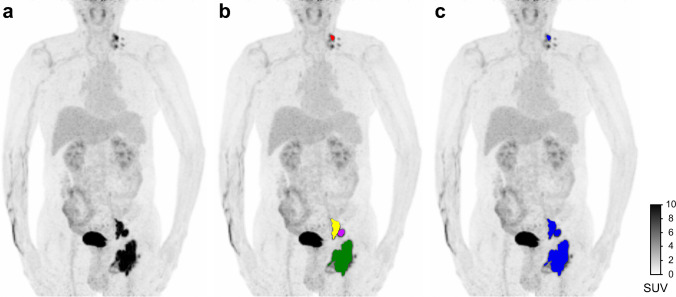
We retrospectively enrolled 152 DLBCL patients and divided them into a training cohort (n = 100) and a validation cohort (n = 52). A total of 1245 radiomic features were extracted from the total metabolic tumor volume (TMTV) and the metabolic bulk volume (MBV) of pre-treatment PET/CT images. The least absolute shrinkage and selection operator (LASSO) algorithm was applied to develop the RS. Cox regression analysis was used to construct hybrid nomograms based on different RS and clinical variables. The performances of hybrid nomograms were evaluated using the time-dependent receiver operator characteristic (ROC) curve and the Hosmer-Lemeshow test. The clinical utilities of prediction nomograms were determined via decision curve analysis. The predictive efficiency of different RS, clinical variables, and hybrid nomograms was compared.
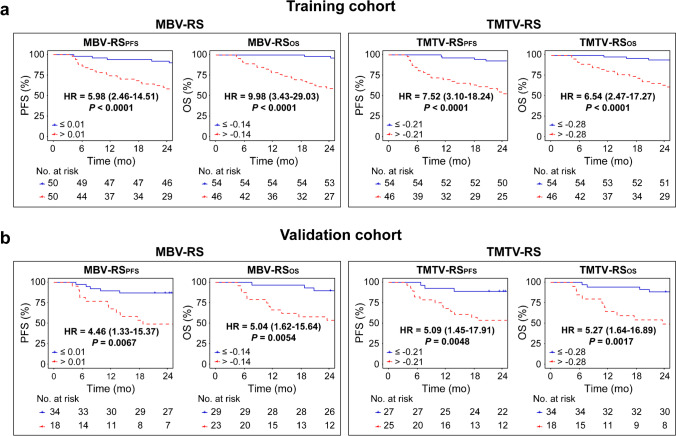
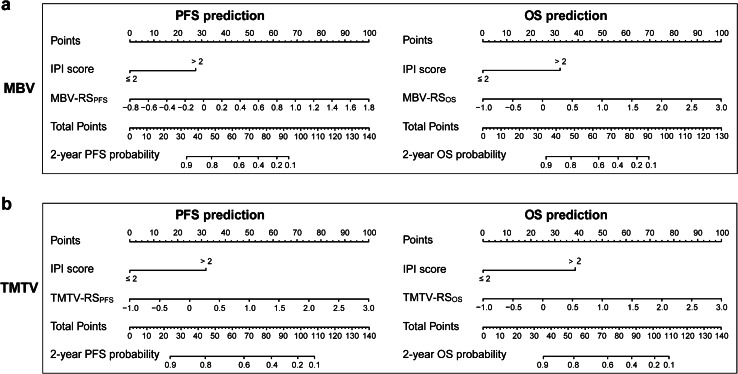
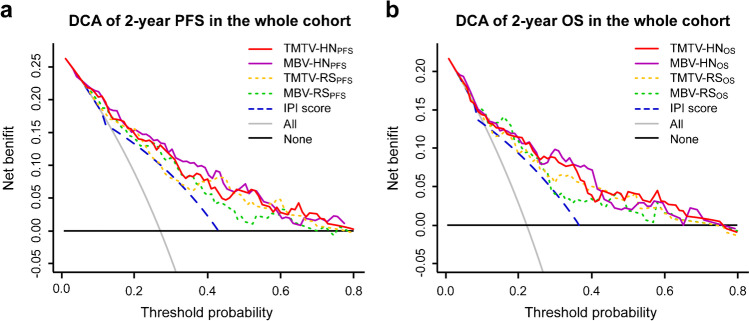
The RS and IPI were identified as independent predictors of PFS and OS, and were selected to construct hybrid nomograms. Both TMTV- and MBV-based hybrid nomograms had significantly higher values of area under the curve (AUC) than IPI in training and validation cohorts (all P < 0.05), while no significant difference was found between TMTV- and MBV-based hybrid nomograms (P > 0.05). The Hosmer-Lemeshow test showed that both TMTV- and MBV-based hybrid nomograms calibrated well in the training and validation cohorts (all P > 0.05). Decision curve analysis indicated that hybrid nomograms had higher net benefits than IPI.
The hybrid nomograms combining RS with IPI could significantly improve survival prediction in DLBCL. Radiomic analysis on MBV may serve as a potential approach for prognosis assessment in DLBCL.
NCT04317313. Registered March 16, 2020. Public site: https://clinicaltrials.gov/ct2/show/NCT04317313.
本研究旨在开发一种基于 2-脱氧-2-[F]氟代-D-葡萄糖正电子发射断层扫描/计算机断层扫描([F]FDG PET/CT)放射组学特征(RS)和国际预后指数(IPI)的新分析方法,以预测弥漫性大 B 细胞淋巴瘤(DLBCL)患者的无进展生存期(PFS)和总生存期(OS)。
我们回顾性纳入了 152 例 DLBCL 患者,将其分为训练队列(n=100)和验证队列(n=52)。从治疗前 PET/CT 图像的总代谢肿瘤体积(TMTV)和代谢体体积(MBV)中提取了 1245 个放射组学特征。应用最小绝对收缩和选择算子(LASSO)算法构建 RS。采用 Cox 回归分析基于不同 RS 和临床变量构建混合列线图。采用时间依赖性受试者工作特征(ROC)曲线和 Hosmer-Lemeshow 检验评估混合列线图的性能。通过决策曲线分析确定预测列线图的临床实用性。比较了不同 RS、临床变量和混合列线图的预测效率。
RS 和 IPI 被确定为 PFS 和 OS 的独立预测因素,并被选入构建混合列线图。在训练和验证队列中,基于 TMTV 和 MBV 的混合列线图的曲线下面积(AUC)均显著高于 IPI(均 P<0.05),但基于 TMTV 和 MBV 的混合列线图之间无显著差异(P>0.05)。Hosmer-Lemeshow 检验表明,基于 TMTV 和 MBV 的混合列线图在训练和验证队列中均具有良好的校准度(均 P>0.05)。决策曲线分析表明,混合列线图的净获益高于 IPI。
将 RS 与 IPI 相结合的混合列线图可显著提高 DLBCL 的生存预测能力。MBV 的放射组学分析可能成为 DLBCL 预后评估的一种潜在方法。
NCT04317313。注册于 2020 年 3 月 16 日。公共网站:https://clinicaltrials.gov/ct2/show/NCT04317313。