Institut de Génomique Fonctionnelle, Université de Montpellier, CNRS, INSERM, 34090 Montpellier, France.
LabEx Ion Channels Science and Therapeutics (ICST), 34090 Montpellier, France.
Cells. 2022 Mar 25;11(7):1114. doi: 10.3390/cells11071114.
Sinoatrial node cells (SANC) automaticity is generated by functional association between the activity of plasmalemmal ion channels and local diastolic intracellular Ca release (LCR) from ryanodine receptors. Strikingly, most isolated SANC exhibit a "dormant" state, whereas only a fraction shows regular firing as observed in intact SAN. Recent studies showed that β-adrenergic stimulation can initiate spontaneous firing in dormant SANC, though this mechanism is not entirely understood.
To investigate the role of L-type Ca1.3 Ca channels in the adrenergic regulation of automaticity in dormant SANC, we used a knock-in mouse strain in which the sensitivity of L-type Ca1.2 α1 subunits to dihydropyridines (DHPs) was inactivated (), enabling the selective pharmacological inhibition of Ca1.3 by DHPs.
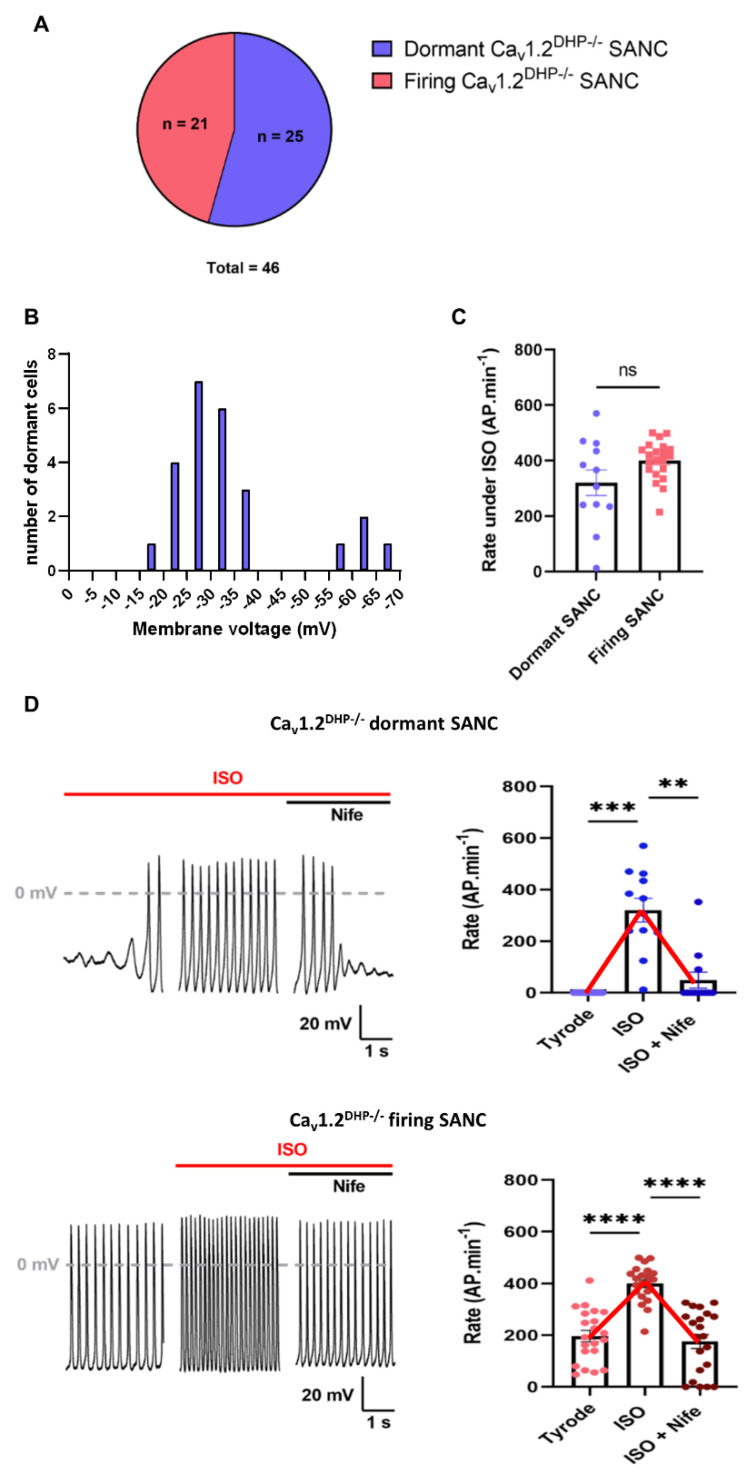
In dormant SANC, β-adrenergic stimulation with isoproterenol (ISO) induced spontaneous action potentials (AP) and Ca transients, which were completely arrested with concomitant perfusion of the DHP nifedipine. In spontaneously firing SANC at baseline, Ca1.3 inhibition completely reversed the effect of β-adrenergic stimulation on AP and the frequency of Ca transients. Confocal calcium imaging of SANC showed that the β-adrenergic-induced synchronization of LCRs is regulated by the activity of Ca1.3 channels.
Our study shows a novel role of Ca1.3 channels in initiating and maintaining automaticity in dormant SANC upon β-adrenergic stimulation.
窦房结细胞(SANC)的自动性是由质膜离子通道的活动与兰尼碱受体的局部舒张细胞内 Ca 释放(LCR)之间的功能关联产生的。引人注目的是,大多数分离的 SANC 表现出“休眠”状态,而只有一部分表现出如在完整的 SAN 中观察到的规则发射。最近的研究表明,β-肾上腺素能刺激可以在休眠的 SANC 中引发自发发射,尽管这种机制尚未完全理解。
为了研究 L 型钙 1.3 Ca 通道在β-肾上腺素能调节休眠 SANC 自动性中的作用,我们使用了一种基因敲入小鼠品系,其中 L 型钙 1.2α1 亚基对二氢吡啶(DHPs)的敏感性被失活(),从而能够选择性地用 DHPs 抑制 Ca1.3。
在休眠的 SANC 中,异丙肾上腺素(ISO)的β-肾上腺素能刺激诱导自发动作电位(AP)和 Ca 瞬变,同时用 DHP 硝苯地平灌注可完全阻止这些反应。在基线时自发发射的 SANC 中,Ca1.3 抑制完全逆转了β-肾上腺素能刺激对 AP 和 Ca 瞬变频率的影响。SANC 的共聚焦钙成像显示,β-肾上腺素能诱导的 LCR 同步由 Ca1.3 通道的活性调节。
我们的研究表明,Ca1.3 通道在β-肾上腺素能刺激下,在休眠的 SANC 中具有引发和维持自动性的新作用。