Department of Vascular Diseases, University Medical Center, 1000 Ljubljana, Slovenia.
Allergy Research Center, Mashhad University of Medical Sciences, Mashhad 1696700, Iran.
Cells. 2022 Mar 31;11(7):1185. doi: 10.3390/cells11071185.
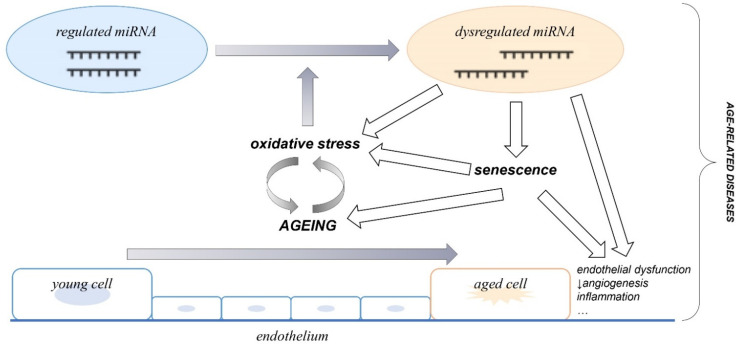
Cellular senescence is a complex, dynamic process consisting of the irreversible arrest of growth and gradual deterioration of cellular function. Endothelial senescence affects the cell's ability to repair itself, which is essential for maintaining vascular integrity and leads to the development of endothelial dysfunction, which has an important role in the pathogenesis of cardiovascular diseases. Senescent endothelial cells develop a particular, senescence-associated secretory phenotype (SASP) that detrimentally affects both surrounding and distant endothelial cells, thereby facilitating the ageing process and development of age-related disorders. Recent studies highlight the role of endothelial senescence and its dysfunction in the pathophysiology of several age-related diseases. MicroRNAs are small noncoding RNAs that have an important role in the regulation of gene expression at the posttranscriptional level. Recently, it has been discovered that miRNAs could importantly contribute to endothelial cell senescence. Overall, the research focus has been shifting to new potential mechanisms and targets to understand and prevent the structural and functional changes in ageing senescent endothelial cells in order to prevent the development and limit the progression of the wide spectrum of age-related diseases. The aim of this review is to provide some insight into the most important pathways involved in the modulation of endothelial senescence and to reveal the specific roles of several miRNAs involved in this complex process. Better understanding of miRNA's role in endothelial senescence could lead to new approaches for prevention and possibly also for the treatment of endothelial cells ageing and associated age-related diseases.
细胞衰老(Cellular senescence)是一个复杂的动态过程,包括生长的不可逆停滞和细胞功能的逐渐恶化。内皮细胞衰老(Endothelial senescence)会影响细胞自我修复的能力,这对于维持血管完整性至关重要,导致内皮功能障碍(Endothelial dysfunction)的发展,而内皮功能障碍在心血管疾病的发病机制中起着重要作用。衰老的内皮细胞会产生一种特殊的、与衰老相关的分泌表型(SASP),这会对周围和远处的内皮细胞产生不利影响,从而促进衰老过程和与年龄相关的疾病的发展。最近的研究强调了内皮细胞衰老及其功能障碍在几种与年龄相关的疾病的病理生理学中的作用。microRNAs(miRNAs)是一种小的非编码 RNA,在转录后水平上对基因表达的调控起着重要作用。最近,人们发现 miRNAs 可能对内皮细胞衰老有重要贡献。总的来说,研究的重点已经转移到新的潜在机制和靶点上,以了解和防止衰老的内皮细胞的结构和功能变化,从而预防和限制与年龄相关的广泛疾病的发展和进展。本综述的目的是提供一些关于调节内皮细胞衰老的最重要途径的见解,并揭示几种参与这一复杂过程的 miRNAs 的特定作用。更好地了解 miRNA 在内皮细胞衰老中的作用可能会为预防和治疗内皮细胞衰老和相关的与年龄相关的疾病提供新的方法。