Domínguez-Rodríguez Alberto, Hernández-Vaquero Daniel, Abreu-González Pedro, Báez-Ferrer Néstor, Díaz Rocío, Avanzas Pablo, Simko Fedor, Domínguez-González Virginia, Sharma Ramaswamy, Reiter Russel J
Servicio de Cardiología, Hospital Universitario de Canarias, 38010 Santa Cruz de Tenerife, Spain.
Facultad de Ciencias de la Salud, Universidad Europea de Canarias, 38200 Santa Cruz de Tenerife, Spain.
J Clin Med. 2022 Mar 30;11(7):1909. doi: 10.3390/jcm11071909.
Matrix metalloproteinase-9 (MMP-9) is crucial in tissue remodeling after an adverse cardiac event. In experimental studies, melatonin has been found to attenuate MMP-9 activation. The present study assessed the effects of systemic melatonin administration on the prognosis of patients with acute myocardial infarction (AMI) successfully treated with primary percutaneous coronary intervention, and to examine the effects on MMP-9 levels.
We conducted a randomized controlled trial, enrolling patients who underwent primary percutaneous coronary intervention due to AMI. They were assigned to two groups for melatonin or placebo. The primary endpoint was a combined event of mortality and heart failure readmission at 2 years. The secondary endpoint was the levels of MMP-9 after the percutaneous coronary intervention.
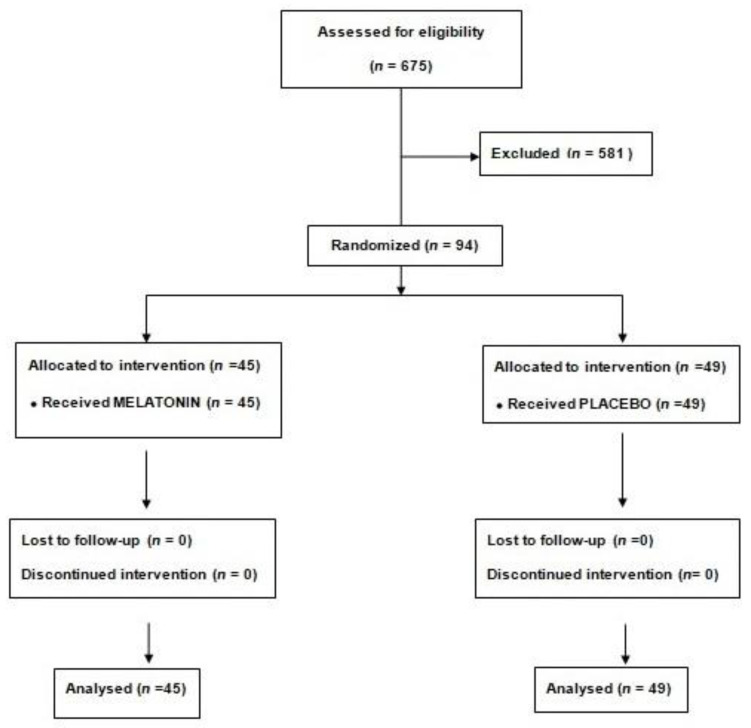
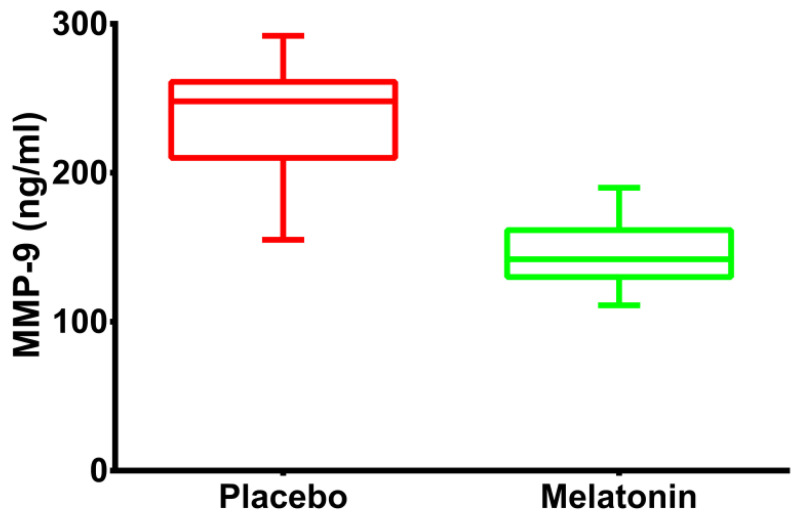
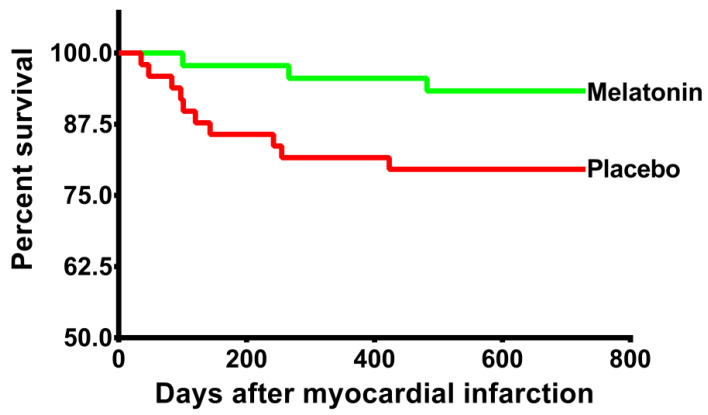
Ninety-four patients were enrolled, 45 in the melatonin group and 49 in the control group. At 2 years of follow-up, 13 (13.8%) patients suffered the primary endpoint (3 deaths and 10 readmissions due to heart failure), 3 patients in the melatonin group and 10 in the placebo group. The difference in the restricted mean survival time was 87.5 days ( = 0.02); HR = 0.3 (95% CI 0.08-1.08; = 0.06); Log-rank test 0.04. After controlling for confounding variables, melatonin administration reduced MMP-9 levels to 90 ng/mL (95% CI 77.3-102.6).
This pilot study demonstrated that compared to placebo, melatonin administration was associated with better outcomes in AMI patients undergoing primary percutaneous coronary intervention.
基质金属蛋白酶-9(MMP-9)在不良心脏事件后的组织重塑中起关键作用。在实验研究中,已发现褪黑素可减弱MMP-9的激活。本研究评估了全身性给予褪黑素对成功接受直接经皮冠状动脉介入治疗的急性心肌梗死(AMI)患者预后的影响,并研究其对MMP-9水平的影响。
我们进行了一项随机对照试验,纳入因AMI接受直接经皮冠状动脉介入治疗的患者。他们被分为两组,分别接受褪黑素或安慰剂治疗。主要终点是2年时的死亡和心力衰竭再入院复合事件。次要终点是经皮冠状动脉介入治疗后的MMP-9水平。
共纳入94例患者,褪黑素组45例,对照组49例。随访2年时,13例(13.8%)患者发生主要终点事件(3例死亡和10例因心力衰竭再入院),褪黑素组3例,安慰剂组10例。受限平均生存时间的差异为87.5天(P = 0.02);风险比(HR)= 0.3(95%置信区间0.08 - 1.08;P = 0.06);对数秩检验P = 0.04。在控制混杂变量后,给予褪黑素可将MMP-9水平降至90 ng/mL(95%置信区间77.3 - 102.6)。
这项初步研究表明,与安慰剂相比,给予褪黑素与接受直接经皮冠状动脉介入治疗的AMI患者更好的预后相关。