• 文献检索
  • 文档翻译
  • 深度研究
  • 学术资讯
  • Suppr Zotero 插件Zotero 插件
  • 邀请有礼
  • 套餐&价格
  • 历史记录
应用&插件
Suppr Zotero 插件Zotero 插件浏览器插件Mac 客户端Windows 客户端微信小程序
定价
高级版会员购买积分包购买API积分包
服务
文献检索文档翻译深度研究API 文档MCP 服务
关于我们
关于 Suppr公司介绍联系我们用户协议隐私条款
关注我们

Suppr 超能文献

核心技术专利:CN118964589B侵权必究
粤ICP备2023148730 号-1Suppr @ 2026

文献检索

告别复杂PubMed语法,用中文像聊天一样搜索,搜遍4000万医学文献。AI智能推荐,让科研检索更轻松。

立即免费搜索

文件翻译

保留排版,准确专业,支持PDF/Word/PPT等文件格式,支持 12+语言互译。

免费翻译文档

深度研究

AI帮你快速写综述,25分钟生成高质量综述,智能提取关键信息,辅助科研写作。

立即免费体验

通过对设计流畅性概况的细粒度分析捕捉患有和未患有抽动秽语综合征儿童的细微神经认知差异。

Capturing Subtle Neurocognitive Differences in Children with and without Tourette Syndrome through a Fine-Grained Analysis of Design Fluency Profiles.

作者信息

Tessier Mélina, Desmarais Annie, Leclerc Julie B, Lavoie Marc E, O'Connor Kieron P, Gauthier Bruno

机构信息

Département de Psychologie, Université de Montréal, Montréal, QC H2V 2S9, Canada.

Centre de Recherche de l'Institut Universitaire en Santé Mentale de Montréal, Montréal, QC H1N 3V2, Canada.

出版信息

J Clin Med. 2022 Mar 31;11(7):1946. doi: 10.3390/jcm11071946.

DOI:10.3390/jcm11071946
PMID:35407554
原文链接:https://pmc.ncbi.nlm.nih.gov/articles/PMC8999369/
Abstract

BACKGROUND

Tourette syndrome (TS) can be accompanied by neurocognitive impairment. Only a few studies have focused on executive function assessment in TS using design fluency, providing preliminary results. This study aimed to characterize the detailed design fluency profile of children with TS compared with neurotypical children, while addressing the central concern of frequent comorbidities in studies on TS by considering tic severity and attention-deficit/hyperactivity disorder (ADHD) symptoms and diagnosis.

METHODS

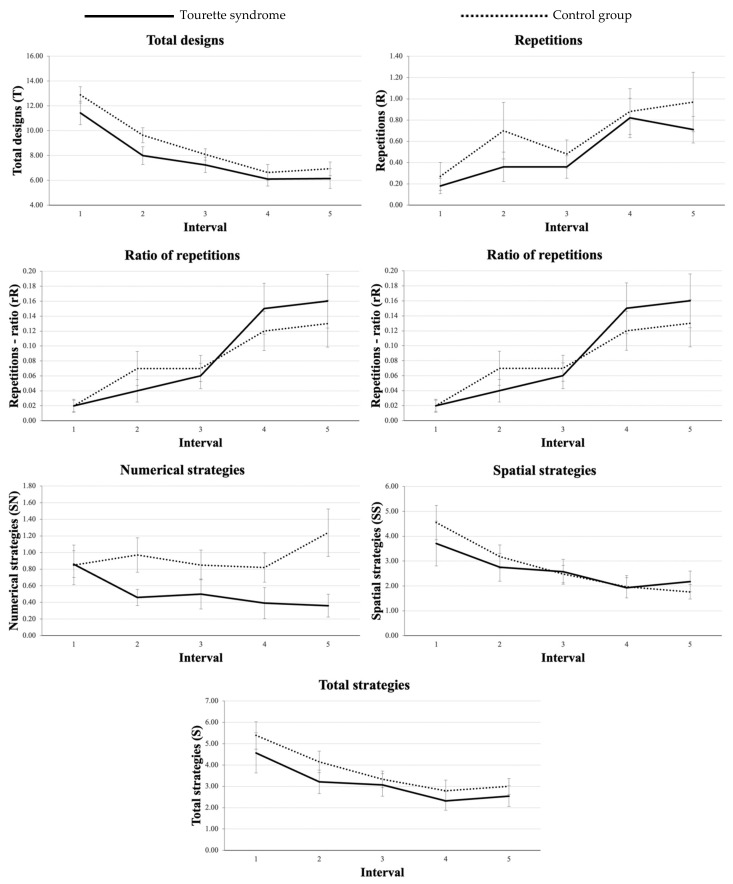
Sixty-one children aged between 6 and 15 years participated and were divided into a TS group ( = 28 (with ADHD = 15)) and a control group ( = 33). Our objective was addressed by examining a wide range of measures of the Five-Point-Test, presumably sensitive to frontostriatal dysfunction. The total number of designs, repetitions, repetition ratio, unique designs, and numerical, spatial, and total strategies were examined for the total duration of the test (global measures) and at five equal time intervals (process measures).

RESULTS

The TS group produced significantly fewer numerical strategies. Groups did not differ in other global or process measures. ADHD did not affect performance.

CONCLUSIONS

Children with TS do not inherently show general executive dysfunction but may present with subtle neurocognitive characteristics here revealed by comprehensive design fluency profiles.

摘要

背景

抽动秽语综合征(TS)可能伴有神经认知障碍。仅有少数研究使用设计流畅性对TS患者的执行功能进行评估并得出了初步结果。本研究旨在描绘TS患儿与神经发育正常儿童相比详细的设计流畅性概况,同时通过考虑抽动严重程度以及注意力缺陷多动障碍(ADHD)症状和诊断情况,来解决TS研究中常见共病这一核心问题。

方法

61名年龄在6至15岁之间的儿童参与了研究,他们被分为TS组(n = 28(其中患有ADHD的有15名))和对照组(n = 33)。我们通过检查五点测试的一系列指标来实现研究目的,这些指标可能对额纹状体功能障碍敏感。在测试的总时长(整体指标)以及五个相等的时间间隔(过程指标)内,对设计总数、重复数、重复率、独特设计以及数字、空间和总策略进行了检查。

结果

TS组产生的数字策略明显更少。两组在其他整体或过程指标上没有差异。ADHD不影响表现。

结论

TS患儿本身并不表现出一般的执行功能障碍,但可能具有在此通过全面设计流畅性概况所揭示的细微神经认知特征。

https://cdn.ncbi.nlm.nih.gov/pmc/blobs/b167/8999369/80c3186e33b4/jcm-11-01946-g002.jpg
https://cdn.ncbi.nlm.nih.gov/pmc/blobs/b167/8999369/f5ebb6fd423c/jcm-11-01946-g001.jpg
https://cdn.ncbi.nlm.nih.gov/pmc/blobs/b167/8999369/80c3186e33b4/jcm-11-01946-g002.jpg
https://cdn.ncbi.nlm.nih.gov/pmc/blobs/b167/8999369/f5ebb6fd423c/jcm-11-01946-g001.jpg
https://cdn.ncbi.nlm.nih.gov/pmc/blobs/b167/8999369/80c3186e33b4/jcm-11-01946-g002.jpg

相似文献

1
Capturing Subtle Neurocognitive Differences in Children with and without Tourette Syndrome through a Fine-Grained Analysis of Design Fluency Profiles.通过对设计流畅性概况的细粒度分析捕捉患有和未患有抽动秽语综合征儿童的细微神经认知差异。
J Clin Med. 2022 Mar 31;11(7):1946. doi: 10.3390/jcm11071946.
2
Executive function in fluency and recall measures among children with Tourette syndrome or ADHD.抽动秽语综合征或注意力缺陷多动障碍儿童在流畅性和回忆测量方面的执行功能
J Int Neuropsychol Soc. 2001 Jan;7(1):102-11. doi: 10.1017/s1355617701711101.
3
Executive function in children with Tourette syndrome and attention-deficit/hyperactivity disorder: Cross-disorder or unique impairments?抽动秽语综合征和注意力缺陷多动障碍患儿的执行功能:跨障碍还是独特损害?
Cortex. 2020 Mar;124:176-187. doi: 10.1016/j.cortex.2019.11.007. Epub 2019 Dec 3.
4
Design Fluency in Children with ADHD and Comorbid Disorders.注意缺陷多动障碍及共病儿童的设计流畅性
Brain Sci. 2020 Mar 17;10(3):172. doi: 10.3390/brainsci10030172.
5
Tourette syndrome in a longitudinal perspective. Clinical course of tics and comorbidities, coexisting psychopathologies, phenotypes and predictors.抽动秽语综合征的纵向研究。抽动症状及共病、并存精神病理学、表型和预测因素的临床病程。
Dan Med J. 2018 Apr;65(4).
6
Neuropsychological functioning in children with Tourette syndrome with and without attention-deficit/hyperactivity disorder.抽动障碍伴与不伴注意缺陷多动障碍患儿的神经心理学功能。
J Am Acad Child Adolesc Psychiatry. 2010 Nov;49(11):1155-64. doi: 10.1016/j.jaac.2010.08.008.
7
Impact of co-morbid attention-deficit and hyperactivity disorder on cognitive function in male children with Tourette syndrome: A controlled study.共患注意缺陷多动障碍对男性抽动秽语综合征患儿认知功能的影响:一项对照研究。
Psychiatry Res. 2016 Sep 30;243:263-7. doi: 10.1016/j.psychres.2016.06.048. Epub 2016 Jun 29.
8
Exploring the dynamics of design fluency in children with and without ADHD using artificial neural networks.使用人工神经网络探索患有和未患有注意力缺陷多动障碍(ADHD)的儿童的设计流畅性动态。
Child Neuropsychol. 2016;22(2):238-46. doi: 10.1080/09297049.2014.988606. Epub 2014 Dec 11.
9
Executive function in children with Tourette syndrome and/or attention deficit hyperactivity disorder.患有抽动秽语综合征和/或注意力缺陷多动障碍儿童的执行功能
J Int Neuropsychol Soc. 1995 Nov;1(6):511-6. doi: 10.1017/s1355617700000631.
10
Elucidating X chromosome influences on Attention Deficit Hyperactivity Disorder and executive function.阐明X染色体对注意力缺陷多动障碍和执行功能的影响。
J Psychiatr Res. 2015 Sep;68:217-25. doi: 10.1016/j.jpsychires.2015.06.021. Epub 2015 Jul 2.

引用本文的文献

1
Tourette syndrome research highlights from 2022.2022 年图雷特综合征研究亮点。
F1000Res. 2023 Oct 23;12:826. doi: 10.12688/f1000research.135702.1. eCollection 2023.
2
Co-Occurrence of Tic Disorders and Attention-Deficit/Hyperactivity Disorder-Does It Reflect a Common Neurobiological Background?抽动障碍与注意力缺陷/多动障碍的共病——它是否反映了共同的神经生物学背景?
Biomedicines. 2022 Nov 17;10(11):2950. doi: 10.3390/biomedicines10112950.

本文引用的文献

1
The cognitive neuropsychiatry of Tourette syndrome.抽动秽语综合征的认知神经精神病学
Cogn Neuropsychiatry. 2020 Jul;25(4):254-268. doi: 10.1080/13546805.2020.1760812. Epub 2020 May 6.
2
Design Fluency in Children with ADHD and Comorbid Disorders.注意缺陷多动障碍及共病儿童的设计流畅性
Brain Sci. 2020 Mar 17;10(3):172. doi: 10.3390/brainsci10030172.
3
Executive control development in Tourette syndrome and its role in tic reduction.抽动秽语综合征的执行控制发展及其在减少抽动中的作用。
Psychiatry Res. 2018 Apr;262:527-535. doi: 10.1016/j.psychres.2017.09.038. Epub 2017 Sep 18.
4
Cognitive flexibility and its electrophysiological correlates in Gilles de la Tourette syndrome.抽动秽语综合征中的认知灵活性及其电生理关联
Dev Cogn Neurosci. 2017 Oct;27:78-90. doi: 10.1016/j.dcn.2017.08.008. Epub 2017 Aug 18.
5
A Review of the Neuropsychological Dimensions of Tourette Syndrome.抽动秽语综合征的神经心理学维度综述
Brain Sci. 2017 Aug 18;7(8):106. doi: 10.3390/brainsci7080106.
6
Genetic and phenotypic overlap of specific obsessive-compulsive and attention-deficit/hyperactive subtypes with Tourette syndrome.特定的强迫症和注意缺陷/多动障碍亚型与妥瑞氏症的遗传和表型重叠。
Psychol Med. 2018 Jan;48(2):279-293. doi: 10.1017/S0033291717001672. Epub 2017 Jun 27.
7
Neurobiology of the Premonitory Urge in Tourette's Syndrome: Pathophysiology and Treatment Implications.抽动秽语综合征预警冲动的神经生物学:病理生理学及治疗意义
J Neuropsychiatry Clin Neurosci. 2017 Spring;29(2):95-104. doi: 10.1176/appi.neuropsych.16070141. Epub 2017 Jan 25.
8
What makes you tic? Translational approaches to study the role of stress and contextual triggers in Tourette syndrome.是什么让你抽动?研究压力和情境触发因素在抽动秽语综合征中作用的转化方法。
Neurosci Biobehav Rev. 2017 May;76(Pt A):123-133. doi: 10.1016/j.neubiorev.2016.10.003. Epub 2016 Dec 8.
9
The Effect of a New Therapy for Children with Tics Targeting Underlying Cognitive, Behavioral, and Physiological Processes.一种针对潜在认知、行为和生理过程的儿童抽动症新疗法的效果
Front Psychiatry. 2016 Aug 11;7:135. doi: 10.3389/fpsyt.2016.00135. eCollection 2016.
10
A verbal strength in children with Tourette syndrome? Evidence from a non-word repetition task.抽动秽语综合征患儿的言语优势?来自非词重复任务的证据。
Brain Lang. 2016 Sep;160:61-70. doi: 10.1016/j.bandl.2016.07.005. Epub 2016 Aug 1.