Wu Yi, Guo Gang, Wei Zhuxuan, Qian Jin
Key Laboratory of Soft Machines and Smart Devices of Zhejiang Province, Department of Engineering Mechanics, Zhejiang University, Hangzhou 310027, China.
Materials (Basel). 2022 Mar 24;15(7):2397. doi: 10.3390/ma15072397.
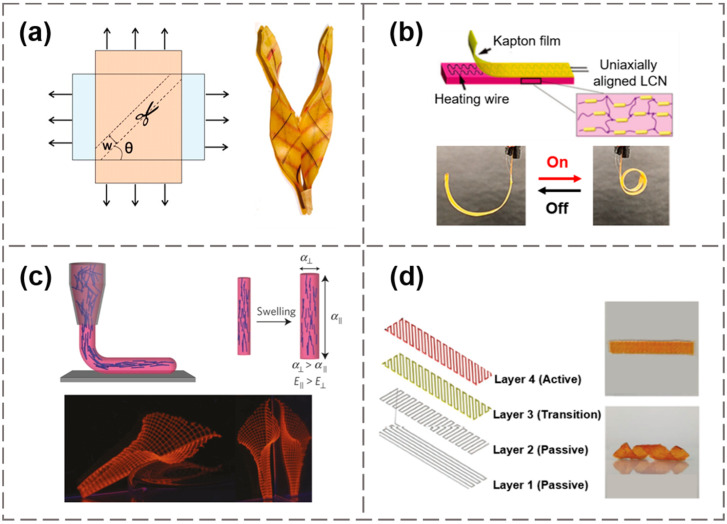
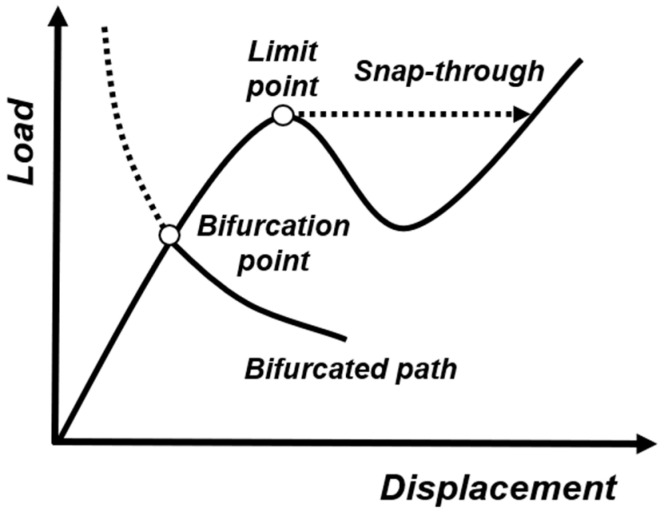
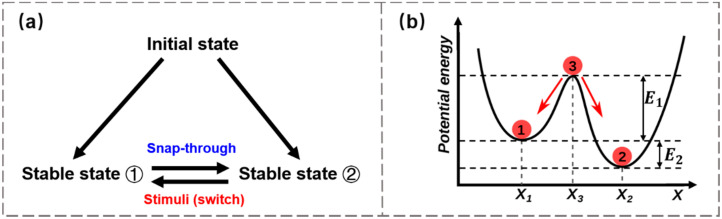
Multi-modal and controllable shape-morphing constitutes the cornerstone of the functionalization of soft actuators/robots. Involving heterogeneity through material layout is a widely used strategy to generate internal mismatches in active morphing structures. Once triggered by external stimuli, the entire structure undergoes cooperative deformation by minimizing the potential energy. However, the intrinsic limitation of soft materials emerges when it comes to applications such as soft actuators or load-bearing structures that require fast response and large output force. Many researchers have explored the use of the structural principle of snap-through bistability as the morphing mechanisms. Bistable or multi-stable mechanical systems possess more than one local energy minimum and are capable of resting in any of these equilibrium states without external forces. The snap-through motion could overcome energy barriers to switch among these stable or metastable states with dramatically distinct geometries. Attributed to the energy storage and release mechanism, such snap-through transition is quite highly efficient, accompanied by fast response speed, large displacement magnitude, high manipulation strength, and moderate driving force. For example, the shape-morphing timescale of conventional hydrogel systems is usually tens of minutes, while the activation time of hydrogel actuators using the elastic snapping instability strategy can be reduced to below 1 s. By rationally embedding stimuli-responsive inclusions to offer the required trigger energy, various controllable snap-through actuations could be achieved. This review summarizes the current shape-morphing programming strategies based on mismatch strain induced by material heterogeneity, with emphasis on how to leverage snap-through bistability to broaden the applications of the shape-morphing structures in soft robotics and mechanical metamaterials.
多模态且可控的形状变形是软致动器/机器人功能化的基石。通过材料布局引入非均匀性是在主动变形结构中产生内部失配的一种广泛使用的策略。一旦受到外部刺激触发,整个结构会通过使势能最小化来进行协同变形。然而,当涉及到诸如需要快速响应和大输出力的软致动器或承重结构等应用时,软材料的固有局限性就显现出来了。许多研究人员探索了利用快速翻转双稳态的结构原理作为变形机制。双稳态或多稳态机械系统具有不止一个局部能量最小值,并且能够在没有外力的情况下处于这些平衡状态中的任何一个。快速翻转运动可以克服能量障碍,在这些具有显著不同几何形状的稳定或亚稳态之间切换。由于能量存储和释放机制,这种快速翻转转变非常高效,伴随着快速的响应速度、大的位移量、高的操纵强度和适度的驱动力。例如,传统水凝胶系统的形状变形时间尺度通常为几十分钟,而采用弹性快速翻转不稳定性策略的水凝胶致动器的激活时间可以缩短到1秒以下。通过合理地嵌入刺激响应性内含物以提供所需的触发能量,可以实现各种可控的快速翻转致动。本综述总结了基于材料非均匀性引起的失配应变的当前形状变形编程策略,重点在于如何利用快速翻转双稳态来拓宽形状变形结构在软机器人和机械超材料中的应用。